
Cyclically Rotating a Grid
MedPrompt
You are given an m x n integer matrix grid, where m and n are both even integers, and an integer k.
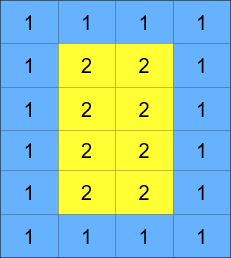
The matrix is composed of several layers, which is shown in the below image, where each color is its own layer:
A cyclic rotation of the matrix is done by cyclically rotating each layer in the matrix. To cyclically rotate a layer once, each element in the layer will take the place of the adjacent element in the counter-clockwise direction. An example rotation is shown below:
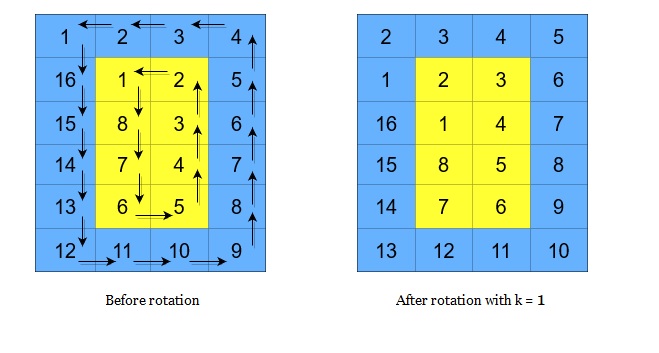
Return the matrix after applying k cyclic rotations to it.
Example 1:
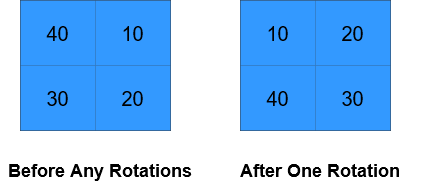
Input: grid = [[40,10],[30,20]], k = 1
Output: [[10,20],[40,30]]
Explanation: The figures above represent the grid at every state.
Example 2:
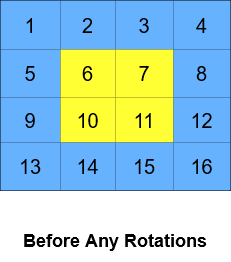
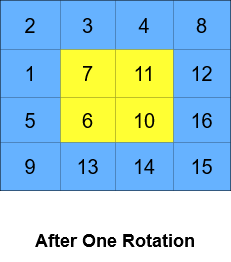
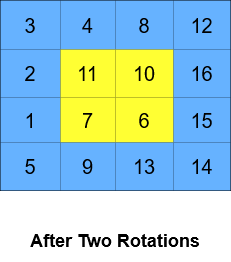
Input: grid = [[1,2,3,4],[5,6,7,8],[9,10,11,12],[13,14,15,16]], k = 2
Output: [[3,4,8,12],[2,11,10,16],[1,7,6,15],[5,9,13,14]]
Explanation: The figures above represent the grid at every state.
Constraints:
m == grid.lengthn == grid[i].length2 <= m, n <= 50- Both
mandnare even integers. 1 <= grid[i][j] <= 50001 <= k <= 109
Approaches
2 approaches with complexity analysis and trade-offs.
This approach directly simulates the process described in the problem. It performs the cyclic rotation k times, one rotation at a time for each layer. While simple to conceptualize, its performance is directly tied to the value of k, making it unsuitable for large rotation counts.
Algorithm
- Loop
countfrom 1 tok. - Inside the loop, iterate through each layer
ifrom0tomin(m, n) / 2 - 1. - For each layer, perform one counter-clockwise rotation. This is done by:
- Saving the top-left element
grid[i][i]in a temporary variable. - Shifting elements on the top edge to the left.
- Shifting elements on the right edge upwards.
- Shifting elements on the bottom edge to the right.
- Shifting elements on the left edge downwards.
- Placing the saved temporary element into its new position
grid[i+1][i].
- Saving the top-left element
- After the loops complete, return the modified
grid.
Walkthrough
The main idea is to have a loop that runs k times. Inside this loop, we iterate through each layer of the grid. The number of layers is determined by min(m, n) / 2. For each layer, we perform a single counter-clockwise rotation. This can be done in-place by saving one element (e.g., the top-left corner) in a temporary variable and then shifting all other elements one by one along the layer's boundary. This entire process of rotating every layer once is repeated k times.
class Solution { public int[][] rotateGrid(int[][] grid, int k) { int m = grid.length; int n = grid[0].length; // This outer loop makes the approach inefficient. for (int rot = 0; rot < k; rot++) { for (int i = 0; i < Math.min(m, n) / 2; i++) { int top = i, left = i; int bottom = m - 1 - i, right = n - 1 - i; // Store top-left element int temp = grid[top][left]; // Shift top row (left to right) for (int j = left; j < right; j++) { grid[top][j] = grid[top][j + 1]; } // Shift right column (bottom to top) for (int j = top; j < bottom; j++) { grid[j][right] = grid[j + 1][right]; } // Shift bottom row (right to left) for (int j = right; j > left; j--) { grid[bottom][j] = grid[bottom][j - 1]; } // Shift left column (top to bottom) for (int j = bottom; j > top + 1; j--) { grid[j][left] = grid[j - 1][left]; } // Place stored element grid[top + 1][left] = temp; } } return grid; }}Complexity
Time
O(k * m * n). For each of the `k` rotations, we iterate through almost all `m * n` cells of the grid. This is very slow when `k` is large.
Space
O(1). The rotation is performed in-place, using only a few extra variables for layer boundaries and temporary storage during swaps.
Trade-offs
Pros
Simple to understand and implement as it directly follows the problem's description of a single rotation.
Space efficient, as it performs the rotation in-place with
O(1)extra space.
Cons
Extremely inefficient for large values of
kas it performskfull passes over the grid.Will result in a 'Time Limit Exceeded' error for the given constraints on
k.
Solutions
Solution
class Solution {private int m;private int n;private int[][] grid;public int[][] rotateGrid(int[][] grid, int k) { m = grid.length; n = grid[0].length; this.grid = grid; for (int p = 0; p < Math.min(m, n) / 2; ++p) { rotate(p, k); } return grid; }private void rotate(int p, int k) { List<Integer> nums = new ArrayList<>(); for (int j = p; j < n - p - 1; ++j) { nums.add(grid[p][j]); } for (int i = p; i < m - p - 1; ++i) { nums.add(grid[i][n - p - 1]); } for (int j = n - p - 1; j > p; --j) { nums.add(grid[m - p - 1][j]); } for (int i = m - p - 1; i > p; --i) { nums.add(grid[i][p]); } int l = nums.size(); k %= l; if (k == 0) { return; } for (int j = p; j < n - p - 1; ++j) { grid[p][j] = nums.get(k++ % l); } for (int i = p; i < m - p - 1; ++i) { grid[i][n - p - 1] = nums.get(k++ % l); } for (int j = n - p - 1; j > p; --j) { grid[m - p - 1][j] = nums.get(k++ % l); } for (int i = m - p - 1; i > p; --i) { grid[i][p] = nums.get(k++ % l); } }}Video walkthrough
Newsletter
One sharp idea, every week
System design and interview prep — short enough to finish.
No spam. Unsubscribe anytime.
Practice
Same difficulty — related problems to reinforce the pattern.