
Detect Squares
MedPrompt
You are given a stream of points on the X-Y plane. Design an algorithm that:
- Adds new points from the stream into a data structure. Duplicate points are allowed and should be treated as different points.
- Given a query point, counts the number of ways to choose three points from the data structure such that the three points and the query point form an axis-aligned square with positive area.
An axis-aligned square is a square whose edges are all the same length and are either parallel or perpendicular to the x-axis and y-axis.
Implement the DetectSquares class:
DetectSquares()Initializes the object with an empty data structure.void add(int[] point)Adds a new pointpoint = [x, y]to the data structure.int count(int[] point)Counts the number of ways to form axis-aligned squares with pointpoint = [x, y]as described above.
Example 1:
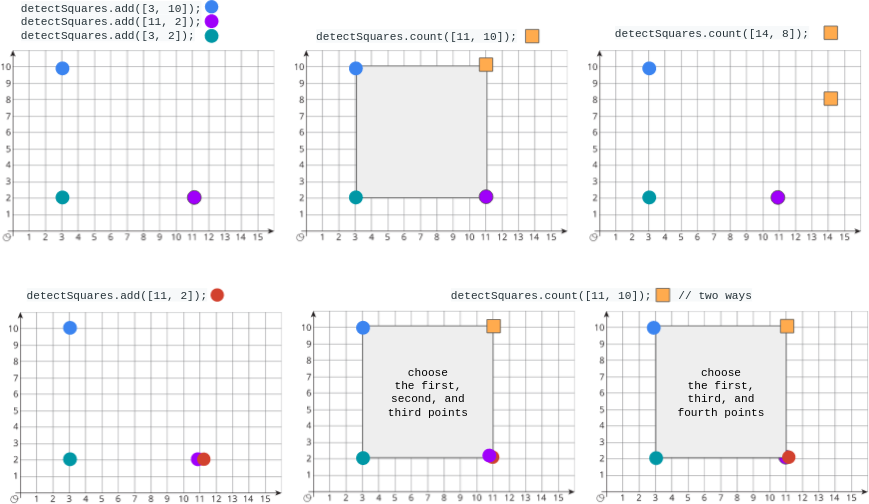
Input
["DetectSquares", "add", "add", "add", "count", "count", "add", "count"]
[[], [[3, 10]], [[11, 2]], [[3, 2]], [[11, 10]], [[14, 8]], [[11, 2]], [[11, 10]]]
Output
[null, null, null, null, 1, 0, null, 2]

Explanation
DetectSquares detectSquares = new DetectSquares();
detectSquares.add([3, 10]);
detectSquares.add([11, 2]);
detectSquares.add([3, 2]);
detectSquares.count([11, 10]); // return 1. You can choose:
                               //   - The first, second, and third points
detectSquares.count([14, 8]);  // return 0. The query point cannot form a square with any points in the data structure.
detectSquares.add([11, 2]);    // Adding duplicate points is allowed.
detectSquares.count([11, 10]); // return 2. You can choose:
                               //   - The first, second, and third points
                               //   - The first, third, and fourth points
Constraints:
point.length == 20 <= x, y <= 1000- At most
3000calls in total will be made toaddandcount.
Approaches
2 approaches with complexity analysis and trade-offs.
This approach uses a simple List to store all the points as they are added. While the add operation is very fast, the count operation is less efficient because it requires searching through the list to find the necessary points to form a square.
Algorithm
-
add(int[] point)- Add the
pointto aList<int[]> points.
- Add the
-
count(int[] point)- Let the query point be
p1 = (x1, y1). - Create a
HashSetof unique points from thepointslist to iterate over. - Initialize
total_squares = 0. - For each unique point
p4 = (x4, y4)in the hash set:- Check if
p4is a valid diagonal top1:x1 != x4,y1 != y4, andabs(x1 - x4) == abs(y1 - y4). - If it is not a valid diagonal, continue to the next unique point.
- If it is a valid diagonal, the other two corners are
p2 = (x1, y4)andp3 = (x4, y1). - Count the occurrences of
p2,p3, andp4in thepointslist. Let these counts bec2,c3, andc4respectively. This requires three separate traversals of the list for each unique diagonal. - Add the product
c2 * c3 * c4tototal_squares.
- Check if
- Return
total_squares.
- Let the query point be
Walkthrough
Data Structure
A java.util.List<int[]> is used to store all points, including duplicates.
add(point) Operation
The add operation is straightforward: the new point is simply appended to the end of the list. This is an O(1) operation.
count(point) Operation
The count operation relies on a geometric property of axis-aligned squares. Given a query point p1, any other point p4 can form a square with p1 only if it's a diagonal corner. This means p1 and p4 must have different x and y coordinates, and the absolute difference of their x-coordinates must equal the absolute difference of their y-coordinates.
The algorithm works as follows:
- To avoid redundant calculations for duplicate points, we first create a
HashSetof unique points from our list. - We iterate through each unique point
p4from this set. - For each
p4, we check if it can form a valid diagonal with the query pointp1. - If it's a valid diagonal, we can determine the coordinates of the other two required corners,
p2andp3. - The crucial, and time-consuming, step is to then iterate through the entire original list to count the occurrences of
p2,p3, andp4. - The number of squares that can be formed with this specific diagonal configuration is the product of these counts:
count(p2) * count(p3) * count(p4). - We sum these products for all valid unique diagonals to get the final answer.
import java.util.ArrayList;import java.util.HashSet;import java.util.List;import java.util.Objects; class DetectSquares { private static class Point { int x, y; Point(int x, int y) { this.x = x; this.y = y; } @Override public boolean equals(Object o) { if (this == o) return true; if (o == null || getClass() != o.getClass()) return false; Point point = (Point) o; return x == point.x && y == point.y; } @Override public int hashCode() { return Objects.hash(x, y); } } List<Point> points; public DetectSquares() { points = new ArrayList<>(); } public void add(int[] point) { points.add(new Point(point[0], point[1])); } public int count(int[] point) { Point p1 = new Point(point[0], point[1]); int totalSquares = 0; HashSet<Point> uniquePoints = new HashSet<>(points); for (Point p4 : uniquePoints) { if (p1.x == p4.x || p1.y == p4.y || Math.abs(p1.x - p4.x) != Math.abs(p1.y - p4.y)) { continue; } Point p2 = new Point(p1.x, p4.y); Point p3 = new Point(p4.x, p1.y); long count2 = 0, count3 = 0, count4 = 0; for (Point p : points) { if (p.equals(p2)) count2++; if (p.equals(p3)) count3++; if (p.equals(p4)) count4++; } totalSquares += count2 * count3 * count4; } return totalSquares; }}Complexity
Time
`add(point)`: `O(1)` `count(point)`: `O(M * N)`, where `N` is the total number of points added and `M` is the number of unique points. In the worst case where all points are unique (`M=N`), the complexity is `O(N^2)`. This can be too slow if the number of `count` calls is high or `N` is large.
Space
`O(N)` to store all the points in the list. The `count` method temporarily uses an additional `O(M)` space for the `HashSet` of unique points, where `N` is the total number of points and `M` is the number of unique points.
Trade-offs
Pros
The
addoperation is very fast,O(1).The implementation is relatively straightforward to understand.
Cons
The
countoperation is inefficient, with a time complexity ofO(N^2)in the worst case.Repeatedly scanning the list to count points is computationally expensive.
Requires extra space for the
HashSetwithin thecountmethod.
This approach significantly optimizes the count operation by pre-calculating and storing the frequency of each point. Instead of searching a list repeatedly, we can retrieve the count of any point in constant time. Given the coordinate constraints, a 2D array serves as a highly efficient frequency map, but a standard Hash Map also works perfectly.
Algorithm
The core idea is to find squares by picking a point p2 that is vertically aligned with the query point p1, which defines a side of a potential square. Then, we calculate where the other two points (p3, p4) must be and use our frequency map to count how many times they exist.
- Data Structure: A nested Hash Map,
Map<Integer, Map<Integer, Integer>> counts, wherecounts.get(x).get(y)stores the frequency of point(x, y). add(int[] point): Update the count forpointin the nested map. This is anO(1)operation on average.count(int[] point):- Let the query point be
p1 = (x1, y1). - Initialize
total_squares = 0. - Get the map of all points that share the same x-coordinate
x1. - Iterate through each such point
p2 = (x1, y2). - If
y1 == y2, the points are identical, so they cannot form a side. Skip. - The distance
s = abs(y1 - y2)is the side length of a potential square. - Case 1: Square extends to the right. The other two corners must be
p3 = (x1 + s, y1)andp4 = (x1 + s, y2). Fetch their countsc3andc4from the map. - The number of squares formed this way is
count(p2) * c3 * c4. Add this tototal_squares. - Case 2: Square extends to the left. The other two corners must be
p3 = (x1 - s, y1)andp4 = (x1 - s, y2). Fetch their counts and add the product tototal_squares. - Return the final
total_squares.
- Let the query point be
Walkthrough
Data Structure
We use a data structure to map each point to its frequency. The constraints 0 <= x, y <= 1000 make a 2D array int[1001][1001] an excellent choice. counts[x][y] will store the number of times the point (x, y) has been added.
Alternatively, a HashMap can be used, which is more flexible if coordinate ranges are large or sparse. A nested map Map<Integer, Map<Integer, Integer>> is a good way to structure this, mapping an x-coordinate to another map where keys are y-coordinates and values are frequencies.
add(point) Operation
When a point is added, we simply increment its corresponding counter in our frequency map/array. This is an O(1) operation.
count(point) Operation
Instead of the diagonal logic, we can iterate through points adjacent to the query point. For a query point p1, we can iterate through all stored points p2 that share the same x-coordinate. The distance between p1 and p2 defines the side length s of a potential square. With p1, p2, and s, the positions of the other two corners (p3 and p4) are determined. The key improvement is that we can fetch the counts of p3 and p4 in O(1) time from our frequency map. This avoids expensive searches and leads to a much faster count operation.
import java.util.HashMap;import java.util.Map; class DetectSquares { Map<Integer, Map<Integer, Integer>> counts; public DetectSquares() { counts = new HashMap<>(); } public void add(int[] point) { int x = point[0]; int y = point[1]; counts.computeIfAbsent(x, k -> new HashMap<>()).merge(y, 1, Integer::sum); } public int count(int[] point) { int x1 = point[0]; int y1 = point[1]; int totalSquares = 0; if (!counts.containsKey(x1)) { return 0; } // Get all points that share the same x-coordinate as the query point Map<Integer, Integer> yCounts = counts.get(x1); // Iterate through each point p2=(x1, y2) that could form a vertical side with p1 for (Map.Entry<Integer, Integer> entry : yCounts.entrySet()) { int y2 = entry.getKey(); if (y1 == y2) { // p1 and p2 are the same point, cannot form a square with positive area continue; } int side = Math.abs(y1 - y2); int count_p2 = entry.getValue(); // Case 1: Square is to the right of the side p1-p2 int x3 = x1 + side; int count_p3 = getCount(x3, y1); int count_p4 = getCount(x3, y2); totalSquares += count_p2 * count_p3 * count_p4; // Case 2: Square is to the left of the side p1-p2 x3 = x1 - side; count_p3 = getCount(x3, y1); count_p4 = getCount(x3, y2); totalSquares += count_p2 * count_p3 * count_p4; } return totalSquares; } private int getCount(int x, int y) { if (!counts.containsKey(x)) { return 0; } return counts.get(x).getOrDefault(y, 0); }}Complexity
Time
`add(point)`: `O(1)` on average for a HashMap. `count(point)`: `O(Y)` where `Y` is the number of unique y-coordinates that share the same x-coordinate as the query point. In the worst case, this is `O(N)`, but on average, it can be much faster than iterating through all `N` points.
Space
`O(M)` where `M` is the number of unique points stored. For a 2D array implementation, the space is `O(C^2)` where `C` is the maximum coordinate value (1001), which is constant space.
Trade-offs
Pros
Both
addandcountoperations are very efficient.The
countoperation's time complexity is optimal for the problem.Flexible approach that works well with sparse data.
Cons
Requires more complex data structures (nested maps or a large 2D array).
Space complexity depends on the number of unique points, which could be large if coordinate ranges were not bounded.
Solutions
Solution
class DetectSquares { private Map < Integer , Map < Integer , Integer >> cnt = new HashMap <>(); public DetectSquares () { } public void add ( int [] point ) { int x = point [ 0 ], y = point [ 1 ]; cnt . computeIfAbsent ( x , k -> new HashMap <>()). merge ( y , 1 , Integer: : sum ); } public int count ( int [] point ) { int x1 = point [ 0 ], y1 = point [ 1 ]; if (! cnt . containsKey ( x1 )) { return 0 ; } int ans = 0 ; for ( var e : cnt . entrySet ()) { int x2 = e . getKey (); if ( x2 != x1 ) { int d = x2 - x1 ; var cnt1 = cnt . get ( x1 ); var cnt2 = e . getValue (); ans += cnt2 . getOrDefault ( y1 , 0 ) * cnt1 . getOrDefault ( y1 + d , 0 ) * cnt2 . getOrDefault ( y1 + d , 0 ); ans += cnt2 . getOrDefault ( y1 , 0 ) * cnt1 . getOrDefault ( y1 - d , 0 ) * cnt2 . getOrDefault ( y1 - d , 0 ); } } return ans ; } } /** * Your DetectSquares object will be instantiated and called as such: * DetectSquares obj = new DetectSquares(); * obj.add(point); * int param_2 = obj.count(point); */class DetectSquares { public: DetectSquares () { } void add ( vector < int > point ) { int x = point [ 0 ], y = point [ 1 ]; ++ cnt [ x ][ y ]; } int count ( vector < int > point ) { int x1 = point [ 0 ], y1 = point [ 1 ]; if ( ! cnt . count ( x1 )) { return 0 ; } int ans = 0 ; for ( auto & [ x2 , cnt2 ] : cnt ) { if ( x2 != x1 ) { int d = x2 - x1 ; auto & cnt1 = cnt [ x1 ]; ans += cnt2 [ y1 ] * cnt1 [ y1 + d ] * cnt2 [ y1 + d ]; ans += cnt2 [ y1 ] * cnt1 [ y1 - d ] * cnt2 [ y1 - d ]; } } return ans ; } private: unordered_map < int , unordered_map < int , int >> cnt ; }; /** * Your DetectSquares object will be instantiated and called as such: * DetectSquares* obj = new DetectSquares(); * obj->add(point); * int param_2 = obj->count(point); */class DetectSquares : def __init__ ( self ): self . cnt = defaultdict ( Counter ) def add ( self , point : List [ int ]) -> None : x , y = point self . cnt [ x ][ y ] += 1 def count ( self , point : List [ int ]) -> int : x1 , y1 = point if x1 not in self . cnt : return 0 ans = 0 for x2 in self . cnt . keys (): if x2 != x1 : d = x2 - x1 ans += self . cnt [ x2 ][ y1 ] * self . cnt [ x1 ][ y1 + d ] * self . cnt [ x2 ][ y1 + d ] ans += self . cnt [ x2 ][ y1 ] * self . cnt [ x1 ][ y1 - d ] * self . cnt [ x2 ][ y1 - d ] return ans # Your DetectSquares object will be instantiated and called as such: # obj = DetectSquares() # obj.add(point) # param_2 = obj.count(point)Video walkthrough
Newsletter
One sharp idea, every week
System design and interview prep — short enough to finish.
No spam. Unsubscribe anytime.
Practice
Same difficulty — related problems to reinforce the pattern.