
Difference Between Ones and Zeros in Row and Column
MedPrompt
You are given a 0-indexed m x n binary matrix grid.
A 0-indexed m x n difference matrix diff is created with the following procedure:
- Let the number of ones in the
ithrow beonesRowi. - Let the number of ones in the
jthcolumn beonesColj. - Let the number of zeros in the
ithrow bezerosRowi. - Let the number of zeros in the
jthcolumn bezerosColj. diff[i][j] = onesRowi + onesColj - zerosRowi - zerosColj
Return the difference matrix diff.
Example 1:
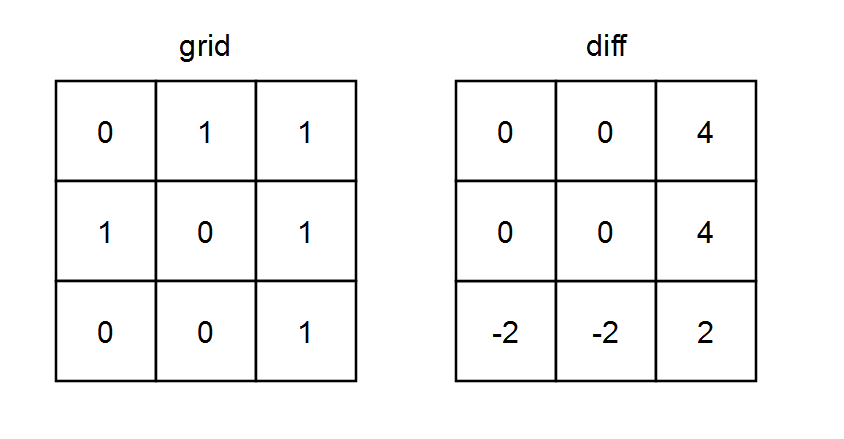
onesRow<sub>0</sub> + onesCol<sub>0</sub> - zerosRow<sub>0</sub> - zerosCol<sub>0</sub>Example 2:
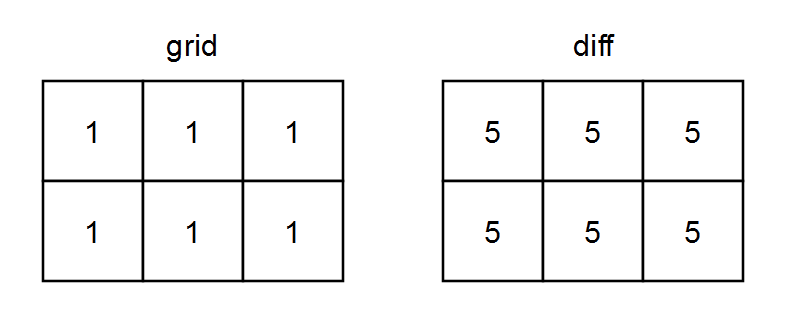
Input: grid = [[1,1,1],[1,1,1]]
Output: [[5,5,5],[5,5,5]]
Explanation:
- diff[0][0] = onesRow0 + onesCol0 - zerosRow0 - zerosCol0 = 3 + 2 - 0 - 0 = 5
- diff[0][1] = onesRow0 + onesCol1 - zerosRow0 - zerosCol1 = 3 + 2 - 0 - 0 = 5
- diff[0][2] = onesRow0 + onesCol2 - zerosRow0 - zerosCol2 = 3 + 2 - 0 - 0 = 5
- diff[1][0] = onesRow1 + onesCol0 - zerosRow1 - zerosCol0 = 3 + 2 - 0 - 0 = 5
- diff[1][1] = onesRow1 + onesCol1 - zerosRow1 - zerosCol1 = 3 + 2 - 0 - 0 = 5
- diff[1][2] = onesRow1 + onesCol2 - zerosRow1 - zerosCol2 = 3 + 2 - 0 - 0 = 5
Constraints:
m == grid.lengthn == grid[i].length1 <= m, n <= 1051 <= m * n <= 105grid[i][j]is either0or1.
Approaches
2 approaches with complexity analysis and trade-offs.
This approach directly implements the formula given in the problem statement. For each cell (i, j) in the output matrix, it iterates through the corresponding row i and column j of the input grid to count the number of ones and zeros, and then calculates the difference.
Algorithm
- Initialize an
m x nresult matrixdiff. - Iterate through each cell
(i, j)of thediffmatrix. - For each
(i, j), calculateonesRow_i,zerosRow_i,onesCol_j, andzerosCol_jby scanning thei-th row andj-th column of the inputgrid. - Compute
diff[i][j] = onesRow_i + onesCol_j - zerosRow_i - zerosCol_j. - Return the
diffmatrix.
Walkthrough
The brute-force approach is a direct translation of the problem description into code. It calculates the value for each cell diff[i][j] independently without any optimization or reuse of calculations.
The algorithm is as follows:
- Get the dimensions of the grid,
m(rows) andn(columns). - Create a new
m x ninteger matrix calleddiffto store the results. - Use nested loops to iterate through each cell
(i, j)of thediffmatrix. - Inside the loops, for the current cell
(i, j): a. Initialize counters:onesRow_i = 0,zerosRow_i = 0,onesCol_j = 0,zerosCol_j = 0. b. Iterate through thei-th row of thegridto countonesRow_iandzerosRow_i. c. Iterate through thej-th column of thegridto countonesCol_jandzerosCol_j. d. Calculatediff[i][j]using the formula:onesRow_i + onesCol_j - zerosRow_i - zerosCol_j. - After iterating through all cells, return the
diffmatrix.
This method is straightforward but highly inefficient because for each cell (i, j), it re-scans the entire row i and column j.
Here is the implementation in Java:
class Solution { public int[][] onesMinusZeros(int[][] grid) { int m = grid.length; int n = grid[0].length; int[][] diff = new int[m][n]; for (int i = 0; i < m; i++) { for (int j = 0; j < n; j++) { int onesRow_i = 0; int zerosRow_i = 0; // Count ones and zeros in row i for (int k = 0; k < n; k++) { if (grid[i][k] == 1) { onesRow_i++; } else { zerosRow_i++; } } int onesCol_j = 0; int zerosCol_j = 0; // Count ones and zeros in column j for (int k = 0; k < m; k++) { if (grid[k][j] == 1) { onesCol_j++; } else { zerosCol_j++; } } diff[i][j] = onesRow_i + onesCol_j - zerosRow_i - zerosCol_j; } } return diff; }}Complexity
Time
O(m * n * (m + n)). For each of the `m * n` cells in the `diff` matrix, we perform a scan of a row (size `n`) and a column (size `m`). This makes the total time complexity prohibitive for the given constraints.
Space
O(m * n) to store the output matrix `diff`. The auxiliary space complexity is O(1) as we only use a few variables for counting in the inner loops.
Trade-offs
Pros
Simple to understand and implement directly from the problem definition.
Cons
Highly inefficient due to redundant calculations.
The counts for each row and column are recalculated for every cell in that row/column, leading to a high time complexity.
Will likely result in a 'Time Limit Exceeded' error for larger inputs.
This approach optimizes the calculation by first simplifying the formula and then pre-computing the required values. Instead of recalculating row and column sums for each cell, we compute them once and store them in auxiliary arrays. This avoids redundant work.
Algorithm
- First, simplify the formula for
diff[i][j]to2 * onesRow_i + 2 * onesCol_j - n - m. - Create two arrays,
onesRowof sizemandonesColof sizen, to store the count of ones for each row and column, respectively. - Iterate through the input
gridonce. For each cellgrid[i][j]that is 1, incrementonesRow[i]andonesCol[j]. - Initialize an
m x nresult matrixdiff. - Iterate through each cell
(i, j)of thediffmatrix. - Calculate
diff[i][j]using the pre-computed counts and the simplified formula:diff[i][j] = 2 * onesRow[i] + 2 * onesCol[j] - m - n. - Return the
diffmatrix.
Walkthrough
This approach significantly improves performance by avoiding redundant computations. The key idea is to first pre-calculate the number of ones for each row and each column and then use a simplified version of the given formula to construct the difference matrix diff.
First, let's simplify the formula:
diff[i][j] = onesRow_i + onesCol_j - zerosRow_i - zerosCol_j
We know that for any row i, the number of zeros is the total number of columns n minus the number of ones:
zerosRow_i = n - onesRow_i
Similarly, for any column j, the number of zeros is the total number of rows m minus the number of ones:
zerosCol_j = m - onesCol_j
Substituting these into the original formula:
diff[i][j] = onesRow_i + onesCol_j - (n - onesRow_i) - (m - onesCol_j)
diff[i][j] = onesRow_i + onesCol_j - n + onesRow_i - m + onesCol_j
diff[i][j] = 2 * onesRow_i + 2 * onesCol_j - n - m
This simplified formula is much more efficient to compute once we have the counts of ones for all rows and columns.
The algorithm proceeds as follows:
- Create two arrays,
onesRowof sizemandonesColof sizen, to store the counts of ones. - Traverse the input
gridonce. For each cellgrid[i][j], if its value is 1, incrementonesRow[i]andonesCol[j]. - After the traversal,
onesRow[i]will hold the total number of ones in rowi, andonesCol[j]will hold the total number of ones in columnj. - Create the
diffmatrix of sizem x n. - Traverse from
i = 0tom-1andj = 0ton-1, and for each celldiff[i][j], calculate its value using the simplified formula:diff[i][j] = 2 * onesRow[i] + 2 * onesCol[j] - n - m. - Return the resulting
diffmatrix.
Here is the implementation in Java:
class Solution { public int[][] onesMinusZeros(int[][] grid) { int m = grid.length; int n = grid[0].length; int[] onesRow = new int[m]; int[] onesCol = new int[n]; for (int i = 0; i < m; i++) { for (int j = 0; j < n; j++) { if (grid[i][j] == 1) { onesRow[i]++; onesCol[j]++; } } } int[][] diff = new int[m][n]; for (int i = 0; i < m; i++) { for (int j = 0; j < n; j++) { // Using the simplified formula: // diff[i][j] = 2 * onesRow[i] + 2 * onesCol[j] - n - m diff[i][j] = 2 * onesRow[i] + 2 * onesCol[j] - n - m; } } return diff; }}Complexity
Time
O(m * n). We make two passes over the grid dimensions. The first pass is over the `grid` to compute the counts (`O(m * n)`). The second pass is to fill the `diff` matrix (`O(m * n)`). The total time complexity is linear.
Space
O(m * n). We need `O(m + n)` auxiliary space for the `onesRow` and `onesCol` arrays, and `O(m * n)` space for the output `diff` matrix.
Trade-offs
Pros
Highly efficient with a linear time complexity relative to the number of cells in the grid.
Avoids redundant calculations by pre-computing and storing row and column sums.
Passes all test cases within the time limits.
Cons
Requires extra space for the auxiliary arrays to store the row and column counts.
Solutions
Solution
class Solution {public int[][] onesMinusZeros(int[][] grid) { int m = grid.length, n = grid[0].length; int[] rows = new int[m]; int[] cols = new int[n]; for (int i = 0; i < m; ++i) { for (int j = 0; j < n; ++j) { int v = grid[i][j]; rows[i] += v; cols[j] += v; } } int[][] diff = new int[m][n]; for (int i = 0; i < m; ++i) { for (int j = 0; j < n; ++j) { diff[i][j] = rows[i] + cols[j] - (n - rows[i]) - (m - cols[j]); } } return diff; }}class Solution {public: vector<vector<int>> onesMinusZeros(vector<vector<int>> &grid) { int m = grid.size(), n = grid[0].size(); vector<int> rows(m); vector<int> cols(n); for (int i = 0; i < m; ++i) { for (int j = 0; j < n; ++j) { int v = grid[i][j]; rows[i] += v; cols[j] += v; } } vector<vector<int>> diff(m, vector<int>(n)); for (int i = 0; i < m; ++i) { for (int j = 0; j < n; ++j) { diff[i][j] = rows[i] + cols[j] - (n - rows[i]) - (m - cols[j]); } } return diff; }};class Solution: def onesMinusZeros(self, grid: List[List[int]]) -> List[List[int]]: m, n = len(grid), len(grid[0]) rows = [0] * m cols = [0] * n for i, row in enumerate(grid): for j, v in enumerate(row): rows[i] += v cols[j] += v diff = [[0] * n for _ in range(m)] for i, r in enumerate(rows): for j, c in enumerate(cols): diff[i][j] = r + c - (n - r) - (m - c) return diffVideo walkthrough
Newsletter
One sharp idea, every week
System design and interview prep — short enough to finish.
No spam. Unsubscribe anytime.
Practice
Same difficulty — related problems to reinforce the pattern.