
Double a Number Represented as a Linked List
MedPrompt
You are given the head of a non-empty linked list representing a non-negative integer without leading zeroes.
Return the head of the linked list after doubling it.
Example 1:
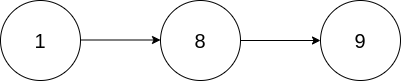
Input: head = [1,8,9]
Output: [3,7,8]
Explanation: The figure above corresponds to the given linked list which represents the number 189. Hence, the returned linked list represents the number 189 * 2 = 378.
Example 2:
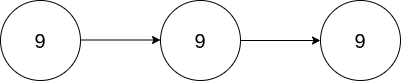
Input: head = [9,9,9]
Output: [1,9,9,8]
Explanation: The figure above corresponds to the given linked list which represents the number 999. Hence, the returned linked list reprersents the number 999 * 2 = 1998.
Constraints:
- The number of nodes in the list is in the range
[1, 104] 0 <= Node.val <= 9- The input is generated such that the list represents a number that does not have leading zeros, except the number
0itself.
Approaches
4 approaches with complexity analysis and trade-offs.
This approach converts the linked list representation of the number into a BigInteger, doubles it, and then converts the result back into a new linked list. It's conceptually simple but very inefficient for large numbers due to the overhead of BigInteger operations, making it impractical for the given constraints.
Algorithm
- Initialize a
BigIntegervariablenumberto zero. - Traverse the linked list from the
head. - In each step, update the
numberby the formula:number = number * 10 + node.val. - After the traversal, multiply the
numberby 2. - Convert the resulting
BigIntegerto its string representation. - Create a new dummy
headfor the result list. - Iterate through the characters of the string, create a new
ListNodefor each digit, and append it to the result list. - Return the
nextnode of the dummyhead.
Walkthrough
The most straightforward way to approach this problem is to treat it as a standard arithmetic problem. We first convert the linked list, which represents the number digit by digit, into an actual integer data type. Since the number of digits can be up to 10,000, we must use a data type that supports arbitrary-precision arithmetic, such as Java's BigInteger.
Once the number is in BigInteger form, we can simply multiply it by two. The final step is to convert this doubled number back into a linked list. We can do this by first converting the BigInteger to a string, and then creating a new linked list where each node corresponds to a digit in the string.
import java.math.BigInteger; /** * Definition for singly-linked list. * public class ListNode { * int val; * ListNode next; * ListNode() {} * ListNode(int val) { this.val = val; } * ListNode(int val, ListNode next) { this.val = val; this.next = next; } * } */class Solution { public ListNode doubleIt(ListNode head) { if (head == null) { return null; } // 1. Convert list to BigInteger BigInteger number = BigInteger.ZERO; ListNode current = head; while (current != null) { number = number.multiply(BigInteger.TEN).add(BigInteger.valueOf(current.val)); current = current.next; } // 2. Double the number number = number.multiply(BigInteger.valueOf(2)); // 3. Convert back to linked list String s = number.toString(); ListNode newHead = new ListNode(0); ListNode tail = newHead; for (char c : s.toCharArray()) { tail.next = new ListNode(c - '0'); tail = tail.next; } return newHead.next; }}Complexity
Time
O(N^2), where N is the number of nodes. Building the `BigInteger` involves multiplications that take time proportional to the number of digits, leading to a quadratic time complexity.
Space
O(N), where N is the number of nodes. This space is used to store the `BigInteger` representation, its string form, and the new linked list.
Trade-offs
Pros
The logic is very simple and easy to understand.
It leverages powerful, built-in libraries for handling large numbers.
Cons
Highly inefficient with a time complexity of O(N^2) due to repeated
BigIntegermultiplications.The constraints of the problem (up to 10^4 nodes) make standard integer types like
longoverflow, necessitating the use of aBigIntegerlibrary which might not be desirable or available.
Solutions
Solution
/** * Definition for singly-linked list. * public class ListNode { * int val; * ListNode next; * ListNode() {} * ListNode(int val) { this.val = val; } * ListNode(int val, ListNode next) { this.val = val; this.next = next; } * } */ class Solution { public ListNode doubleIt ( ListNode head ) { head = reverse ( head ); ListNode dummy = new ListNode (); ListNode cur = dummy ; int mul = 2 , carry = 0 ; while ( head != null ) { int x = head . val * mul + carry ; carry = x / 10 ; cur . next = new ListNode ( x % 10 ); cur = cur . next ; head = head . next ; } if ( carry > 0 ) { cur . next = new ListNode ( carry ); } return reverse ( dummy . next ); } private ListNode reverse ( ListNode head ) { ListNode dummy = new ListNode (); ListNode cur = head ; while ( cur != null ) { ListNode next = cur . next ; cur . next = dummy . next ; dummy . next = cur ; cur = next ; } return dummy . next ; } }Video walkthrough
Newsletter
One sharp idea, every week
System design and interview prep — short enough to finish.
No spam. Unsubscribe anytime.
Practice
Same difficulty — related problems to reinforce the pattern.