
Employee Importance
MedPrompt
You have a data structure of employee information, including the employee's unique ID, importance value, and direct subordinates' IDs.
You are given an array of employees employees where:
employees[i].idis the ID of theithemployee.employees[i].importanceis the importance value of theithemployee.employees[i].subordinatesis a list of the IDs of the direct subordinates of theithemployee.
Given an integer id that represents an employee's ID, return the total importance value of this employee and all their direct and indirect subordinates.
Example 1:
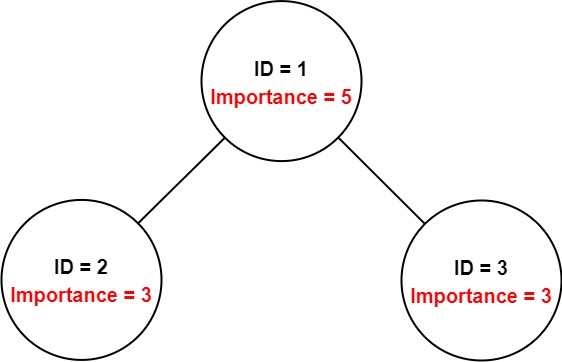
Input: employees = [[1,5,[2,3]],[2,3,[]],[3,3,[]]], id = 1
Output: 11
Explanation: Employee 1 has an importance value of 5 and has two direct subordinates: employee 2 and employee 3.
They both have an importance value of 3.
Thus, the total importance value of employee 1 is 5 + 3 + 3 = 11.
Example 2:
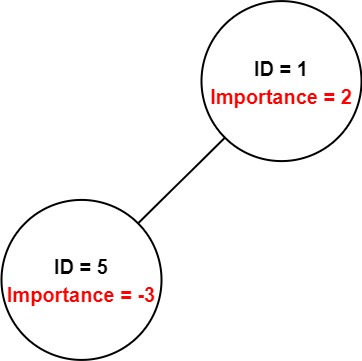
Input: employees = [[1,2,[5]],[5,-3,[]]], id = 5
Output: -3
Explanation: Employee 5 has an importance value of -3 and has no direct subordinates.
Thus, the total importance value of employee 5 is -3.
Constraints:
1 <= employees.length <= 20001 <= employees[i].id <= 2000- All
employees[i].idare unique. -100 <= employees[i].importance <= 100- One employee has at most one direct leader and may have several subordinates.
- The IDs in
employees[i].subordinatesare valid IDs.
Approaches
3 approaches with complexity analysis and trade-offs.
This approach directly traverses the employee hierarchy starting from the given ID. For each employee encountered during the traversal, it performs a linear search through the entire input list to find their details. This method avoids any preprocessing but results in a significant performance penalty due to the repeated searches.
Algorithm
- Initialize
totalImportanceto 0. - Create a queue (e.g.,
LinkedList) and add the startingidto it. - Loop while the queue is not empty:
a. Dequeue an
employeeId. b. Iterate through the entireemployeeslist to find theEmployeeobject whoseidmatchesemployeeId. c. Once found, add the employee'simportancetototalImportance. d. Add all of the employee'ssubordinatesto the queue. e. Break the inner loop and continue to the next ID in the queue. - After the loop finishes, return
totalImportance.
Walkthrough
In this brute-force method, we use a queue to perform a Breadth-First Search (BFS) starting with the initial employee ID. We initialize a running total for the importance value. In a loop, we process one employee ID from the queue at a time. The core inefficiency lies in how we retrieve employee details: for each ID, we must iterate through the entire employees list to find the matching Employee object. Once the employee is found, we add their importance to our total and add all their subordinate IDs to the queue for future processing. This continues until the queue is empty, meaning we have visited the initial employee and all their direct and indirect subordinates.
/*// Definition for Employee.class Employee { public int id; public int importance; public List<Integer> subordinates;};*/class Solution { public int getImportance(List<Employee> employees, int id) { int totalImportance = 0; Queue<Integer> queue = new LinkedList<>(); queue.offer(id); while (!queue.isEmpty()) { int currentId = queue.poll(); // Inefficiently find the employee by iterating through the list for (Employee emp : employees) { if (emp.id == currentId) { totalImportance += emp.importance; for (int subordinateId : emp.subordinates) { queue.offer(subordinateId); } break; // Found the employee, can break inner loop } } } return totalImportance; }}Complexity
Time
O(N*K), where N is the total number of employees and K is the number of employees in the hierarchy of the given `id`. The traversal visits K employees, and for each one, it scans the list of N employees. In the worst case, K=N, leading to O(N^2).
Space
O(N), where N is the total number of employees. In the worst case, the queue could hold up to N-1 subordinates.
Trade-offs
Pros
Simple to conceptualize without complex data structures.
Uses minimal extra space besides the queue for traversal.
Cons
Extremely inefficient for larger inputs, with a time complexity of O(N^2) in the worst case.
Performs a lot of redundant work by repeatedly scanning the entire list of employees.
Solutions
Solution
/* // Definition for Employee. class Employee { public int id; public int importance; public List<Integer> subordinates; }; */ class Solution { private final Map < Integer , Employee > map = new HashMap <>(); public int getImportance ( List < Employee > employees , int id ) { for ( Employee employee : employees ) { map . put ( employee . id , employee ); } return dfs ( id ); } private int dfs ( int id ) { Employee employee = map . get ( id ); int sum = employee . importance ; for ( Integer subordinate : employee . subordinates ) { sum += dfs ( subordinate ); } return sum ; } }Video walkthrough
Newsletter
One sharp idea, every week
System design and interview prep — short enough to finish.
No spam. Unsubscribe anytime.
Practice
Same difficulty — related problems to reinforce the pattern.