
Equal Sum Grid Partition II
HardPrompt
You are given an m x n matrix grid of positive integers. Your task is to determine if it is possible to make either one horizontal or one vertical cut on the grid such that:
- Each of the two resulting sections formed by the cut is non-empty.
- The sum of elements in both sections is equal, or can be made equal by discounting at most one single cell in total (from either section).
- If a cell is discounted, the rest of the section must remain connected.
Return true if such a partition exists; otherwise, return false.
Note: A section is connected if every cell in it can be reached from any other cell by moving up, down, left, or right through other cells in the section.
Example 1:
Input: grid = [[1,4],[2,3]]
Output: true
Explanation:
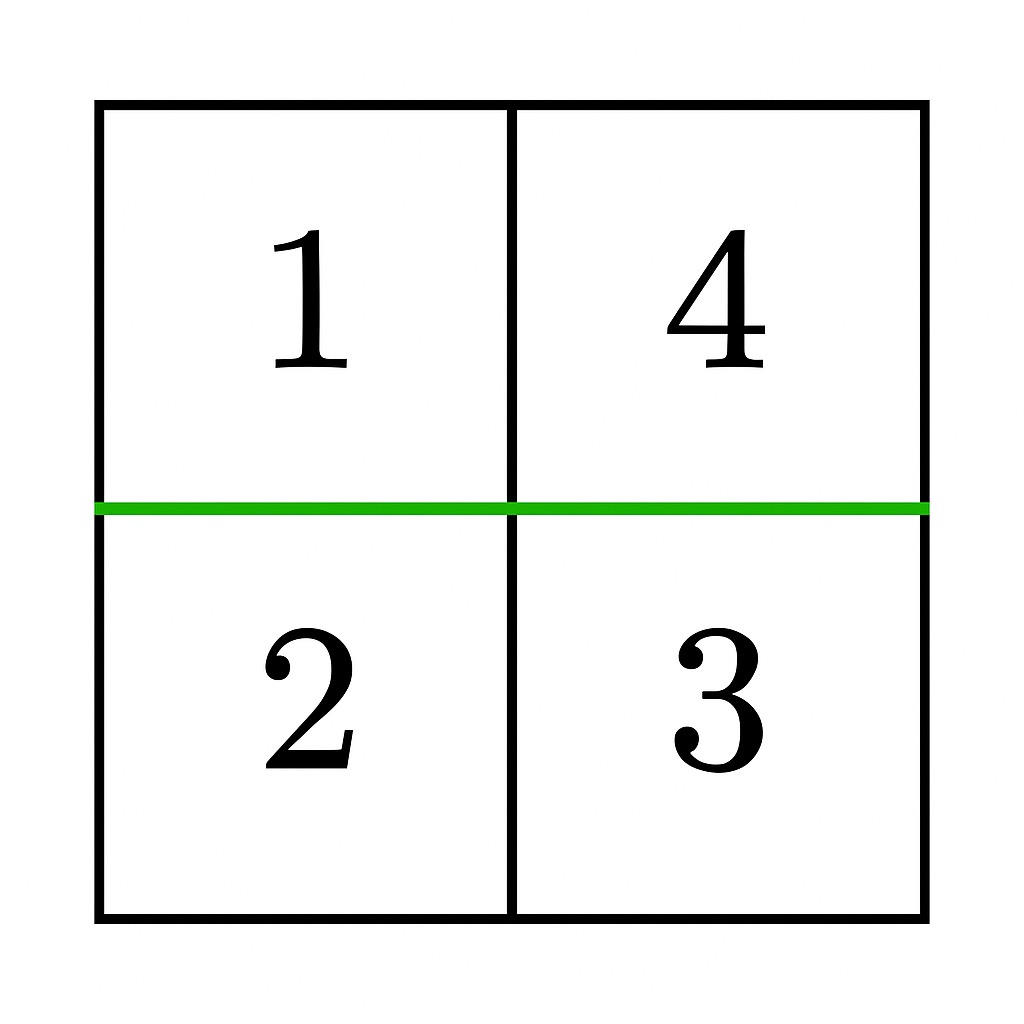
- A horizontal cut after the first row gives sums
1 + 4 = 5and2 + 3 = 5, which are equal. Thus, the answer istrue.
Example 2:
Input: grid = [[1,2],[3,4]]
Output: true
Explanation:
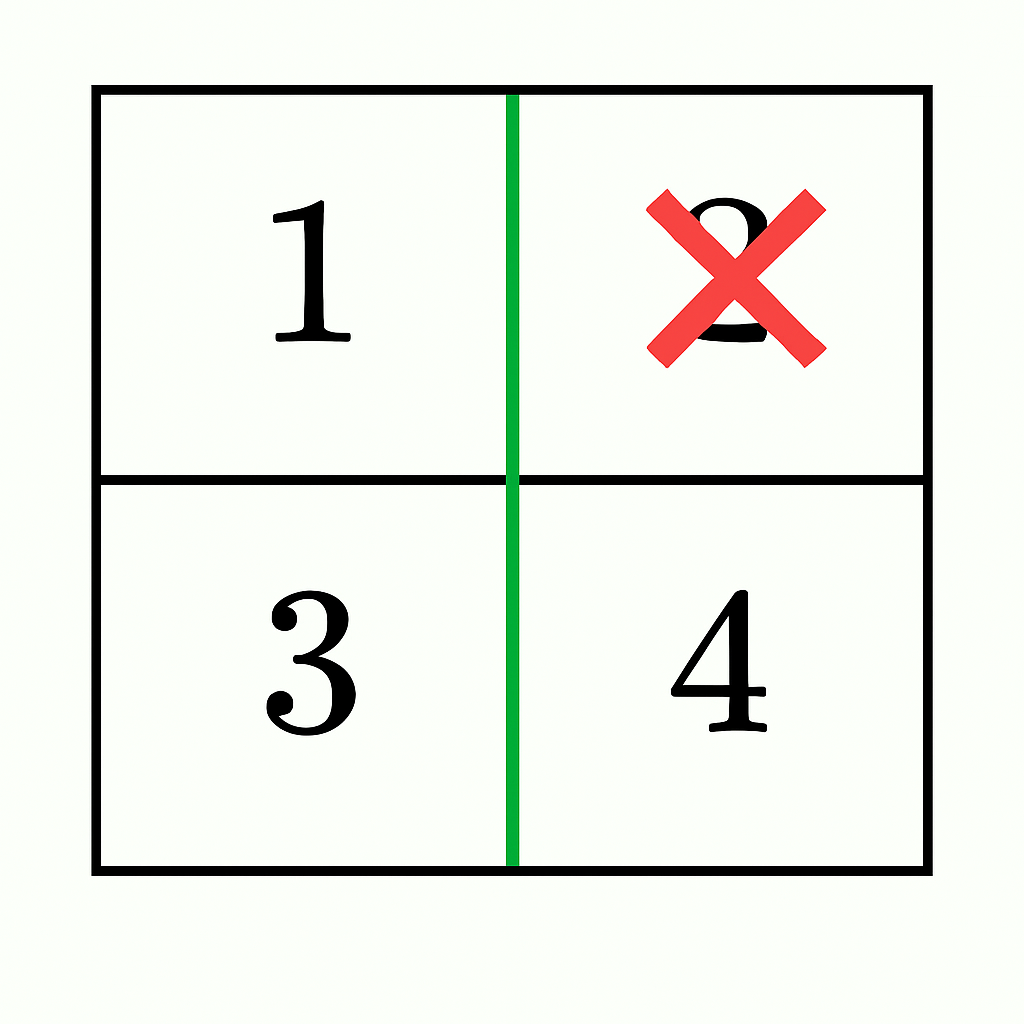
- A vertical cut after the first column gives sums
1 + 3 = 4and2 + 4 = 6. - By discounting 2 from the right section (
6 - 2 = 4), both sections have equal sums and remain connected. Thus, the answer istrue.
Example 3:
Input: grid = [[1,2,4],[2,3,5]]
Output: false
Explanation:
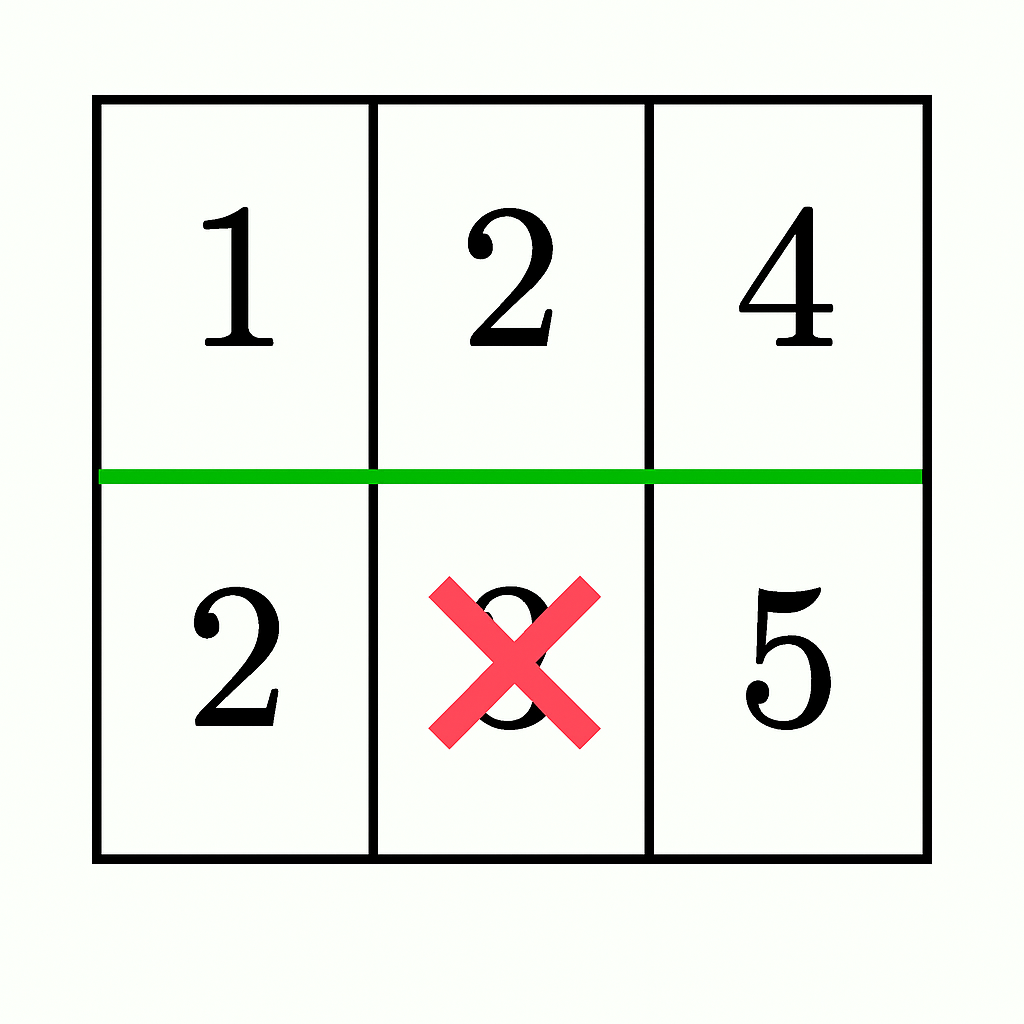
- A horizontal cut after the first row gives
1 + 2 + 4 = 7and2 + 3 + 5 = 10. - By discounting 3 from the bottom section (
10 - 3 = 7), both sections have equal sums, but they do not remain connected as it splits the bottom section into two parts ([2]and[5]). Thus, the answer isfalse.
Example 4:
Input: grid = [[4,1,8],[3,2,6]]
Output: false
Explanation:
No valid cut exists, so the answer is false.
Constraints:
1 <= m == grid.length <= 1051 <= n == grid[i].length <= 1052 <= m * n <= 1051 <= grid[i][j] <= 105
Approaches
2 approaches with complexity analysis and trade-offs.
This approach systematically checks every possible horizontal and vertical cut. For each potential cut, it calculates the sum of elements in the two resulting sections. If the sums are not equal, it naively scans one of the sections to find a cell that can be discounted to make the sums equal, while also checking the connectivity constraint.
Algorithm
- First, pre-calculate the sum of each row and each column to speed up the sum calculation for sections. This takes
O(m*n)time. - Iterate through all
m-1possible horizontal cuts. - For each horizontal cut, calculate the sum of the top section (
sum1) and the bottom section (sum2). - Check the three conditions:
- If
sum1 == sum2, a valid partition is found, returntrue. - If
sum1 > sum2, iterate through every cell in the top section. If a cell's value equalssum1 - sum2, check if removing it preserves connectivity. If so, a valid partition is found, returntrue. - If
sum2 > sum1, perform a similar check on the bottom section.
- If
- If no valid horizontal cut is found, repeat the entire process for all
n-1possible vertical cuts. - If no valid partition is found after checking all possible cuts, return
false.
Walkthrough
The brute-force method involves a straightforward, exhaustive search. We begin by pre-calculating row and column sums to avoid re-calculating them for every partition, which is a minor optimization. Then, we loop through each possible horizontal cut line. For each cut, we find the sums of the two resulting partitions. If they aren't equal, we determine the difference, diff, and then iterate through every single cell of the larger partition to see if any cell's value matches diff. If a match is found, we perform a check to ensure that removing this cell doesn't violate the connectivity rule. The connectivity check is based on the dimensions of the partition: a multi-row, multi-column section always remains connected, but a single-row or single-column section only remains connected if an endpoint is removed. If no valid horizontal cut works, we apply the same logic to all possible vertical cuts. This method is simple but highly inefficient due to the repeated scanning of grid sections.
Complexity
Time
O(m*n * (m+n)). For each of the `m-1` horizontal cuts, we might iterate over `O(m*n)` cells in the worst case. A similar logic applies to the `n-1` vertical cuts, leading to a very high time complexity.
Space
O(m + n) to store the pre-calculated row and column sums.
Trade-offs
Pros
Simple to conceptualize and implement.
Uses minimal extra space, mainly for storing row and column sums.
Cons
Extremely inefficient and will likely result in a 'Time Limit Exceeded' error for larger grids.
The nested loops lead to a high polynomial time complexity.
This approach dramatically improves performance by pre-computing essential information about the grid. Instead of repeatedly searching for a value to discount, we can query pre-built data structures in constant time. This avoids the nested loops of the brute-force method, reducing the overall time complexity to be linear with respect to the number of cells in the grid.
Algorithm
- Perform a single pass over the grid to pre-compute the following data in
O(m*n)time:row_sums: an array with the sum of each row.col_sums: an array with the sum of each column.total_sum: the sum of all elements in the grid.- Four HashMaps to store location metadata for each distinct value
v:val_to_min_row: mapsvto its minimum row index.val_to_max_row: mapsvto its maximum row index.val_to_min_col: mapsvto its minimum column index.val_to_max_col: mapsvto its maximum column index.
- Horizontal Cuts: Iterate from
i = 0tom-2. Calculatetop_sumandbottom_sum.- If sums are equal, return
true. - Otherwise, calculate
diffand use the pre-computed maps and direct corner checks to see if a valid discount is possible inO(1)time.
- If sums are equal, return
- Vertical Cuts: Perform a similar
O(1)check for each vertical cut fromj = 0ton-2using the column-based metadata maps. - If any check passes, return
true. If all checks fail, returnfalse.
Walkthrough
This optimized solution hinges on efficient data retrieval. We start with a single O(m*n) pass through the grid to gather all necessary information upfront. This includes row/column sums and, crucially, four HashMaps that store the minimum and maximum row/column indices for each unique value in the grid.
With this pre-computed data, checking each potential cut becomes very fast. For each horizontal cut, we calculate the two partition sums. If they differ, we calculate the required diff. To check if we can discount a cell with value diff from a partition, we no longer need to scan it. Instead, we use our maps. For instance, to check if diff exists in a multi-row, multi-column top partition (rows 0 to i), we simply check if val_to_min_row.get(diff) <= i. This is an O(1) lookup. For single-row or single-column partitions where connectivity is a concern, we perform direct O(1) checks on the specific endpoint cells. The same logic is applied to vertical cuts using the column-based maps. This transforms the problem from a high-degree polynomial complexity to a linear one.
import java.util.HashMap;import java.util.Map; class Solution { public boolean equalSumGridPartition(int[][] grid) { int m = grid.length; int n = grid[0].length; long[] rowSums = new long[m]; long[] colSums = new long[n]; long totalSum = 0; Map<Integer, Integer> valToMinRow = new HashMap<>(); Map<Integer, Integer> valToMaxRow = new HashMap<>(); Map<Integer, Integer> valToMinCol = new HashMap<>(); Map<Integer, Integer> valToMaxCol = new HashMap<>(); for (int i = 0; i < m; i++) { for (int j = 0; j < n; j++) { int val = grid[i][j]; rowSums[i] += val; colSums[j] += val; totalSum += val; valToMinRow.put(val, Math.min(valToMinRow.getOrDefault(val, i), i)); valToMaxRow.put(val, Math.max(valToMaxRow.getOrDefault(val, i), i)); valToMinCol.put(val, Math.min(valToMinCol.getOrDefault(val, j), j)); valToMaxCol.put(val, Math.max(valToMaxCol.getOrDefault(val, j), j)); } } // Check horizontal cuts long currentSum = 0; for (int i = 0; i < m - 1; i++) { currentSum += rowSums[i]; long otherSum = totalSum - currentSum; if (currentSum == otherSum) return true; long diff = Math.abs(currentSum - otherSum); if (diff > Integer.MAX_VALUE) continue; int intDiff = (int) diff; if (currentSum > otherSum) { if (valToMinRow.containsKey(intDiff)) { if (i > 0 && n > 1) { // Multi-row, multi-col top if (valToMinRow.get(intDiff) <= i) return true; } else if (i == 0 && n > 1) { // Single row top if (grid[0][0] == intDiff || grid[0][n - 1] == intDiff) return true; } else if (n == 1 && i > 0) { // Single col top if (grid[0][0] == intDiff || grid[i][0] == intDiff) return true; } } } else { // otherSum > currentSum if (valToMaxRow.containsKey(intDiff)) { if (m - 1 - i > 1 && n > 1) { // Multi-row, multi-col bottom if (valToMaxRow.get(intDiff) >= i + 1) return true; } else if (m - 1 - i == 1 && n > 1) { // Single row bottom if (grid[m - 1][0] == intDiff || grid[m - 1][n - 1] == intDiff) return true; } else if (n == 1 && m - 1 - i > 1) { // Single col bottom if (grid[i + 1][0] == intDiff || grid[m - 1][0] == intDiff) return true; } } } } // Check vertical cuts currentSum = 0; for (int j = 0; j < n - 1; j++) { currentSum += colSums[j]; long otherSum = totalSum - currentSum; if (currentSum == otherSum) return true; long diff = Math.abs(currentSum - otherSum); if (diff > Integer.MAX_VALUE) continue; int intDiff = (int) diff; if (currentSum > otherSum) { if (valToMinCol.containsKey(intDiff)) { if (m > 1 && j > 0) { // Multi-row, multi-col left if (valToMinCol.get(intDiff) <= j) return true; } else if (m > 1 && j == 0) { // Single col left if (grid[0][0] == intDiff || grid[m - 1][0] == intDiff) return true; } else if (m == 1 && j > 0) { // Single row left if (grid[0][0] == intDiff || grid[0][j] == intDiff) return true; } } } else { // otherSum > currentSum if (valToMaxCol.containsKey(intDiff)) { if (m > 1 && n - 1 - j > 1) { // Multi-row, multi-col right if (valToMaxCol.get(intDiff) >= j + 1) return true; } else if (m > 1 && n - 1 - j == 1) { // Single col right if (grid[0][n - 1] == intDiff || grid[m - 1][n - 1] == intDiff) return true; } else if (m == 1 && n - 1 - j > 1) { // Single row right if (grid[0][j + 1] == intDiff || grid[0][n - 1] == intDiff) return true; } } } } return false; }}Complexity
Time
O(m*n). The initial pre-computation pass takes `O(m*n)`. The subsequent loops for checking horizontal and vertical cuts take `O(m)` and `O(n)` time, respectively. The overall complexity is dominated by the pre-computation step.
Space
O(m*n). The space is dominated by the HashMaps storing location metadata. In the worst-case scenario where all grid elements are distinct, the maps will store `O(m*n)` entries.
Trade-offs
Pros
Highly efficient with a linear time complexity, making it suitable for large grids.
The core logic for checking each partition is constant time after the initial setup.
Cons
Requires significant extra space to store the location metadata maps, which can be up to
O(m*n)in the worst case.
Video walkthrough
Newsletter
One sharp idea, every week
System design and interview prep — short enough to finish.
No spam. Unsubscribe anytime.
Practice
Same difficulty — related problems to reinforce the pattern.