
Find All Groups of Farmland
MedPrompt
You are given a 0-indexed m x n binary matrix land where a 0 represents a hectare of forested land and a 1 represents a hectare of farmland.
To keep the land organized, there are designated rectangular areas of hectares that consist entirely of farmland. These rectangular areas are called groups. No two groups are adjacent, meaning farmland in one group is not four-directionally adjacent to another farmland in a different group.
land can be represented by a coordinate system where the top left corner of land is (0, 0) and the bottom right corner of land is (m-1, n-1). Find the coordinates of the top left and bottom right corner of each group of farmland. A group of farmland with a top left corner at (r1, c1) and a bottom right corner at (r2, c2) is represented by the 4-length array [r1, c1, r2, c2].
Return a 2D array containing the 4-length arrays described above for each group of farmland in land. If there are no groups of farmland, return an empty array. You may return the answer in any order.
Example 1:
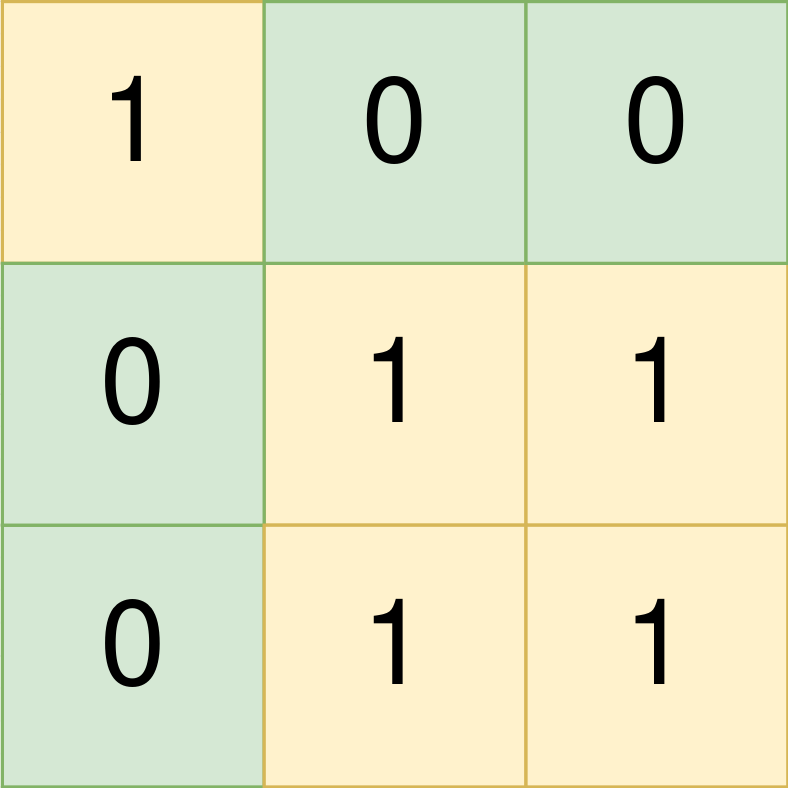
Input: land = [[1,0,0],[0,1,1],[0,1,1]]
Output: [[0,0,0,0],[1,1,2,2]]
Explanation:
The first group has a top left corner at land[0][0] and a bottom right corner at land[0][0].
The second group has a top left corner at land[1][1] and a bottom right corner at land[2][2].
Example 2:
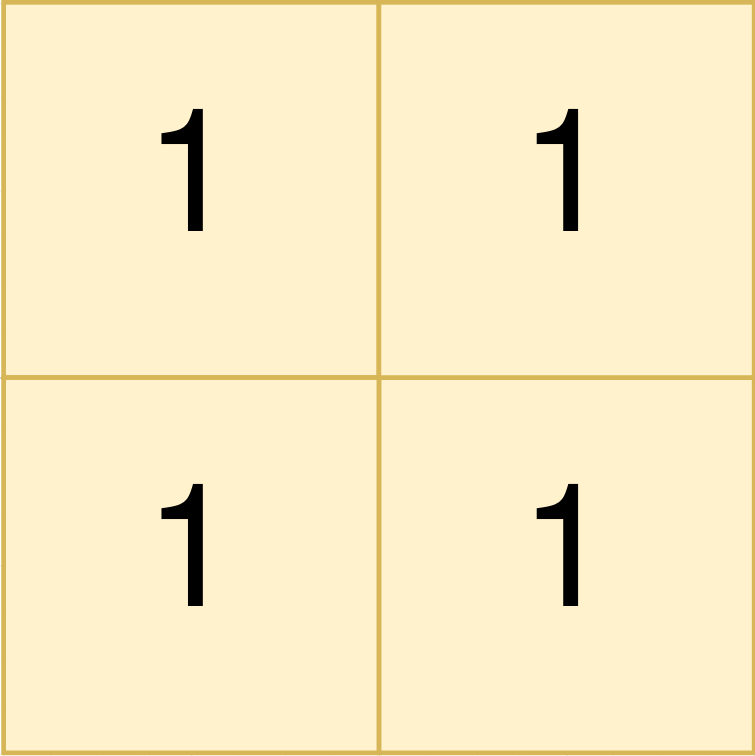
Input: land = [[1,1],[1,1]]
Output: [[0,0,1,1]]
Explanation:
The first group has a top left corner at land[0][0] and a bottom right corner at land[1][1].
Example 3:

Input: land = [[0]]
Output: []
Explanation:
There are no groups of farmland.
Constraints:
m == land.lengthn == land[i].length1 <= m, n <= 300landconsists of only0's and1's.- Groups of farmland are rectangular in shape.
Approaches
2 approaches with complexity analysis and trade-offs.
This approach models the grid as a graph, where each cell containing a '1' is a node, and adjacent '1's are connected by edges. We traverse the grid cell by cell. When we encounter a '1' that hasn't been visited yet, we initiate a graph traversal algorithm like Depth-First Search (DFS) or Breadth-First Search (BFS) from that cell. This traversal explores the entire connected component of farmland. During the search, we keep track of the maximum row and column indices to identify the bottom-right corner of the rectangular group. A separate boolean matrix, visited, is used to ensure that each cell is processed only once.
Algorithm
- Initialize an
m x nboolean matrixvisitedto allfalse. - Initialize an empty list
resultto store the coordinates. - Iterate through each cell
(r, c)of thelandmatrix. - If
land[r][c] == 1andvisited[r][c]isfalse:- This is a new group. The top-left corner is
(r, c). - Initialize
max_r = randmax_c = c. - Start a DFS/BFS from
(r, c). In the traversal, for each cell(curr_r, curr_c):- Mark
(curr_r, curr_c)as visited. - Update
max_r = max(max_r, curr_r)andmax_c = max(max_c, curr_c). - Explore its unvisited '1' neighbors.
- Mark
- After the traversal, add
[r, c, max_r, max_c]toresult.
- This is a new group. The top-left corner is
- Return
result.
Walkthrough
We iterate through the land matrix. If we find a cell (r, c) with a '1' that we haven't visited, we know it's the top-left corner of a new group. We then start a DFS from (r, c). The DFS will explore all reachable '1's from this starting point. We pass a reference to an array (e.g., maxCoords) to the DFS function to keep track of the maximum row and column index seen so far in the current component. The DFS function marks the current cell as visited, updates maxCoords, and recursively calls itself for all four neighbors. Once the DFS for a component is complete, (r, c) is the top-left corner and (maxCoords[0], maxCoords[1]) is the bottom-right corner. We add these coordinates to our result list. This process continues until the entire grid has been scanned.
class Solution { public int[][] findFarmland(int[][] land) { int m = land.length; int n = land[0].length; boolean[][] visited = new boolean[m][n]; List<int[]> result = new ArrayList<>(); for (int i = 0; i < m; i++) { for (int j = 0; j < n; j++) { if (land[i][j] == 1 && !visited[i][j]) { int[] maxCoords = new int[]{i, j}; // [max_r, max_c] dfs(land, visited, i, j, maxCoords); result.add(new int[]{i, j, maxCoords[0], maxCoords[1]}); } } } return result.toArray(new int[result.size()][]); } private void dfs(int[][] land, boolean[][] visited, int r, int c, int[] maxCoords) { int m = land.length; int n = land[0].length; if (r < 0 || r >= m || c < 0 || c >= n || visited[r][c] || land[r][c] == 0) { return; } visited[r][c] = true; maxCoords[0] = Math.max(maxCoords[0], r); maxCoords[1] = Math.max(maxCoords[1], c); dfs(land, visited, r + 1, c, maxCoords); dfs(land, visited, r - 1, c, maxCoords); dfs(land, visited, r, c + 1, maxCoords); dfs(land, visited, r, c - 1, maxCoords); }}Complexity
Time
O(m * n), where `m` is the number of rows and `n` is the number of columns. Each cell is visited a constant number of times.
Space
O(m * n) to store the `visited` matrix. The recursion stack for DFS (or queue for BFS) can also grow up to `O(m * n)` in the worst case.
Trade-offs
Pros
It's a standard and general approach for finding connected components in a grid.
Does not modify the original input
landmatrix.
Cons
Requires extra space for the
visitedmatrix, leading toO(m * n)space complexity.The recursive DFS might lead to a stack overflow for very large groups, although the constraints
m, n <= 300make this unlikely.It's less efficient than necessary because the problem guarantees rectangular, non-adjacent groups, which allows for a simpler search than a full DFS/BFS.
This is a more efficient approach that leverages the specific properties of the problem: the farmland groups are rectangular and non-adjacent. We can iterate through the grid, and whenever we find a '1', we can be certain it's the top-left corner of a new group. This is because if there were a '1' to its top or left, we would have already processed it in our top-to-bottom, left-to-right scan. Once a top-left corner is found, we can easily find the bottom-right corner by just extending downwards and rightwards. To avoid re-processing the same group, we modify the input grid by changing the '1's of the found group to '0's. This eliminates the need for an auxiliary visited matrix.
Algorithm
- Initialize an empty list
result. - Iterate
rfrom0tom-1. - Iterate
cfrom0ton-1. - If
land[r][c] == 1:- This is the top-left corner
(r1, c1) = (r, c). - Find the bottom-right corner
(r2, c2). - Initialize
r2 = r,c2 = c. - Extend downwards: while
r2 + 1 < mandland[r2 + 1][c] == 1, incrementr2. - Extend rightwards: while
c2 + 1 < nandland[r][c2 + 1] == 1, incrementc2. - Add
[r1, c1, r2, c2]toresult. - Mark the rectangle as processed by setting
land[i][j] = 0for allifromr1tor2andjfromc1toc2.
- This is the top-left corner
Walkthrough
The core idea is to find the top-left corner of a rectangle, determine its full extent, record it, and then "erase" it from the grid to ensure it's not processed again. We iterate through the grid with nested loops. When land[r][c] is '1', we've found a top-left corner. We then find the bottom-most row r2 of this rectangle by scanning down from (r, c). Similarly, we find the right-most column c2 by scanning right from (r, c). The coordinates [r, c, r2, c2] define the group. After recording the group, we iterate through this (r, c) to (r2, c2) subgrid and set all land values to '0'. This acts as our "visited" marker. Because we clear the found rectangles, any '1' we encounter later in the main scan is guaranteed to be a new top-left corner.
class Solution { public int[][] findFarmland(int[][] land) { int m = land.length; int n = land[0].length; List<int[]> result = new ArrayList<>(); for (int r1 = 0; r1 < m; r1++) { for (int c1 = 0; c1 < n; c1++) { if (land[r1][c1] == 1) { // Found the top-left corner of a group int r2 = r1; int c2 = c1; // Find the bottom-right corner // Since it's a rectangle, we only need to check one column to find the last row // and one row to find the last column. while (r2 + 1 < m && land[r2 + 1][c1] == 1) { r2++; } while (c2 + 1 < n && land[r1][c2 + 1] == 1) { c2++; } result.add(new int[]{r1, c1, r2, c2}); // Mark this farmland as visited by changing 1s to 0s for (int i = r1; i <= r2; i++) { for (int j = c1; j <= c2; j++) { land[i][j] = 0; } } } } } return result.toArray(new int[result.size()][]); }}Complexity
Time
O(m * n). Each cell is visited a constant number of times. Although there are nested loops for clearing the rectangle, each '1' cell is part of exactly one rectangle and will be cleared only once.
Space
O(1) auxiliary space. The space for the result list depends on the number of farmland groups, but no extra data structures proportional to the grid size are needed.
Trade-offs
Pros
Highly space-efficient, using
O(1)auxiliary space (if the output list is not counted).Very fast and efficient as it's tailored to the problem's specific constraints (rectangular, non-adjacent groups).
The logic is simple and avoids the overhead of recursion or an explicit stack/queue.
Cons
Modifies the input grid, which may be undesirable in some scenarios where the original data must be preserved.
Solutions
Solution
class Solution {public int[][] findFarmland(int[][] land) { List<int[]> ans = new ArrayList<>(); int m = land.length; int n = land[0].length; for (int i = 0; i < m; ++i) { for (int j = 0; j < n; ++j) { if (land[i][j] == 0 || (j > 0 && land[i][j - 1] == 1) || (i > 0 && land[i - 1][j] == 1)) { continue; } int x = i; int y = j; for (; x + 1 < m && land[x + 1][j] == 1; ++x) ; for (; y + 1 < n && land[x][y + 1] == 1; ++y) ; ans.add(new int[]{i, j, x, y}); } } return ans.toArray(new int[ans.size()][4]); }}class Solution {public: vector<vector<int>> findFarmland(vector<vector<int>> &land) { vector<vector<int>> ans; int m = land.size(); int n = land[0].size(); for (int i = 0; i < m; ++i) { for (int j = 0; j < n; ++j) { if (land[i][j] == 0 || (j > 0 && land[i][j - 1] == 1) || (i > 0 && land[i - 1][j] == 1)) continue; int x = i; int y = j; for (; x + 1 < m && land[x + 1][j] == 1; ++x) ; for (; y + 1 < n && land[x][y + 1] == 1; ++y) ; ans.push_back({i, j, x, y}); } } return ans; }};class Solution: def findFarmland(self, land: List[List[int]]) -> List[List[int]]: m, n = len(land), len(land[0]) ans = [] for i in range(m): for j in range(n): if (land[i][j] == 0 or (j > 0 and land[i][j - 1] == 1) or (i > 0 and land[i - 1][j] == 1)): continue x, y = i, j while x + 1 < m and land[x + 1][j] == 1: x += 1 while y + 1 < n and land[x][y + 1] == 1: y += 1 ans . append([i, j, x, y]) return ansVideo walkthrough
Newsletter
One sharp idea, every week
System design and interview prep — short enough to finish.
No spam. Unsubscribe anytime.
Practice
Same difficulty — related problems to reinforce the pattern.