
Find And Replace in String
MedPrompt
You are given a 0-indexed string s that you must perform k replacement operations on. The replacement operations are given as three 0-indexed parallel arrays, indices, sources, and targets, all of length k.
To complete the ith replacement operation:
- Check if the substring
sources[i]occurs at indexindices[i]in the original strings. - If it does not occur, do nothing.
- Otherwise if it does occur, replace that substring with
targets[i].
For example, if s = "abcd", indices[i] = 0, sources[i] = "ab", and targets[i] = "eee", then the result of this replacement will be "eeecd".
All replacement operations must occur simultaneously, meaning the replacement operations should not affect the indexing of each other. The testcases will be generated such that the replacements will not overlap.
- For example, a testcase with
s = "abc",indices = [0, 1], andsources = ["ab","bc"]will not be generated because the"ab"and"bc"replacements overlap.
Return the resulting string after performing all replacement operations on s.
A substring is a contiguous sequence of characters in a string.
Example 1:
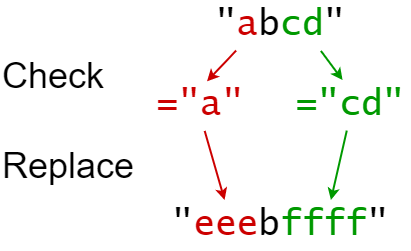
Input: s = "abcd", indices = [0, 2], sources = ["a", "cd"], targets = ["eee", "ffff"]
Output: "eeebffff"
Explanation:
"a" occurs at index 0 in s, so we replace it with "eee".
"cd" occurs at index 2 in s, so we replace it with "ffff".
Example 2:
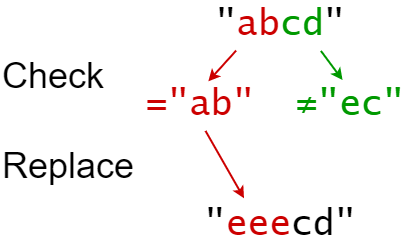
Input: s = "abcd", indices = [0, 2], sources = ["ab","ec"], targets = ["eee","ffff"]
Output: "eeecd"
Explanation:
"ab" occurs at index 0 in s, so we replace it with "eee".
"ec" does not occur at index 2 in s, so we do nothing.
Constraints:
1 <= s.length <= 1000k == indices.length == sources.length == targets.length1 <= k <= 1000 <= indexes[i] < s.length1 <= sources[i].length, targets[i].length <= 50sconsists of only lowercase English letters.sources[i]andtargets[i]consist of only lowercase English letters.
Approaches
3 approaches with complexity analysis and trade-offs.
This is a straightforward brute-force approach. We iterate through the input string s with a pointer. At each position, we loop through all k available operations to see if one applies. If a matching operation is found, we perform the replacement and advance our pointer accordingly. Otherwise, we copy the character and advance the pointer by one.
Algorithm
- Initialize a
StringBuilderto build the result string. - Initialize a pointer
i = 0to traverse the input strings. - Loop while
iis less than the length ofs. - Inside the loop, search for a matching operation at index
i. Initialize a flagmatchFound = false. - Iterate from
j = 0tok-1:- If
indices[j] == iands.startsWith(sources[j], i):- Append
targets[j]to theStringBuilder. - Advance
ibysources[j].length(). - Set
matchFound = trueand break the inner loop (since replacements are non-overlapping).
- Append
- If
- If
matchFoundis false after checking all operations, it means no replacement starts ati.- Append
s.charAt(i)to theStringBuilder. - Increment
iby 1.
- Append
- After the main loop finishes, convert the
StringBuilderto a string and return it.
Walkthrough
class Solution { public String findReplaceString(String s, int[] indices, String[] sources, String[] targets) { StringBuilder result = new StringBuilder(); int k = indices.length; int i = 0; while (i < s.length()) { boolean replaced = false; for (int j = 0; j < k; j++) { // Check if an operation starts at the current index i and the source matches if (indices[j] == i && s.startsWith(sources[j], i)) { result.append(targets[j]); i += sources[j].length(); replaced = true; break; // Non-overlapping, so we can break after finding one match } } if (!replaced) { result.append(s.charAt(i)); i++; } } return result.toString(); }}Complexity
Time
O(N * K * L_s), where `N` is the length of `s`, `K` is the number of operations, and `L_s` is the maximum length of a source string. The outer loop runs up to `N` times. In each iteration, we may loop through all `K` operations, and for each, `startsWith` takes `O(L_s)` time.
Space
O(L_res), where `L_res` is the length of the resulting string. This space is primarily used by the `StringBuilder` to construct the output.
Trade-offs
Pros
Simple logic, easy to understand and implement.
Minimal auxiliary space besides the result builder.
Cons
Inefficient due to the nested loop structure, leading to a high time complexity, especially for large
NandK.
Solutions
Solution
class Solution {public String findReplaceString(String s, int[] indices, String[] sources, String[] targets) { int n = s.length(); var d = new int[n]; Arrays.fill(d, -1); for (int k = 0; k < indices.length; ++k) { int i = indices[k]; if (s.startsWith(sources[k], i)) { d[i] = k; } } var ans = new StringBuilder(); for (int i = 0; i < n;) { if (d[i] >= 0) { ans.append(targets[d[i]]); i += sources[d[i]].length(); } else { ans.append(s.charAt(i++)); } } return ans.toString(); }}Video walkthrough
Newsletter
One sharp idea, every week
System design and interview prep — short enough to finish.
No spam. Unsubscribe anytime.
Practice
Same difficulty — related problems to reinforce the pattern.