
First Completely Painted Row or Column
MedPrompt
You are given a 0-indexed integer array arr, and an m x n integer matrix mat. arr and mat both contain all the integers in the range [1, m * n].
Go through each index i in arr starting from index 0 and paint the cell in mat containing the integer arr[i].
Return the smallest index i at which either a row or a column will be completely painted in mat.
Example 1:
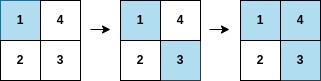
Input: arr = [1,3,4,2], mat = [[1,4],[2,3]]
Output: 2
Explanation: The moves are shown in order, and both the first row and second column of the matrix become fully painted at arr[2].
Example 2:
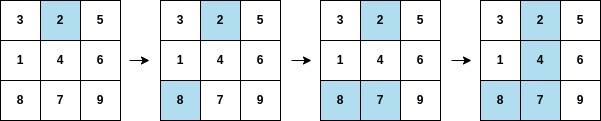
Input: arr = [2,8,7,4,1,3,5,6,9], mat = [[3,2,5],[1,4,6],[8,7,9]]
Output: 3
Explanation: The second column becomes fully painted at arr[3].
Constraints:
m == mat.lengthn = mat[i].lengtharr.length == m * n1 <= m, n <= 1051 <= m * n <= 1051 <= arr[i], mat[r][c] <= m * n- All the integers of
arrare unique. - All the integers of
matare unique.
Approaches
3 approaches with complexity analysis and trade-offs.
This approach directly simulates the process described in the problem. For each number in arr, we perform a full scan of the matrix mat to find its location. We use an auxiliary boolean matrix to keep track of which cells have been painted. After painting a cell, we check its entire row and column to see if they have become completely painted.
Algorithm
- Create a boolean matrix
paintedof the same dimensions asmat, initialized tofalse. - Iterate through the input array
arrfrom indexi = 0toarr.length - 1. - For each number
val = arr[i]:- Search the entire
matto find the rowrand columncwheremat[r][c] == val. - Mark the cell as painted by setting
painted[r][c] = true. - Check if the entire row
ris painted by iterating through its columns. - If the row is complete, return
i. - Check if the entire column
cis painted by iterating through its rows. - If the column is complete, return
i.
- Search the entire
Walkthrough
The brute-force method involves iterating through each element of the arr. In each iteration, we take the number and search for it within the mat. This search operation itself takes O(m*n) time. Once found at (r, c), we mark this position in a separate painted grid. Then, we check if row r is complete by scanning all n cells in that row, and similarly, check column c by scanning all m cells. This entire process (search, mark, check) is repeated for each number in arr until a complete row or column is found.
class Solution { public int firstCompleteIndex(int[] arr, int[][] mat) { int m = mat.length; int n = mat[0].length; boolean[][] painted = new boolean[m][n]; for (int i = 0; i < arr.length; i++) { int val = arr[i]; int r = -1, c = -1; // Find val in mat find_val: for (int row = 0; row < m; row++) { for (int col = 0; col < n; col++) { if (mat[row][col] == val) { r = row; c = col; break find_val; } } } painted[r][c] = true; // Check row r boolean rowComplete = true; for (int col = 0; col < n; col++) { if (!painted[r][col]) { rowComplete = false; break; } } if (rowComplete) { return i; } // Check column c boolean colComplete = true; for (int row = 0; row < m; row++) { if (!painted[row][c]) { colComplete = false; break; } } if (colComplete) { return i; } } return -1; // Should not be reached }}Complexity
Time
O((m*n)^2). The outer loop runs up to `k` times (where `k` is the answer index, worst case `m*n`). Inside the loop, searching the matrix takes O(m*n). This results in a total complexity of O(k * m * n), which is O((m*n)^2) in the worst case.
Space
O(m * n) to store the `painted` boolean matrix.
Trade-offs
Pros
Simple to conceptualize and implement.
Uses a straightforward simulation of the problem statement.
Cons
Extremely inefficient due to repeated searching of the matrix.
Will result in a 'Time Limit Exceeded' error for larger inputs.
Solutions
Solution
class Solution {public int firstCompleteIndex(int[] arr, int[][] mat) { int m = mat.length, n = mat[0].length; Map<Integer, int[]> idx = new HashMap<>(); for (int i = 0; i < m; ++i) { for (int j = 0; j < n; ++j) { idx.put(mat[i][j], new int[]{i, j}); } } int[] row = new int[m]; int[] col = new int[n]; for (int k = 0;; ++k) { var x = idx.get(arr[k]); int i = x[0], j = x[1]; ++row[i]; ++col[j]; if (row[i] == n || col[j] == m) { return k; } } }}Video walkthrough
Newsletter
One sharp idea, every week
System design and interview prep — short enough to finish.
No spam. Unsubscribe anytime.
Practice
Same difficulty — related problems to reinforce the pattern.