
Graph Connectivity With Threshold
HardPrompt
We have n cities labeled from 1 to n. Two different cities with labels x and y are directly connected by a bidirectional road if and only if x and y share a common divisor strictly greater than some threshold. More formally, cities with labels x and y have a road between them if there exists an integer z such that all of the following are true:
x % z == 0,y % z == 0, andz > threshold.
Given the two integers, n and threshold, and an array of queries, you must determine for each queries[i] = [ai, bi] if cities ai and bi are connected directly or indirectly. (i.e. there is some path between them).
Return an array answer, where answer.length == queries.length and answer[i] is true if for the ith query, there is a path between ai and bi, or answer[i] is false if there is no path.
Example 1:
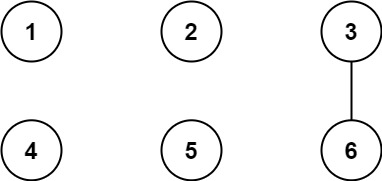
Input: n = 6, threshold = 2, queries = [[1,4],[2,5],[3,6]]
Output: [false,false,true]
Explanation: The divisors for each number:
1:   1
2:   1, 2
3:   1, 3
4:   1, 2, 4
5:   1, 5
6:   1, 2, 3, 6
Using the underlined divisors above the threshold, only cities 3 and 6 share a common divisor, so they are the
only ones directly connected. The result of each query:
[1,4]   1 is not connected to 4
[2,5]   2 is not connected to 5
[3,6]   3 is connected to 6 through path 3--6
Example 2:
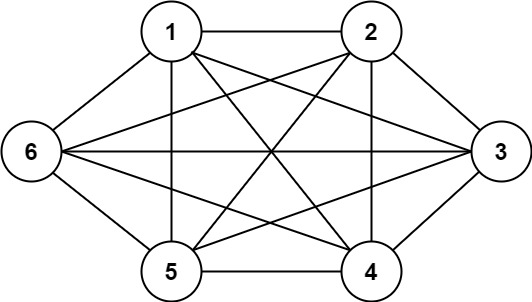
Input: n = 6, threshold = 0, queries = [[4,5],[3,4],[3,2],[2,6],[1,3]]
Output: [true,true,true,true,true]
Explanation: The divisors for each number are the same as the previous example. However, since the threshold is 0,
all divisors can be used. Since all numbers share 1 as a divisor, all cities are connected.
Example 3:
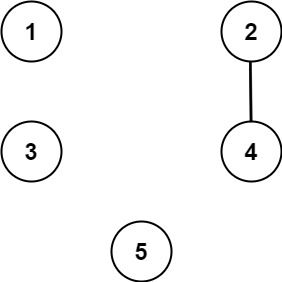
Input: n = 5, threshold = 1, queries = [[4,5],[4,5],[3,2],[2,3],[3,4]]
Output: [false,false,false,false,false]
Explanation: Only cities 2 and 4 share a common divisor 2 which is strictly greater than the threshold 1, so they are the only ones directly connected.
Please notice that there can be multiple queries for the same pair of nodes [x, y], and that the query [x, y] is equivalent to the query [y, x].
Constraints:
2 <= n <= 1040 <= threshold <= n1 <= queries.length <= 105queries[i].length == 21 <= ai, bi <= citiesai != bi
Approaches
3 approaches with complexity analysis and trade-offs.
This is the most naive approach. First, an explicit graph is constructed by checking every pair of cities for a direct connection. An adjacency list is used to store the graph. Then, for each query, a graph traversal algorithm like Breadth-First Search (BFS) or Depth-First Search (DFS) is run to check for a path between the two cities.
Algorithm
1. Create an adjacency listadjof sizen+1to represent the graph.2. For each integerifrom1ton:a. For each integerjfromi + 1ton:i. Iteratezfromthreshold + 1toi.ii. Ifi % z == 0andj % z == 0, an edge exists. Addjtoadj[i]anditoadj[j], then break the inner loop.3. Initialize an empty listanswerto store query results.4. For each query[a, b]inqueries:a. Perform a Breadth-First Search (BFS) or Depth-First Search (DFS) starting fromato check ifbis reachable.b. Addtruetoanswerif a path is found, otherwise addfalse.5. Return theanswerlist.
Walkthrough
This method separates the problem into two distinct phases: graph building and path finding.
Graph Building:
- Create an adjacency list,
adj, to represent the graph, whereadj[i]stores the neighbors of cityi. - Iterate through all pairs of cities
(i, j)with1 <= i < j <= n. - For each pair, check if they share a common divisor
z > threshold. This can be done by iteratingzfromthreshold + 1toi. - If such a
zis found, add an edge betweeniandjin the adjacency list (i.e., addjtoadj[i]anditoadj[j]).
Query Processing:
- For each query
[a, b], perform a traversal (e.g., BFS) starting from citya. - Use a
visitedarray to keep track of visited nodes during the traversal. - If city
bis reached during the traversal, the cities are connected. - If the traversal completes without reaching
b, they are not connected.
This approach is highly inefficient because it rebuilds the path-finding work for every single query.
import java.util.*; class Solution { public List<Boolean> areConnected(int n, int threshold, int[][] queries) { // 1. Graph Building List<List<Integer>> adj = new ArrayList<>(); for (int i = 0; i <= n; i++) { adj.add(new ArrayList<>()); } if (threshold == 0) { List<Boolean> allConnected = new ArrayList<>(); for (int i = 0; i < queries.length; i++) allConnected.add(true); return allConnected; } for (int i = 1; i <= n; i++) { for (int j = i + 1; j <= n; j++) { for (int z = threshold + 1; z <= i; z++) { if (i % z == 0 && j % z == 0) { adj.get(i).add(j); adj.get(j).add(i); break; } } } } // 2. Query Processing List<Boolean> result = new ArrayList<>(); for (int[] query : queries) { result.add(hasPath(query[0], query[1], n, adj)); } return result; } private boolean hasPath(int start, int end, int n, List<List<Integer>> adj) { if (start == end) return true; Queue<Integer> queue = new LinkedList<>(); boolean[] visited = new boolean[n + 1]; queue.offer(start); visited[start] = true; while (!queue.isEmpty()) { int curr = queue.poll(); if (curr == end) return true; for (int neighbor : adj.get(curr)) { if (!visited[neighbor]) { visited[neighbor] = true; queue.offer(neighbor); } } } return false; }}Complexity
Time
O(n^3 + Q * (n + E)), where `n` is the number of cities, `Q` is the number of queries, and `E` is the number of edges. In the worst case, `E` can be `O(n^2)`. The graph construction takes `O(n^3)` and each of the `Q` queries takes `O(n+E)`. This is prohibitively slow.
Space
O(n + E), where E is the number of edges. In the worst case, E can be O(n^2), so the space complexity is O(n^2).
Trade-offs
Pros
Very straightforward and easy to understand for those familiar with basic graph algorithms.
Cons
Extremely inefficient due to the O(n^3) graph construction time.
Query processing is also slow, as it repeats traversal work for each query.
The space complexity for the adjacency list can be large, up to O(n^2).
Guaranteed to result in Time Limit Exceeded for the given constraints.
Solutions
Solution
class UnionFind { private int [] p ; private int [] size ; public UnionFind ( int n ) { p = new int [ n ]; size = new int [ n ]; for ( int i = 0 ; i < n ; ++ i ) { p [ i ] = i ; size [ i ] = 1 ; } } public int find ( int x ) { if ( p [ x ] != x ) { p [ x ] = find ( p [ x ]); } return p [ x ]; } public boolean union ( int a , int b ) { int pa = find ( a ), pb = find ( b ); if ( pa == pb ) { return false ; } if ( size [ pa ] > size [ pb ]) { p [ pb ] = pa ; size [ pa ] += size [ pb ]; } else { p [ pa ] = pb ; size [ pb ] += size [ pa ]; } return true ; } } class Solution { public List < Boolean > areConnected ( int n , int threshold , int [][] queries ) { UnionFind uf = new UnionFind ( n + 1 ); for ( int a = threshold + 1 ; a <= n ; ++ a ) { for ( int b = a + a ; b <= n ; b += a ) { uf . union ( a , b ); } } List < Boolean > ans = new ArrayList <>(); for ( var q : queries ) { ans . add ( uf . find ( q [ 0 ]) == uf . find ( q [ 1 ])); } return ans ; } }Video walkthrough
Newsletter
One sharp idea, every week
System design and interview prep — short enough to finish.
No spam. Unsubscribe anytime.
Practice
Same difficulty — related problems to reinforce the pattern.