
Grid Illumination
HardPrompt
There is a 2D grid of size n x n where each cell of this grid has a lamp that is initially turned off.
You are given a 2D array of lamp positions lamps, where lamps[i] = [rowi, coli] indicates that the lamp at grid[rowi][coli] is turned on. Even if the same lamp is listed more than once, it is turned on.
When a lamp is turned on, it illuminates its cell and all other cells in the same row, column, or diagonal.
You are also given another 2D array queries, where queries[j] = [rowj, colj]. For the jth query, determine whether grid[rowj][colj] is illuminated or not. After answering the jth query, turn off the lamp at grid[rowj][colj] and its 8 adjacent lamps if they exist. A lamp is adjacent if its cell shares either a side or corner with grid[rowj][colj].
Return an array of integers ans, where ans[j] should be 1 if the cell in the jth query was illuminated, or 0 if the lamp was not.
Example 1:
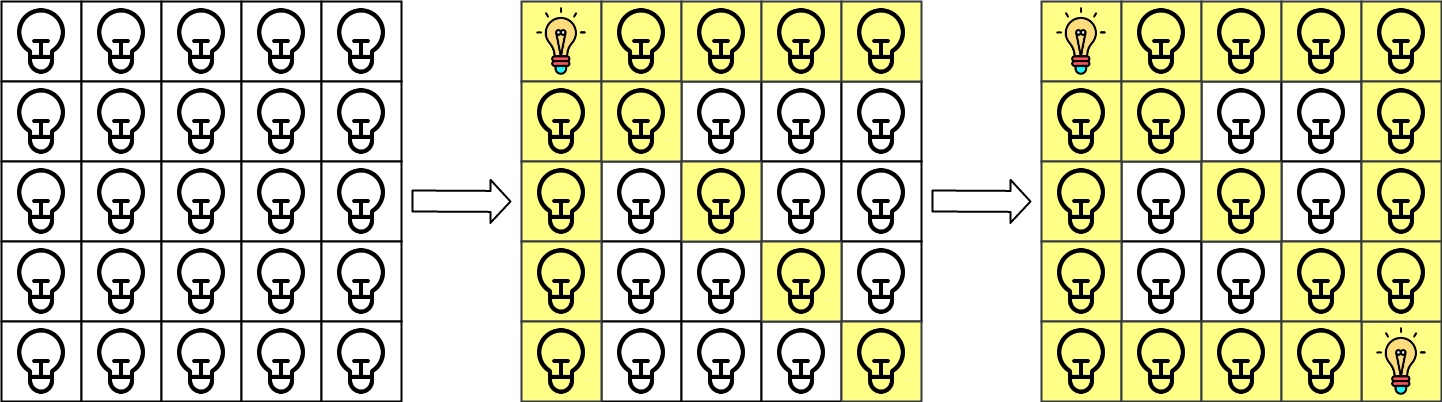
Input: n = 5, lamps = [[0,0],[4,4]], queries = [[1,1],[1,0]]
Output: [1,0]
Explanation: We have the initial grid with all lamps turned off. In the above picture we see the grid after turning on the lamp at grid[0][0] then turning on the lamp at grid[4][4].
The 0th query asks if the lamp at grid[1][1] is illuminated or not (the blue square). It is illuminated, so set ans[0] = 1. Then, we turn off all lamps in the red square.

The 1st query asks if the lamp at grid[1][0] is illuminated or not (the blue square). It is not illuminated, so set ans[1] = 0. Then, we turn off all lamps in the red rectangle.
Example 2:
Input: n = 5, lamps = [[0,0],[4,4]], queries = [[1,1],[1,1]]
Output: [1,1]
Example 3:
Input: n = 5, lamps = [[0,0],[0,4]], queries = [[0,4],[0,1],[1,4]]
Output: [1,1,0]
Constraints:
1 <= n <= 1090 <= lamps.length <= 200000 <= queries.length <= 20000lamps[i].length == 20 <= rowi, coli < nqueries[j].length == 20 <= rowj, colj < n
Approaches
2 approaches with complexity analysis and trade-offs.
This approach directly simulates the process described in the problem. It maintains a set of all currently active lamps. For each query, it checks for illumination by iterating through every single active lamp to see if it lights up the query cell. After the check, it finds and removes any lamps in the 3x3 vicinity of the query cell.
Algorithm
- Create a
HashSet<Long>calledlampSetto store active lamp coordinates, encoded as a singlelongvalue (e.g.,(long)r * n + c) for uniqueness and efficiency. - Populate
lampSetby iterating through the inputlampsarray. - For each query
(r, c)in thequeriesarray:- Initialize a flag
isIlluminatedtofalse. - Iterate through every single lamp coordinate stored in
lampSet. - For each lamp at
(lr, lc), check if it illuminates the query cell(r, c). A lamp illuminates the cell iflr == r(same row),lc == c(same column),lr - lc == r - c(same main diagonal), orlr + lc == r + c(same anti-diagonal). - If an illuminating lamp is found, set
isIlluminatedtotrueand break the inner loop. - Record the result (1 for
true, 0 forfalse). - After checking illumination, iterate through the 3x3 grid of cells centered at
(r, c). For each neighbor cell(nr, nc)(including the center), check if its encoded coordinate exists inlampSet. If it does, remove it to simulate turning the lamp off.
- Initialize a flag
- Return the array of collected results.
Walkthrough
In this brute-force method, we use a HashSet to keep track of the coordinates of all lamps that are currently on. To efficiently store and look up 2D coordinates (r, c) in the set, we encode them into a single long value. A common way to do this is by using the formula key = (long)r * n + c, where n is the grid size. This guarantees a unique key for each cell.
First, we initialize the simulation by populating the HashSet with all the lamps from the input lamps array.
Then, for each query (qr, qc), we perform two main steps:
- Illumination Check: We determine if the cell
(qr, qc)is illuminated. This is done by iterating through every lamp currently in ourHashSet. For each active lamp(lr, lc), we check if it shares a row, column, or diagonal with the query cell. If we find even one such lamp, we know the cell is illuminated, record a1as the answer for this query, and we can stop searching. - Turn Off Lamps: After answering the query, we must turn off lamps. We examine the 3x3 square of cells centered at the query location
(qr, qc). For each of these nine cells, we check if it corresponds to an active lamp by looking up its encoded coordinate in ourHashSet. If a lamp exists at that location, we remove it from the set.
This process is repeated for all queries, and the collected answers are returned.
import java.util.HashSet;import java.util.Set; class Solution { public int[] gridIllumination(int n, int[][] lamps, int[][] queries) { Set<Long> lampSet = new HashSet<>(); for (int[] lamp : lamps) { long r = lamp[0]; long c = lamp[1]; // The key must be large enough to avoid collisions. // (long)r * n + c works since r, c < n. lampSet.add(r * n + c); } int[] ans = new int[queries.length]; int[][] dirs = {{0,0}, {0,1}, {0,-1}, {1,0}, {-1,0}, {1,1}, {1,-1}, {-1,1}, {-1,-1}}; for (int i = 0; i < queries.length; i++) { int r = queries[i][0]; int c = queries[i][1]; boolean isIlluminated = false; // Check illumination by iterating through all lamps for (long lampCode : lampSet) { long lr = lampCode / n; long lc = lampCode % n; if (lr == r || lc == c || lr - lc == (long)r - c || lr + lc == (long)r + c) { isIlluminated = true; break; } } ans[i] = isIlluminated ? 1 : 0; // Turn off lamps in the 3x3 vicinity for (int[] dir : dirs) { long nr = r + dir[0]; long nc = c + dir[1]; if (nr >= 0 && nr < n && nc >= 0 && nc < n) { lampSet.remove(nr * n + nc); } } } return ans; }}Complexity
Time
O(L + Q * L), where L is the number of lamps and Q is the number of queries. Initialization takes O(L). Each of the Q queries requires iterating through up to L lamps for the illumination check, leading to a total time of O(Q * L).
Space
O(L), where L is the number of lamps. The space is used to store the coordinates of the active lamps in a `HashSet`.
Trade-offs
Pros
Simple to understand and implement as it directly models the problem statement.
Uses a reasonable amount of space, proportional only to the number of lamps.
Cons
The time complexity is very high due to the nested loop structure (iterating through all lamps for each query), making it too slow for the given constraints.
It will likely result in a 'Time Limit Exceeded' error on platforms like LeetCode.
This approach avoids the costly iteration over all lamps for each query. Instead of checking lamps one by one, we pre-process the lamp locations to count how many lamps illuminate each row, column, and diagonal. This allows for an O(1) illumination check. We use four hash maps to maintain these counts, along with a hash set to track the exact lamp locations.
Algorithm
- Initialize four
HashMaps:rowCounts,colCounts,diag1Counts, anddiag2Countsto store the number of lamps on each line. - Initialize a
HashSet<Long>calledlampSetto store the coordinates of unique, active lamps. - Iterate through the input
lampsarray. For each unique lamp(r, c):- Add its encoded coordinate
(long)r * n + ctolampSet. - Increment the count for row
rinrowCounts. - Increment the count for column
cincolCounts. - Increment the count for the main diagonal
r-cindiag1Counts. - Increment the count for the anti-diagonal
r+cindiag2Counts.
- Add its encoded coordinate
- For each query
(r, c):- Check if the cell is illuminated by checking if the count for its corresponding row, column, or either diagonal in the maps is greater than 0. If any count is positive, the cell is illuminated.
- Store the result (1 or 0).
- Iterate through the 3x3 grid around
(r, c). If a cell(nr, nc)contains an active lamp (checklampSet), remove it from the set and decrement the counts in all fourHashMaps for that lamp's position.
Walkthrough
The key insight for an efficient solution is that a cell (r, c) is illuminated if and only if there's at least one active lamp on its row r, its column c, its main diagonal (where all cells have the same r-c value), or its anti-diagonal (where all cells have the same r+c value).
This allows us to abstract away from individual lamps and instead focus on which lines are illuminated. We use four HashMap<Integer, Integer>s to maintain these counts:
rowCounts: Maps a row index to the number of lamps in that row.colCounts: Maps a column index to the number of lamps in that column.diag1Counts: Maps a main diagonal identifier (r-c) to the number of lamps on it.diag2Counts: Maps an anti-diagonal identifier (r+c) to the number of lamps on it.
We also still need a HashSet<Long> to keep track of the exact locations of active lamps, which is necessary for turning them off correctly.
Initialization: We iterate through the lamps array. For each unique lamp at (r, c), we add its encoded coordinate to the HashSet and increment the counts in all four HashMaps.
Query Processing: For each query (r, c):
- Illumination Check: We simply check if
rowCounts.get(r) > 0orcolCounts.get(c) > 0ordiag1Counts.get(r-c) > 0ordiag2Counts.get(r+c) > 0. This is anO(1)operation on average. - Turn Off Lamps: We iterate through the 9 cells in the 3x3 square centered at
(r, c). For each cell(nr, nc)in this square, we check if it's an active lamp using ourHashSet. If it is, we "turn it off" by removing it from theHashSetand decrementing the corresponding counts in all fourHashMaps.
This approach dramatically improves the time complexity by making the illumination check, the most frequent operation, extremely fast.
import java.util.HashMap;import java.util.HashSet;import java.util.Map;import java.util.Set; class Solution { public int[] gridIllumination(int n, int[][] lamps, int[][] queries) { Map<Integer, Integer> rowCounts = new HashMap<>(); Map<Integer, Integer> colCounts = new HashMap<>(); Map<Integer, Integer> diag1Counts = new HashMap<>(); // r - c Map<Integer, Integer> diag2Counts = new HashMap<>(); // r + c Set<Long> lampSet = new HashSet<>(); for (int[] lamp : lamps) { int r = lamp[0]; int c = lamp[1]; long lampCode = (long)r * n + c; if (lampSet.contains(lampCode)) { continue; // Skip duplicate lamps } lampSet.add(lampCode); rowCounts.put(r, rowCounts.getOrDefault(r, 0) + 1); colCounts.put(c, colCounts.getOrDefault(c, 0) + 1); diag1Counts.put(r - c, diag1Counts.getOrDefault(r - c, 0) + 1); diag2Counts.put(r + c, diag2Counts.getOrDefault(r + c, 0) + 1); } int[] ans = new int[queries.length]; int[][] dirs = {{0,0}, {0,1}, {0,-1}, {1,0}, {-1,0}, {1,1}, {1,-1}, {-1,1}, {-1,-1}}; for (int i = 0; i < queries.length; i++) { int r = queries[i][0]; int c = queries[i][1]; // Check illumination if (rowCounts.getOrDefault(r, 0) > 0 || colCounts.getOrDefault(c, 0) > 0 || diag1Counts.getOrDefault(r - c, 0) > 0 || diag2Counts.getOrDefault(r + c, 0) > 0) { ans[i] = 1; } else { ans[i] = 0; } // Turn off lamps for (int[] dir : dirs) { int nr = r + dir[0]; int nc = c + dir[1]; long lampCode = (long)nr * n + nc; if (nr >= 0 && nr < n && nc >= 0 && nc < n && lampSet.contains(lampCode)) { lampSet.remove(lampCode); rowCounts.put(nr, rowCounts.get(nr) - 1); colCounts.put(nc, colCounts.get(nc) - 1); diag1Counts.put(nr - nc, diag1Counts.get(nr - nc) - 1); diag2Counts.put(nr + c, diag2Counts.get(nr + c) - 1); } } } return ans; }}Complexity
Time
O(L + Q), where L is the number of lamps and Q is the number of queries. Initialization takes O(L) to process all lamps. Each of the Q queries takes O(1) average time, as it involves a constant number of hash map/set operations (one check for illumination and 9 checks/updates for turning off lamps).
Space
O(L), where L is the number of unique lamps. The `HashSet` and the four `HashMap`s will each store at most L entries. In total, the space is proportional to L.
Trade-offs
Pros
Highly efficient, with an average time complexity that is linear in the number of lamps and queries.
Scales well for the given constraints, easily passing large test cases.
The core logic for checking illumination is an elegant O(1) operation.
Cons
Uses more memory than the brute-force approach due to the four hash maps in addition to the lamp set.
The implementation is slightly more complex due to the need to manage counts across multiple data structures.
Solutions
Solution
class Solution { private int n ; public int [] gridIllumination ( int n , int [][] lamps , int [][] queries ) { this . n = n ; Set < Long > s = new HashSet <>(); Map < Integer , Integer > row = new HashMap <>(); Map < Integer , Integer > col = new HashMap <>(); Map < Integer , Integer > diag1 = new HashMap <>(); Map < Integer , Integer > diag2 = new HashMap <>(); for ( var lamp : lamps ) { int i = lamp [ 0 ], j = lamp [ 1 ]; if ( s . add ( f ( i , j ))) { merge ( row , i , 1 ); merge ( col , j , 1 ); merge ( diag1 , i - j , 1 ); merge ( diag2 , i + j , 1 ); } } int m = queries . length ; int [] ans = new int [ m ]; for ( int k = 0 ; k < m ; ++ k ) { int i = queries [ k ][ 0 ], j = queries [ k ][ 1 ]; if ( exist ( row , i ) || exist ( col , j ) || exist ( diag1 , i - j ) || exist ( diag2 , i + j )) { ans [ k ] = 1 ; } for ( int x = i - 1 ; x <= i + 1 ; ++ x ) { for ( int y = j - 1 ; y <= j + 1 ; ++ y ) { if ( x < 0 || x >= n || y < 0 || y >= n || ! s . contains ( f ( x , y ))) { continue ; } s . remove ( f ( x , y )); merge ( row , x , - 1 ); merge ( col , y , - 1 ); merge ( diag1 , x - y , - 1 ); merge ( diag2 , x + y , - 1 ); } } } return ans ; } private void merge ( Map < Integer , Integer > cnt , int x , int d ) { if ( cnt . merge ( x , d , Integer: : sum ) == 0 ) { cnt . remove ( x ); } } private boolean exist ( Map < Integer , Integer > cnt , int x ) { return cnt . getOrDefault ( x , 0 ) > 0 ; } private long f ( long i , long j ) { return i * n + j ; } }class Solution { public: vector < int > gridIllumination ( int n , vector < vector < int >>& lamps , vector < vector < int >>& queries ) { auto f = [ & ]( int i , int j ) -> long long { return ( long long ) i * n + j ; }; unordered_set < long long > s ; unordered_map < int , int > row , col , diag1 , diag2 ; for ( auto & lamp : lamps ) { int i = lamp [ 0 ], j = lamp [ 1 ]; if ( ! s . count ( f ( i , j ))) { s . insert ( f ( i , j )); row [ i ] ++ ; col [ j ] ++ ; diag1 [ i - j ] ++ ; diag2 [ i + j ] ++ ; } } int m = queries . size (); vector < int > ans ( m ); for ( int k = 0 ; k < m ; ++ k ) { int i = queries [ k ][ 0 ], j = queries [ k ][ 1 ]; if ( row [ i ] > 0 || col [ j ] > 0 || diag1 [ i - j ] > 0 || diag2 [ i + j ] > 0 ) { ans [ k ] = 1 ; } for ( int x = i - 1 ; x <= i + 1 ; ++ x ) { for ( int y = j - 1 ; y <= j + 1 ; ++ y ) { if ( x < 0 || x >= n || y < 0 || y >= n || ! s . count ( f ( x , y ))) { continue ; } s . erase ( f ( x , y )); row [ x ] -- ; col [ y ] -- ; diag1 [ x - y ] -- ; diag2 [ x + y ] -- ; } } } return ans ; } };class Solution : def gridIllumination ( self , n : int , lamps : List [ List [ int ]], queries : List [ List [ int ]] ) -> List [ int ]: s = {( i , j ) for i , j in lamps } row , col , diag1 , diag2 = Counter (), Counter (), Counter (), Counter () for i , j in s : row [ i ] += 1 col [ j ] += 1 diag1 [ i - j ] += 1 diag2 [ i + j ] += 1 ans = [ 0 ] * len ( queries ) for k , ( i , j ) in enumerate ( queries ): if row [ i ] or col [ j ] or diag1 [ i - j ] or diag2 [ i + j ]: ans [ k ] = 1 for x in range ( i - 1 , i + 2 ): for y in range ( j - 1 , j + 2 ): if ( x , y ) in s : s . remove (( x , y )) row [ x ] -= 1 col [ y ] -= 1 diag1 [ x - y ] -= 1 diag2 [ x + y ] -= 1 return ansVideo walkthrough
Newsletter
One sharp idea, every week
System design and interview prep — short enough to finish.
No spam. Unsubscribe anytime.
Practice
Same difficulty — related problems to reinforce the pattern.