
Grid Teleportation Traversal
MedPrompt
You are given a 2D character grid matrix of size m x n, represented as an array of strings, where matrix[i][j] represents the cell at the intersection of the ith row and jth column. Each cell is one of the following:
'.'representing an empty cell.'#'representing an obstacle.- An uppercase letter (
'A'-'Z') representing a teleportation portal.
You start at the top-left cell (0, 0), and your goal is to reach the bottom-right cell (m - 1, n - 1). You can move from the current cell to any adjacent cell (up, down, left, right) as long as the destination cell is within the grid bounds and is not an obstacle.
If you step on a cell containing a portal letter and you haven't used that portal letter before, you may instantly teleport to any other cell in the grid with the same letter. This teleportation does not count as a move, but each portal letter can be used at most once during your journey.
Return the minimum number of moves required to reach the bottom-right cell. If it is not possible to reach the destination, return -1.
Example 1:
Input: matrix = ["A..",".A.","..."]
Output: 2
Explanation:
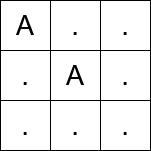
- Before the first move, teleport from
(0, 0)to(1, 1). - In the first move, move from
(1, 1)to(1, 2). - In the second move, move from
(1, 2)to(2, 2).
Example 2:
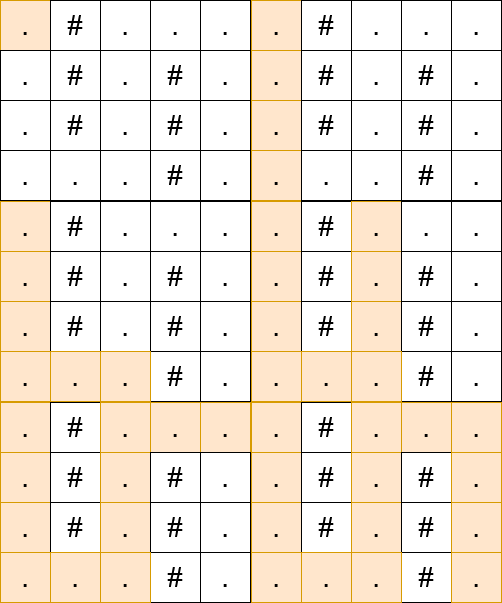
Input: matrix = [".#...",".#.#.",".#.#.","...#."]
Output: 13
Explanation:
Constraints:
1 <= m == matrix.length <= 1031 <= n == matrix[i].length <= 103matrix[i][j]is either'#','.', or an uppercase English letter.matrix[0][0]is not an obstacle.
Approaches
2 approaches with complexity analysis and trade-offs.
This approach models the problem as a shortest path search on a very large state graph. A state is defined not just by the current position (row, col) but also by the set of portals that have been used, represented by a bitmask. Since moves can have a cost of 1 (standard move) or 0 (teleportation), this is a classic 0-1 shortest path problem, which can be solved efficiently using a 0-1 Breadth-First Search (BFS) with a deque.
Algorithm
- The state of the search is defined by
(row, col, mask), where(row, col)is the current cell andmaskis a bitmask representing the set of portals used. - A distance array
dist[row][col][mask]is used to store the minimum moves to reach each state, initialized to infinity. - A double-ended queue (deque) is used to perform a 0-1 Breadth-First Search (BFS).
- The search starts by initializing
dist[0][0][0] = 0and adding the state(0, 0, 0)to the deque. - The algorithm iteratively processes states from the deque:
- When moving to an adjacent cell, the cost increases by 1, and the new state is added to the back of the deque.
- When teleporting, the cost is 0, the mask is updated, and the new state(s) are added to the front of the deque.
- The final answer is the minimum distance found in
dist[m-1][n-1][mask]across all possible masks.
Walkthrough
The core idea is to augment the standard grid BFS state (row, col) with a bitmask mask to keep track of used portals. The state (row, col, mask) represents being at cell (r, c) having used the portals indicated by mask.
We use a distance array dist[m][n][1 << K] (where K is the number of portal types, up to 26) to store the minimum moves to reach each state. The search proceeds as follows:
- Initialization: Pre-process the grid to map portal letters to indices and find their locations. Initialize
distwith infinity. Setdist[0][0][0] = 0and push(0, 0, 0)to a deque. A special check is needed if(0,0)is a portal to handle immediate teleportation. - 0-1 BFS Loop: While the deque is not empty, extract the state
(r, c, mask)with distancedfrom the front. - Regular Moves (Cost 1): For each valid neighbor
(nr, nc), ifd + 1 < dist[nr][nc][mask], update the distance and push(nr, nc, mask)to the back of the deque. - Teleportation (Cost 0): If
matrix[r][c]is an unused portalL(checked viamask), calculatenew_mask = mask | (1 << L). For every other cell(tr, tc)with portalL, ifd < dist[tr][tc][new_mask], update its distance and push(tr, tc, new_mask)to the front of the deque.
The final answer is min(dist[m-1][n-1][mask]) over all mask. While conceptually simple, this approach is not practical due to its massive state space.
Complexity
Time
O(m * n * 2^K). Each state is visited at most once. From each state, we explore a constant number of neighbors and potentially a set of teleport destinations.
Space
O(m * n * 2^K), where `m` and `n` are grid dimensions and `K` is the number of unique portal types. This is prohibitively large.
Trade-offs
Pros
Conceptually simple as it's a direct extension of BFS for shortest paths.
Guaranteed to find the optimal solution if it runs to completion.
Cons
Extremely high time and space complexity, making it infeasible for the given constraints.
The memory required for the
distarray (m * n * 2^K) would exceed typical limits forK > 15.Likely to result in Time Limit Exceeded (TLE) or Memory Limit Exceeded (MLE) on most platforms.
This highly efficient approach separates the problem into two distinct parts: grid traversal and combinatorial path selection. First, it precomputes all relevant shortest path distances within the grid using a series of Breadth-First Searches (BFS). These distances include start-to-cell, cell-to-end, and portal-to-cell. Second, it uses these precomputed costs to build a small, abstract graph where nodes are the start, end, and portal types. The final step is to find the shortest path in this new graph, respecting the 'use each portal once' constraint. This is a classic Traveling Salesperson Problem (TSP) variant on a small number of nodes, solvable with Dynamic Programming on subsets.
Algorithm
- Phase 1: Precomputation with BFS
- Identify all
Kportal types and their locations. - Run a BFS from
(0,0)to finddist_from_start[r][c]. - Run a BFS from
(m-1,n-1)to finddist_to_end[r][c]. - For each of the
Kportal types, run a multi-source BFS starting from all its cells to finddist_from_portal[i][r][c].
- Identify all
- Phase 2: Portal Graph Cost Calculation
- Use the precomputed distances to find the costs between
start,end, and all portal types. cost_start_p[i]: min cost fromstartto any cell of portali.cost_p_end[i]: min cost from any cell of portalitoend.cost_p_p[i][j]: min cost from any cell of portalito any cell of portalj.
- Use the precomputed distances to find the costs between
- Phase 3: DP on Subsets
- Solve the shortest simple path problem on the portal graph using Dijkstra's algorithm on an augmented state
(cost, mask, last_portal). - A DP table
dp[mask][i]stores the minimum cost to visit portals inmask, ending at portali.
- Solve the shortest simple path problem on the portal graph using Dijkstra's algorithm on an augmented state
- Phase 4: Final Answer
- The result is the minimum of the direct path (
dist_from_start[m-1][n-1]) and all paths going through portals (dp[mask][i] + cost_p_end[i]).
- The result is the minimum of the direct path (
Walkthrough
This method is a hybrid approach that tackles the geometric and combinatorial complexities separately, making it feasible for the given constraints.
Phase 1: Precomputation using BFS
We run K+2 separate BFS traversals on the grid to find all necessary distances:
dist_from_start: A single-source BFS from(0,0)to find the shortest moves to every other cell.dist_to_end: A single-source BFS from(m-1,n-1)to find the shortest moves from every cell to the destination.dist_from_portals: For each of theKportal types, we run a multi-source BFS. The queue is initialized with all cells of a given portal type at distance 0. This gives us the shortest distance from that portal type to every other cell in the grid.
Phase 2: Building the Portal Graph
With the distances from Phase 1, we can define the edge weights in an abstract graph of portals:
cost_start_p[i]: The cost to travel from(0,0)to the nearest cell of portali.cost_p_end[i]: The cost to travel from the nearest cell of portalito(m-1,n-1).cost_p_p[i][j]: The cost to travel from any cell of portalito the nearest cell of portalj.
Phase 3: DP on Subsets (via Dijkstra)
The problem reduces to finding a simple path (no repeated portal nodes) in this abstract graph. We use Dijkstra's algorithm on the state (cost, mask, last_portal):
dp[mask][last_portal]stores the minimum cost of a path fromstartthat visits the portals inmaskand ends atlast_portal.- The priority queue is initialized with paths from
startto each portali. - Dijkstra explores paths by adding one unvisited portal at a time, using the
cost_p_pmatrix for edge weights.
Phase 4: Calculating the Final Answer
The overall minimum moves is the minimum of two values:
- The direct path cost:
dist_from_start[m-1][n-1]. - The minimum cost over all portal paths:
min(dp[mask][i] + cost_p_end[i])for alliandmask.
import java.util.*; class Solution { private static final int INF = Integer.MAX_VALUE / 2; public int minimumMoves(String[] matrix) { int m = matrix.length; int n = matrix[0].length; Map<Character, List<int[]>> portalLocations = new HashMap<>(); for (int i = 0; i < m; i++) { for (int j = 0; j < n; j++) { char c = matrix[i].charAt(j); if (Character.isUpperCase(c)) { portalLocations.computeIfAbsent(c, k -> new ArrayList<>()).add(new int[]{i, j}); } } } List<Character> portalChars = new ArrayList<>(portalLocations.keySet()); int k = portalChars.size(); Map<Character, Integer> portalIndexMap = new HashMap<>(); for (int i = 0; i < k; i++) { portalIndexMap.put(portalChars.get(i), i); } int[][] distFromStart = bfs(new int[]{0, 0}, m, n, matrix); int[][] distToEnd = bfs(new int[]{m - 1, n - 1}, m, n, matrix); int[][] distFromPortals = new int[k][m * n]; for (int i = 0; i < k; i++) { char pChar = portalChars.get(i); List<int[]> sources = portalLocations.get(pChar); int[][] tempDist = bfs(sources.toArray(new int[0][]), m, n, matrix); for (int r = 0; r < m; r++) { for (int c = 0; c < n; c++) { distFromPortals[i][r * n + c] = tempDist[r][c]; } } } int[] costStartToPortal = new int[k]; Arrays.fill(costStartToPortal, INF); for (int i = 0; i < k; i++) { for (int[] pos : portalLocations.get(portalChars.get(i))) { costStartToPortal[i] = Math.min(costStartToPortal[i], distFromStart[pos[0]][pos[1]]); } } int[] costPortalToEnd = new int[k]; Arrays.fill(costPortalToEnd, INF); for (int i = 0; i < k; i++) { for (int[] pos : portalLocations.get(portalChars.get(i))) { costPortalToEnd[i] = Math.min(costPortalToEnd[i], distToEnd[pos[0]][pos[1]]); } } int[][] costPortalToPortal = new int[k][k]; for (int i = 0; i < k; i++) { for (int j = 0; j < k; j++) { if (i == j) continue; int minCost = INF; for (int[] pos : portalLocations.get(portalChars.get(j))) { minCost = Math.min(minCost, distFromPortals[i][pos[0] * n + pos[1]]); } costPortalToPortal[i][j] = minCost; } } int[][] dp = new int[1 << k][k]; for (int[] row : dp) Arrays.fill(row, INF); PriorityQueue<int[]> pq = new PriorityQueue<>(Comparator.comparingInt(a -> a[0])); for (int i = 0; i < k; i++) { if (costStartToPortal[i] != INF) { dp[1 << i][i] = costStartToPortal[i]; pq.offer(new int[]{dp[1 << i][i], 1 << i, i}); } } while (!pq.isEmpty()) { int[] curr = pq.poll(); int cost = curr[0]; int mask = curr[1]; int u = curr[2]; if (cost > dp[mask][u]) continue; for (int v = 0; v < k; v++) { if ((mask & (1 << v)) == 0) { // if v is not visited int newCost = cost + costPortalToPortal[u][v]; if (newCost < dp[mask | (1 << v)][v]) { dp[mask | (1 << v)][v] = newCost; pq.offer(new int[]{newCost, mask | (1 << v), v}); } } } } int minMoves = distFromStart[m - 1][n - 1]; for (int mask = 0; mask < (1 << k); mask++) { for (int i = 0; i < k; i++) { if (dp[mask][i] != INF && costPortalToEnd[i] != INF) { minMoves = Math.min(minMoves, dp[mask][i] + costPortalToEnd[i]); } } } return minMoves == INF ? -1 : minMoves; } private int[][] bfs(int[][] sources, int m, int n, String[] matrix) { int[][] dist = new int[m][n]; for (int[] row : dist) Arrays.fill(row, INF); Queue<int[]> q = new LinkedList<>(); for (int[] src : sources) { dist[src[0]][src[1]] = 0; q.offer(src); } int[] dr = {-1, 1, 0, 0}; int[] dc = {0, 0, -1, 1}; while (!q.isEmpty()) { int[] curr = q.poll(); int r = curr[0], c = curr[1]; for (int i = 0; i < 4; i++) { int nr = r + dr[i]; int nc = c + dc[i]; if (nr >= 0 && nr < m && nc >= 0 && nc < n && matrix[nr].charAt(nc) != '#' && dist[nr][nc] == INF) { dist[nr][nc] = dist[r][c] + 1; q.offer(new int[]{nr, nc}); } } } return dist; } private int[][] bfs(int[] source, int m, int n, String[] matrix) { return bfs(new int[][]{source}, m, n, matrix); }}Complexity
Time
O(K * m * n + 2^K * K^2). `O(K*m*n)` for the BFS precomputation phase, and `O(2^K * K^2)` for the Dijkstra's algorithm on the portal states.
Space
O(K * m * n + 2^K * K). The `O(K*m*n)` term dominates for storing precomputed distances, and `O(2^K*K)` for the DP table.
Trade-offs
Pros
Highly efficient and tailored for the problem's constraints.
Handles cases with large grids but few portals, and cases with many portals but small grids effectively.
Guaranteed to find the optimal solution.
Cons
Significantly more complex to implement compared to a simple BFS.
The precomputation phase can be time and memory-intensive if both
Kand the grid size are large (O(K*m*n)space).
Solutions
Solution
class Solution {public int minMoves(String[] matrix) { int m = matrix.length, n = matrix[0].length(); Map<Character, List<int[]>> g = new HashMap<>(); for (int i = 0; i < m; i++) { String row = matrix[i]; for (int j = 0; j < n; j++) { char c = row.charAt(j); if (Character.isAlphabetic(c)) { g.computeIfAbsent(c, k->new ArrayList<>()).add(new int[]{i, j}); } } } int[] dirs = {-1, 0, 1, 0, -1}; int INF = Integer.MAX_VALUE / 2; int[][] dist = new int[m][n]; for (int[] arr : dist) Arrays.fill(arr, INF); dist[0][0] = 0; Deque<int[]> q = new ArrayDeque<>(); q.add(new int[]{0, 0}); while (!q.isEmpty()) { int[] cur = q.pollFirst(); int i = cur[0], j = cur[1]; int d = dist[i][j]; if (i == m - 1 && j == n - 1) return d; char c = matrix[i].charAt(j); if (g.containsKey(c)) { for (int[] pos : g.get(c)) { int x = pos[0], y = pos[1]; if (d < dist[x][y]) { dist[x][y] = d; q.addFirst(new int[]{x, y}); } } g.remove(c); } for (int idx = 0; idx < 4; idx++) { int a = dirs[idx], b = dirs[idx + 1]; int x = i + a, y = j + b; if (0 <= x && x < m && 0 <= y && y < n && matrix[x].charAt(y) != '#' && d + 1 < dist[x][y]) { dist[x][y] = d + 1; q.addLast(new int[]{x, y}); } } } return -1; }}class Solution {public: int minMoves(vector<string> &matrix) { int m = matrix.size(), n = matrix[0].size(); unordered_map<char, vector<pair<int, int>>> g; for (int i = 0; i < m; ++i) for (int j = 0; j < n; ++j) { char c = matrix[i][j]; if (isalpha(c)) g[c].push_back({i, j}); } int dirs[5] = {-1, 0, 1, 0, -1}; int INF = numeric_limits<int>::max() / 2; vector<vector<int>> dist(m, vector<int>(n, INF)); dist[0][0] = 0; deque<pair<int, int>> q; q.push_back({0, 0}); while (!q.empty()) { auto [i, j] = q.front(); q.pop_front(); int d = dist[i][j]; if (i == m - 1 && j == n - 1) return d; char c = matrix[i][j]; if (g.count(c)) { for (auto [x, y] : g[c]) if (d < dist[x][y]) { dist[x][y] = d; q.push_front({x, y}); } g.erase(c); } for (int idx = 0; idx < 4; ++idx) { int x = i + dirs[idx], y = j + dirs[idx + 1]; if (0 <= x && x < m && 0 <= y && y < n && matrix[x][y] != '#' && d + 1 < dist[x][y]) { dist[x][y] = d + 1; q.push_back({x, y}); } } } return -1; }};class Solution: def minMoves(self, matrix: List[str]) -> int: m, n = len(matrix), len(matrix[0]) g = defaultdict(list) for i, row in enumerate(matrix): for j, c in enumerate(row): if c . isalpha(): g[c]. append((i, j)) dirs = (- 1, 0, 1, 0, - 1) dist = [[inf] * n for _ in range(m)] dist[0][0] = 0 q = deque([(0, 0)]) while q: i, j = q . popleft() d = dist[i][j] if i == m - 1 and j == n - 1: return d c = matrix[i][j] if c in g: for x, y in g[c]: if d < dist[x][y]: dist[x][y] = d q . appendleft((x, y)) del g[c] for a, b in pairwise(dirs): x, y = i + a, j + b if (0 <= x < m and 0 <= y < n and matrix[x][y] != "#" and d + 1 < dist[x][y]): dist[x][y] = d + 1 q . append((x, y)) return - 1Video walkthrough
Newsletter
One sharp idea, every week
System design and interview prep — short enough to finish.
No spam. Unsubscribe anytime.
Practice
Same difficulty — related problems to reinforce the pattern.