
Insert Greatest Common Divisors in Linked List
MedPrompt
Given the head of a linked list head, in which each node contains an integer value.
Between every pair of adjacent nodes, insert a new node with a value equal to the greatest common divisor of them.
Return the linked list after insertion.
The greatest common divisor of two numbers is the largest positive integer that evenly divides both numbers.
Example 1:
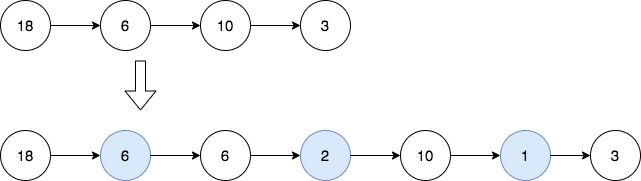
Input: head = [18,6,10,3]
Output: [18,6,6,2,10,1,3]
Explanation: The 1st diagram denotes the initial linked list and the 2nd diagram denotes the linked list after inserting the new nodes (nodes in blue are the inserted nodes).
- We insert the greatest common divisor of 18 and 6 = 6 between the 1st and the 2nd nodes.
- We insert the greatest common divisor of 6 and 10 = 2 between the 2nd and the 3rd nodes.
- We insert the greatest common divisor of 10 and 3 = 1 between the 3rd and the 4th nodes.
There are no more adjacent nodes, so we return the linked list.
Example 2:

Input: head = [7]
Output: [7]
Explanation: The 1st diagram denotes the initial linked list and the 2nd diagram denotes the linked list after inserting the new nodes.
There are no pairs of adjacent nodes, so we return the initial linked list.
Constraints:
- The number of nodes in the list is in the range
[1, 5000]. 1 <= Node.val <= 1000
Approaches
2 approaches with complexity analysis and trade-offs.
A more optimal approach in terms of space complexity is to modify the list in-place. We traverse the list, and for each adjacent pair of nodes, we create the new GCD node and insert it between them by rearranging the next pointers.
Algorithm
- Initialize a pointer
current = head. - If the list is empty or has only one node, no insertions are needed, so return
head. - Iterate through the list with the condition
while (current.next != null):- a. Store the reference to the next node:
nextNode = current.next. - b. Calculate the GCD of
current.valandnextNode.val. - c. Create a new
ListNodewith the GCD value. - d. Rewire the pointers to insert the new node:
current.next = newNodeandnewNode.next = nextNode. - e. Move
currentto the next node of the original list to process the next pair:current = nextNode.
- a. Store the reference to the next node:
- Return the original
head, which now points to the modified list.
Walkthrough
We traverse the list with a pointer, let's call it current, starting at the head. The loop continues as long as current.next is not null, ensuring we can always form a pair (current, current.next). In each iteration, we first get a handle on the node after current, let's call it nextNode. Then, we compute the GCD of current.val and nextNode.val. A new node is created with this GCD value. This new node is inserted between current and nextNode by setting current.next to the new node, and the new node's next to nextNode. Finally, to proceed to the next pair of original nodes, we advance current to nextNode. The process repeats until the end of the list is reached.
/** * Definition for singly-linked list. * public class ListNode { * int val; * ListNode next; * ListNode() {} * ListNode(int val) { this.val = val; } * ListNode(int val, ListNode next) { this.val = val; this.next = next; } * } */class Solution { public ListNode insertGreatestCommonDivisors(ListNode head) { if (head == null || head.next == null) { return head; } ListNode current = head; while (current.next != null) { ListNode nextNode = current.next; // Calculate GCD int gcdVal = gcd(current.val, nextNode.val); // Create and insert the new node ListNode newNode = new ListNode(gcdVal); newNode.next = nextNode; current.next = newNode; // Move to the next original node current = nextNode; } return head; } // Helper function to calculate GCD using Euclidean algorithm private int gcd(int a, int b) { while (b != 0) { int temp = b; b = a % b; a = temp; } return a; }}Complexity
Time
O(N * log(K)), where N is the number of nodes in the original list and K is the maximum value in a node. We traverse the original list once, and each step involves a GCD calculation.
Space
O(1). We modify the list in-place. The space for the new nodes is part of the output structure and is not considered extra auxiliary space. The only extra space is for a few pointers and variables, which is constant.
Trade-offs
Pros
Extremely space-efficient, using only O(1) auxiliary space.
Avoids the overhead of allocating an entire new list.
Cons
Modifies the input list, which might be a side effect to avoid in some applications.
Solutions
Solution
/** * Definition for singly-linked list. * public class ListNode { * int val; * ListNode next; * ListNode() {} * ListNode(int val) { this.val = val; } * ListNode(int val, ListNode next) { this.val = val; this.next = next; } * } */ class Solution { public ListNode insertGreatestCommonDivisors ( ListNode head ) { for ( ListNode pre = head , cur = head . next ; cur != null ; cur = cur . next ) { int x = gcd ( pre . val , cur . val ); pre . next = new ListNode ( x , cur ); pre = cur ; } return head ; } private int gcd ( int a , int b ) { if ( b == 0 ) { return a ; } return gcd ( b , a % b ); } }Video walkthrough
Newsletter
One sharp idea, every week
System design and interview prep — short enough to finish.
No spam. Unsubscribe anytime.
Practice
Same difficulty — related problems to reinforce the pattern.