
Insertion Sort List
MedPrompt
Given the head of a singly linked list, sort the list using insertion sort, and return the sorted list's head.
The steps of the insertion sort algorithm:
- Insertion sort iterates, consuming one input element each repetition and growing a sorted output list.
- At each iteration, insertion sort removes one element from the input data, finds the location it belongs within the sorted list and inserts it there.
- It repeats until no input elements remain.
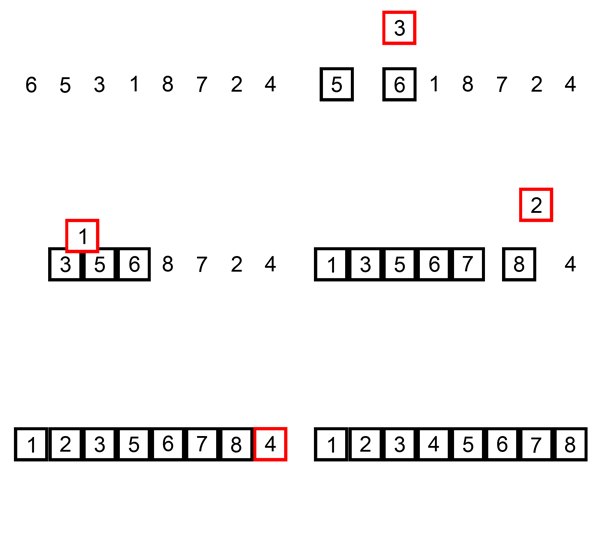
The following is a graphical example of the insertion sort algorithm. The partially sorted list (black) initially contains only the first element in the list. One element (red) is removed from the input data and inserted in-place into the sorted list with each iteration.
Example 1:
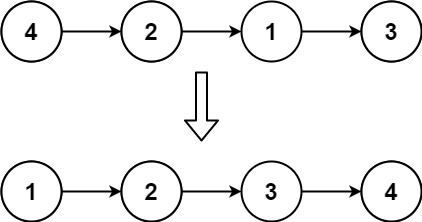
Input: head = [4,2,1,3]
Output: [1,2,3,4]
Example 2:
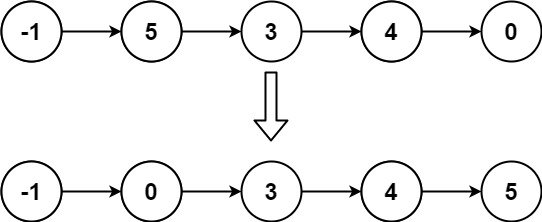
Input: head = [-1,5,3,4,0]
Output: [-1,0,3,4,5]
Constraints:
- The number of nodes in the list is in the range
[1, 5000]. -5000 <= Node.val <= 5000
Approaches
2 approaches with complexity analysis and trade-offs.
This approach directly translates the insertion sort algorithm to a linked list. It builds a new sorted list by taking one node at a time from the original list and inserting it into its correct position in the new list. A dummy head is used to simplify the insertion logic, especially for inserting at the beginning of the sorted list.
Algorithm
- Create a
dummynode to serve as the head of the sorted list. - Initialize
current = headto iterate through the input list. - Loop while
currentis not null:- Store the next node:
nextNode = current.next. - Find the insertion point in the sorted list. Start a pointer
prev = dummy. - Traverse the sorted list:
while (prev.next != null && prev.next.val < current.val) { prev = prev.next; }. - Insert
currentafterprev:current.next = prev.next; prev.next = current;. - Move to the next node in the original list:
current = nextNode;.
- Store the next node:
- Return
dummy.next.
Walkthrough
We initialize a dummy node that will act as a sentinel head for our new sorted list. This helps in handling insertions at the very beginning without special case logic.
We iterate through the original linked list using a current pointer, starting from the head. In each iteration, we "pick" the current node and find where it belongs in the sorted list (which is being built starting from dummy).
To find the insertion point, we use another pointer, prev, starting from dummy and traversing the sorted portion until we find the correct spot (prev.next == null or prev.next.val >= current.val). Once the position is found, we insert the current node after prev.
We must save the next node from the original list before we modify current.next for the insertion. This process is repeated until all nodes from the original list have been moved to the sorted list. Finally, we return dummy.next, which is the head of the fully sorted list.
/** * Definition for singly-linked list. * public class ListNode { * int val; * ListNode next; * ListNode() {} * ListNode(int val) { this.val = val; } * ListNode(int val, ListNode next) { this.val = val; this.next = next; } * } */class Solution { public ListNode insertionSortList(ListNode head) { if (head == null || head.next == null) { return head; } ListNode dummy = new ListNode(0); // Dummy head for the sorted list ListNode current = head; // Pointer to iterate through the original list while (current != null) { // Store the next node to process from the original list ListNode nextNode = current.next; // Find the correct position to insert 'current' in the sorted list // We always start searching from the beginning of the sorted list ListNode prev = dummy; while (prev.next != null && prev.next.val < current.val) { prev = prev.next; } // Insert 'current' between 'prev' and 'prev.next' current.next = prev.next; prev.next = current; // Move to the next node in the original list current = nextNode; } return dummy.next; }}Complexity
Time
O(N^2)
Space
O(1)
Trade-offs
Pros
Simple to understand and implement.
Space-efficient as it only uses a constant amount of extra space.
Cons
Inefficient time complexity (O(N^2)), making it slow for large lists.
Performs poorly even on nearly sorted lists because it always scans the sorted part from the beginning.
Solutions
Solution
/** * Definition for singly-linked list. * public class ListNode { * int val; * ListNode next; * ListNode() {} * ListNode(int val) { this.val = val; } * ListNode(int val, ListNode next) { this.val = val; this.next = next; } * } */ class Solution { public ListNode insertionSortList ( ListNode head ) { if ( head == null || head . next == null ) { return head ; } ListNode dummy = new ListNode ( head . val , head ); ListNode pre = dummy , cur = head ; while ( cur != null ) { if ( pre . val <= cur . val ) { pre = cur ; cur = cur . next ; continue ; } ListNode p = dummy ; while ( p . next . val <= cur . val ) { p = p . next ; } ListNode t = cur . next ; cur . next = p . next ; p . next = cur ; pre . next = t ; cur = t ; } return dummy . next ; } }Video walkthrough
Newsletter
One sharp idea, every week
System design and interview prep — short enough to finish.
No spam. Unsubscribe anytime.
Practice
Same difficulty — related problems to reinforce the pattern.