
Insufficient Nodes in Root to Leaf Paths
MedPrompt
Given the root of a binary tree and an integer limit, delete all insufficient nodes in the tree simultaneously, and return the root of the resulting binary tree.
A node is insufficient if every root to leaf path intersecting this node has a sum strictly less than limit.
A leaf is a node with no children.
Example 1:
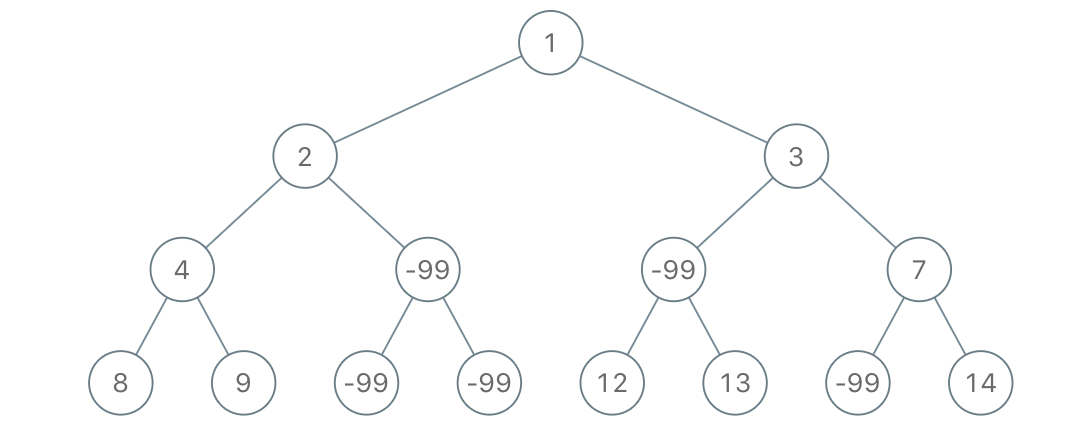
Input: root = [1,2,3,4,-99,-99,7,8,9,-99,-99,12,13,-99,14], limit = 1
Output: [1,2,3,4,null,null,7,8,9,null,14]
Example 2:
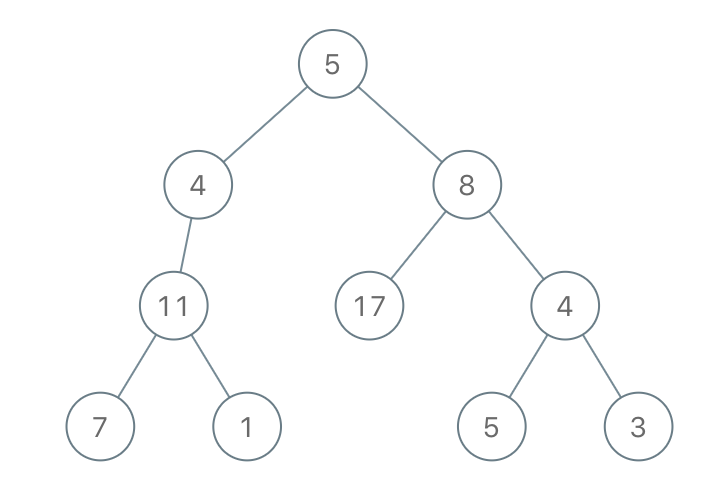
Input: root = [5,4,8,11,null,17,4,7,1,null,null,5,3], limit = 22
Output: [5,4,8,11,null,17,4,7,null,null,null,5]
Example 3:
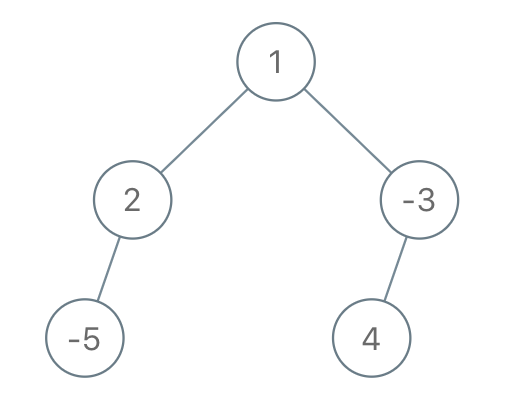
Input: root = [1,2,-3,-5,null,4,null], limit = -1
Output: [1,null,-3,4]
Constraints:
- The number of nodes in the tree is in the range
[1, 5000]. -105 <= Node.val <= 105-109 <= limit <= 109
Approaches
2 approaches with complexity analysis and trade-offs.
This approach uses two separate traversals of the binary tree. The first pass is to identify and mark every node that lies on at least one 'sufficient' root-to-leaf path (a path with sum >= limit). The second pass then uses this information to reconstruct the tree, pruning any node that was not marked as sufficient.
Algorithm
- Create a
Map<TreeNode, Boolean>to store whether a node is part of a sufficient path. - Pass 1: Mark Sufficient Nodes
- Implement a recursive DFS function
isNodeSufficient(node, currentSum). - This function traverses the tree in a post-order fashion.
- For a leaf node, it checks if the path sum
currentSum + node.valis>= limit. It stores this boolean result in the map and returns it. - For an internal node, it recursively calls itself for its left and right children.
- A node is considered sufficient if either its left or right subtree contains a sufficient path (
leftSufficient || rightSufficient). This result is stored in the map and returned. - Initiate this pass by calling
isNodeSufficient(root, 0).
- Implement a recursive DFS function
- Pass 2: Rebuild the Tree
- Implement a second recursive function
rebuild(node). - This function traverses the tree and constructs the final version.
- For each
node, it checks the map. If the map indicates the node is insufficient (sufficientMap.get(node)is false), it returnsnull, effectively pruning this node and its entire subtree. - If the node is sufficient, it recursively calls
rebuildfor its children:node.left = rebuild(node.left)andnode.right = rebuild(node.right). - The final result is the tree returned by
rebuild(root).
- Implement a second recursive function
Walkthrough
In this method, we first need to determine for every single node whether it's part of a sufficient path. A node is sufficient if at least one root-to-leaf path passing through it has a sum greater than or equal to limit. We can use a post-order traversal to compute this for all nodes and store the results in a hash map.
Once we have this information, we perform a second traversal (e.g., pre-order) to build the new tree. During this traversal, if we encounter a node that our map indicates is insufficient, we prune it by returning null to its parent. Otherwise, we keep the node and continue the process for its children.
import java.util.HashMap;import java.util.Map; class Solution { private Map<TreeNode, Boolean> sufficientMap = new HashMap<>(); private int limit; public TreeNode sufficientSubset(TreeNode root, int limit) { this.limit = limit; if (root == null) { return null; } // Pass 1: Populate the map with sufficiency information for each node. isNodeSufficient(root, 0); // Pass 2: Rebuild the tree by pruning insufficient nodes. return rebuild(root); } // Pass 1: Returns true if the subtree at 'node' contains a sufficient path. private boolean isNodeSufficient(TreeNode node, long sum) { if (node == null) { return false; } sum += node.val; if (node.left == null && node.right == null) { // Leaf node boolean sufficient = sum >= limit; sufficientMap.put(node, sufficient); return sufficient; } boolean leftSufficient = isNodeSufficient(node.left, sum); boolean rightSufficient = isNodeSufficient(node.right, sum); // A node is on a sufficient path if any of its descendant paths are sufficient. boolean isSufficient = leftSufficient || rightSufficient; sufficientMap.put(node, isSufficient); return isSufficient; } // Pass 2: Returns the modified tree node, or null if it should be pruned. private TreeNode rebuild(TreeNode node) { if (node == null) { return null; } // If a node is not on any sufficient path, prune it. if (!sufficientMap.getOrDefault(node, false)) { return null; } node.left = rebuild(node.left); node.right = rebuild(node.right); return node; }}Complexity
Time
O(N), where N is the number of nodes. The first pass visits each node once, and the second pass also visits each node once, leading to a total time complexity of O(N) + O(N) = O(N).
Space
O(N), where N is the number of nodes in the tree. This is because we use a hash map to store the sufficiency status for every node.
Trade-offs
Pros
The logic is separated into two distinct, clear steps: identification and modification, which can be easier to reason about.
Cons
Requires O(N) extra space for the hash map, making it less space-efficient than the single-pass approach.
Involves two separate traversals of the tree, which is less elegant and slightly more complex to implement.
Solutions
Solution
/** * Definition for a binary tree node. * public class TreeNode { * int val; * TreeNode left; * TreeNode right; * TreeNode() {} * TreeNode(int val) { this.val = val; } * TreeNode(int val, TreeNode left, TreeNode right) { * this.val = val; * this.left = left; * this.right = right; * } * } */ class Solution { public TreeNode sufficientSubset ( TreeNode root , int limit ) { if ( root == null ) { return null ; } limit -= root . val ; if ( root . left == null && root . right == null ) { return limit > 0 ? null : root ; } root . left = sufficientSubset ( root . left , limit ); root . right = sufficientSubset ( root . right , limit ); return root . left == null && root . right == null ? null : root ; } }Video walkthrough
Newsletter
One sharp idea, every week
System design and interview prep — short enough to finish.
No spam. Unsubscribe anytime.
Practice
Same difficulty — related problems to reinforce the pattern.