
Interleaving String
MedPrompt
Given strings s1, s2, and s3, find whether s3 is formed by an interleaving of s1 and s2.
An interleaving of two strings s and t is a configuration where s and t are divided into n and m substrings respectively, such that:
s = s1 + s2 + ... + snt = t1 + t2 + ... + tm|n - m| <= 1- The interleaving is
s1 + t1 + s2 + t2 + s3 + t3 + ...ort1 + s1 + t2 + s2 + t3 + s3 + ...
Note: a + b is the concatenation of strings a and b.
Example 1:
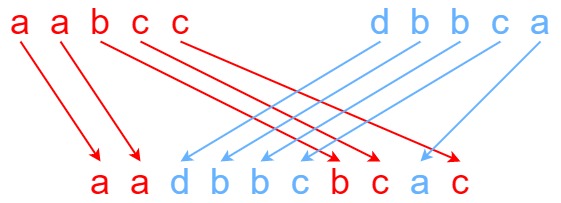
Input: s1 = "aabcc", s2 = "dbbca", s3 = "aadbbcbcac"
Output: true
Explanation: One way to obtain s3 is:
Split s1 into s1 = "aa" + "bc" + "c", and s2 into s2 = "dbbc" + "a".
Interleaving the two splits, we get "aa" + "dbbc" + "bc" + "a" + "c" = "aadbbcbcac".
Since s3 can be obtained by interleaving s1 and s2, we return true.
Example 2:
Input: s1 = "aabcc", s2 = "dbbca", s3 = "aadbbbaccc"
Output: false
Explanation: Notice how it is impossible to interleave s2 with any other string to obtain s3.
Example 3:
Input: s1 = "", s2 = "", s3 = ""
Output: true
Constraints:
0 <= s1.length, s2.length <= 1000 <= s3.length <= 200s1,s2, ands3consist of lowercase English letters.
Follow up: Could you solve it using only O(s2.length) additional memory space?
Approaches
4 approaches with complexity analysis and trade-offs.
This approach uses a simple recursive function to explore all possible ways of forming s3 by picking characters from s1 and s2. It directly models the decision process: at each character of s3, we decide whether to match it with the current character of s1 or s2. If a character in s3 matches both, we explore both possibilities recursively.
Algorithm
- The core idea is to use a recursive function, say
check(i, j), which determines if the rest ofs3(from indexi+j) can be formed by the rest ofs1(from indexi) and the rest ofs2(from indexj). - First, perform a preliminary check: if
s1.length() + s2.length() != s3.length(), it's impossible to forms3, so returnfalse. - Base Case: If we have successfully traversed all of
s1ands2(i.e.,i == s1.length()andj == s2.length()), it means we have successfully formeds3. Returntrue. - Recursive Step: At the current state
(i, j), we are trying to matchs3.charAt(i+j).- If
s1.charAt(i)matchess3.charAt(i+j), we make a recursive callcheck(i + 1, j). If this call returnstrue, we have found a valid interleaving. - If
s2.charAt(j)matchess3.charAt(i+j), we make a recursive callcheck(i, j + 1). If this call returnstrue, we have also found a valid interleaving. - The result for
check(i, j)istrueif either of the possible recursive calls returnstrue. - If neither character matches or if the subsequent recursive calls return
false, this path is invalid.
- If
Walkthrough
The method involves a helper function that takes two pointers, i for s1 and j for s2, indicating the number of characters already used from each string. The current character to be matched in s3 is at index k = i + j.
If the current character of s3 matches the character at s1[i], we recursively call the function with i+1. If it matches s2[j], we recursively call with j+1. If it matches both, we try both paths and return true if either path leads to a solution. The recursion stops when we have successfully used all characters from both s1 and s2.
public class Solution { public boolean isInterleave(String s1, String s2, String s3) { if (s1.length() + s2.length() != s3.length()) { return false; } return check(s1, s2, s3, 0, 0); } private boolean check(String s1, String s2, String s3, int i, int j) { // Base case: if we have reached the end of all strings if (i == s1.length() && j == s2.length()) { return true; } boolean match1 = false; if (i < s1.length() && s1.charAt(i) == s3.charAt(i + j)) { match1 = check(s1, s2, s3, i + 1, j); } // If the first path was successful, no need to check the second if (match1) { return true; } boolean match2 = false; if (j < s2.length() && s2.charAt(j) == s3.charAt(i + j)) { match2 = check(s1, s2, s3, i, j + 1); } return match2; }}Complexity
Time
O(2^(m+n))
Space
O(m + n)
Trade-offs
Pros
Simple to understand and implement.
Directly translates the problem definition into code.
Cons
Extremely inefficient due to a large number of redundant computations for the same subproblems (i.e., the same
iandjvalues are computed multiple times through different recursive paths).Will likely result in a 'Time Limit Exceeded' error on most online judges for non-trivial inputs.
Solutions
Solution
public class Solution { public bool IsInterleave(string s1, string s2, string s3) { int m = s1.Length, n = s2.Length; if (m + n != s3.Length) { return false; } bool[] f = new bool[n + 1]; f[0] = true; for (int i = 0; i <= m; ++i) { for (int j = 0; j <= n; ++j) { int k = i + j - 1; if (i > 0) { f[j] &= s1[i - 1] == s3[k]; } if (j > 0) { f[j] |= (f[j - 1] & s2[j - 1] == s3[k]); } } } return f[n]; }}Video walkthrough
Newsletter
One sharp idea, every week
System design and interview prep — short enough to finish.
No spam. Unsubscribe anytime.
Practice
Same difficulty — related problems to reinforce the pattern.