
K Highest Ranked Items Within a Price Range
MedPrompt
You are given a 0-indexed 2D integer array grid of size m x n that represents a map of the items in a shop. The integers in the grid represent the following:
0represents a wall that you cannot pass through.1represents an empty cell that you can freely move to and from.- All other positive integers represent the price of an item in that cell. You may also freely move to and from these item cells.
It takes 1 step to travel between adjacent grid cells.
You are also given integer arrays pricing and start where pricing = [low, high] and start = [row, col] indicates that you start at the position (row, col) and are interested only in items with a price in the range of [low, high] (inclusive). You are further given an integer k.
You are interested in the positions of the k highest-ranked items whose prices are within the given price range. The rank is determined by the first of these criteria that is different:
- Distance, defined as the length of the shortest path from the
start(shorter distance has a higher rank). - Price (lower price has a higher rank, but it must be in the price range).
- The row number (smaller row number has a higher rank).
- The column number (smaller column number has a higher rank).
Return the k highest-ranked items within the price range sorted by their rank (highest to lowest). If there are fewer than k reachable items within the price range, return all of them.
Example 1:
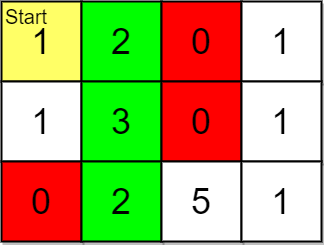
Input: grid = [[1,2,0,1],[1,3,0,1],[0,2,5,1]], pricing = [2,5], start = [0,0], k = 3
Output: [[0,1],[1,1],[2,1]]
Explanation: You start at (0,0).
With a price range of [2,5], we can take items from (0,1), (1,1), (2,1) and (2,2).
The ranks of these items are:
- (0,1) with distance 1
- (1,1) with distance 2
- (2,1) with distance 3
- (2,2) with distance 4
Thus, the 3 highest ranked items in the price range are (0,1), (1,1), and (2,1).
Example 2:
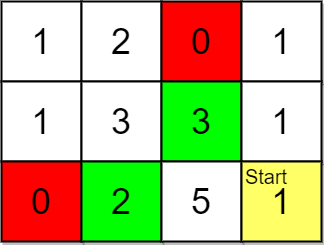
Input: grid = [[1,2,0,1],[1,3,3,1],[0,2,5,1]], pricing = [2,3], start = [2,3], k = 2
Output: [[2,1],[1,2]]
Explanation: You start at (2,3).
With a price range of [2,3], we can take items from (0,1), (1,1), (1,2) and (2,1).
The ranks of these items are:
- (2,1) with distance 2, price 2
- (1,2) with distance 2, price 3
- (1,1) with distance 3
- (0,1) with distance 4
Thus, the 2 highest ranked items in the price range are (2,1) and (1,2).
Example 3:
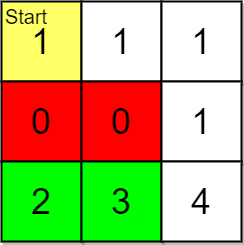
Input: grid = [[1,1,1],[0,0,1],[2,3,4]], pricing = [2,3], start = [0,0], k = 3
Output: [[2,1],[2,0]]
Explanation: You start at (0,0).
With a price range of [2,3], we can take items from (2,0) and (2,1).
The ranks of these items are:
- (2,1) with distance 5
- (2,0) with distance 6
Thus, the 2 highest ranked items in the price range are (2,1) and (2,0).
Note that k = 3 but there are only 2 reachable items within the price range.
Constraints:
m == grid.lengthn == grid[i].length1 <= m, n <= 1051 <= m * n <= 1050 <= grid[i][j] <= 105pricing.length == 22 <= low <= high <= 105start.length == 20 <= row <= m - 10 <= col <= n - 1grid[row][col] > 01 <= k <= m * n
Approaches
3 approaches with complexity analysis and trade-offs.
This approach leverages the properties of Breadth-First Search more effectively. BFS naturally explores the grid in layers of increasing distance. By processing items level by level, we can find the highest-ranked items in the correct order of the primary ranking criterion (distance). This allows us to stop the search as soon as we have found k items, avoiding unnecessary exploration of the grid.
Algorithm
- Initialize an empty list
resultto store the answers. - Initialize a BFS queue with the
startcoordinates and avisitedmatrix. - Start a
whileloop that runs as long as the queue is not empty. This loop represents processing levels.- Inside the loop, get the current
levelSizeof the queue. - Create a temporary list
itemsOnLevelto store valid items found at the current distance. - Loop
levelSizetimes to process all nodes at the current level:- Dequeue a cell
(r, c). - If
grid[r][c]is a valid item within the price range, add[price, r, c]toitemsOnLevel. - Enqueue all valid, unvisited neighbors.
- Dequeue a cell
- After the inner loop, sort
itemsOnLevelbased on price, then row, then column. - Iterate through the sorted
itemsOnLeveland add each item's coordinates[r, c]to theresultlist. - If
result.size()becomes equal tok, returnresultimmediately.
- Inside the loop, get the current
- If the
whileloop finishes (queue becomes empty) and we have fewer thankitems, return theresultlist as is.
Walkthrough
The algorithm works by performing a level-order (or layer-by-layer) BFS.
- Initialization: We start a BFS from the
startcell. We use a queue for the BFS, avisitedset or array to avoid cycles, and a list to store the final results. - Level-Order Traversal: The BFS proceeds in levels, where each level corresponds to a specific distance from the start. In each iteration of the main loop, we process all nodes at the current distance.
- We find all items at the current level that are within the price range and add them to a temporary list for this level.
- Since all items found in the same level have the same distance, we only need to sort this temporary list based on the remaining criteria: price, row, and column.
- After sorting, we add these items to our final result list.
- Early Exit: We continuously check the size of our result list. As soon as it contains
kitems, we have found thekhighest-ranked items because any item found in subsequent BFS levels will have a greater distance and thus a lower rank. We can then terminate the BFS and return the result. If the BFS completes before we findkitems, we return all the valid items found.
import java.util.*; class Solution { public List<List<Integer>> highestRankedKItems(int[][] grid, int[] pricing, int[] start, int k) { int m = grid.length; int n = grid[0].length; int low = pricing[0]; int high = pricing[1]; List<List<Integer>> result = new ArrayList<>(); Queue<int[]> queue = new LinkedList<>(); boolean[][] visited = new boolean[m][n]; queue.offer(new int[]{start[0], start[1]}); visited[start[0]][start[1]] = true; int[] dr = {-1, 1, 0, 0}; int[] dc = {0, 0, -1, 1}; while (!queue.isEmpty()) { int levelSize = queue.size(); List<int[]> itemsOnLevel = new ArrayList<>(); for (int i = 0; i < levelSize; i++) { int[] curr = queue.poll(); int r = curr[0]; int c = curr[1]; int price = grid[r][c]; if (price > 1 && price >= low && price <= high) { itemsOnLevel.add(new int[]{price, r, c}); } for (int j = 0; j < 4; j++) { int nr = r + dr[j]; int nc = c + dc[j]; if (nr >= 0 && nr < m && nc >= 0 && nc < n && grid[nr][nc] != 0 && !visited[nr][nc]) { visited[nr][nc] = true; queue.offer(new int[]{nr, nc}); } } } // Sort items found on the current level Collections.sort(itemsOnLevel, (a, b) -> { if (a[0] != b[0]) return a[0] - b[0]; // price if (a[1] != b[1]) return a[1] - b[1]; // row return a[2] - b[2]; // col }); // Add sorted items to result until we have k items for (int[] item : itemsOnLevel) { if (result.size() < k) { result.add(Arrays.asList(item[1], item[2])); } } if (result.size() == k) { return result; } } return result; }}Complexity
Time
O(V + P_k * log L_max), where `V` is the number of cells visited, `P_k` is the number of valid items found, and `L_max` is the max items at a single level. The worst case is `O(M*N * log(M*N))`, but the average case is often much better.
Space
O(M*N). Required for the BFS queue and the `visited` matrix. The `itemsOnLevel` list can also grow up to `O(M*N)` in the worst case.
Trade-offs
Pros
More efficient on average than the brute-force approach, especially if
kis small and the highest-ranked items are close to the start.Logically clean as it processes items in the order of the most important ranking criterion (distance).
Avoids traversing the entire grid if not necessary due to the early exit condition.
Cons
The worst-case time complexity is similar to the brute-force approach if
kis large and items are distributed unfavorably across levels.Can be less efficient than the heap-based approach in specific worst-case scenarios where a single level contains a very large number of items.
Solutions
Solution
class Solution {public List<List<Integer>> highestRankedKItems(int[][] grid, int[] pricing, int[] start, int k) { int m = grid.length, n = grid[0].length; int row = start[0], col = start[1]; int low = pricing[0], high = pricing[1]; List<int[]> items = new ArrayList<>(); if (low <= grid[row][col] && grid[row][col] <= high) { items.add(new int[]{0, grid[row][col], row, col}); } grid[row][col] = 0; Deque<int[]> q = new ArrayDeque<>(); q.offer(new int[]{row, col, 0}); int[] dirs = {-1, 0, 1, 0, -1}; while (!q.isEmpty()) { int[] p = q.poll(); int i = p[0], j = p[1], d = p[2]; for (int l = 0; l < 4; ++l) { int x = i + dirs[l], y = j + dirs[l + 1]; if (x >= 0 && x < m && y >= 0 && y < n && grid[x][y] > 0) { if (low <= grid[x][y] && grid[x][y] <= high) { items.add(new int[]{d + 1, grid[x][y], x, y}); } grid[x][y] = 0; q.offer(new int[]{x, y, d + 1}); } } } items.sort((a, b)->{ if (a[0] != b[0]) { return a[0] - b[0]; } if (a[1] != b[1]) { return a[1] - b[1]; } if (a[2] != b[2]) { return a[2] - b[2]; } return a[3] - b[3]; }); List<List<Integer>> ans = new ArrayList<>(); for (int i = 0; i < items.size() && i < k; ++i) { int[] p = items.get(i); ans.add(Arrays.asList(p[2], p[3])); } return ans; }}Video walkthrough
Newsletter
One sharp idea, every week
System design and interview prep — short enough to finish.
No spam. Unsubscribe anytime.
Practice
Same difficulty — related problems to reinforce the pattern.