
K Radius Subarray Averages
MedPrompt
You are given a 0-indexed array nums of n integers, and an integer k.
The k-radius average for a subarray of nums centered at some index i with the radius k is the average of all elements in nums between the indices i - k and i + k (inclusive). If there are less than k elements before or after the index i, then the k-radius average is -1.
Build and return an array avgs of length n where avgs[i] is the k-radius average for the subarray centered at index i.
The average of x elements is the sum of the x elements divided by x, using integer division. The integer division truncates toward zero, which means losing its fractional part.
- For example, the average of four elements
2,3,1, and5is(2 + 3 + 1 + 5) / 4 = 11 / 4 = 2.75, which truncates to2.
Example 1:
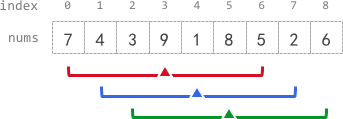
Input: nums = [7,4,3,9,1,8,5,2,6], k = 3
Output: [-1,-1,-1,5,4,4,-1,-1,-1]
Explanation:
- avg[0], avg[1], and avg[2] are -1 because there are less than k elements before each index.
- The sum of the subarray centered at index 3 with radius 3 is: 7 + 4 + 3 + 9 + 1 + 8 + 5 = 37.
  Using integer division, avg[3] = 37 / 7 = 5.
- For the subarray centered at index 4, avg[4] = (4 + 3 + 9 + 1 + 8 + 5 + 2) / 7 = 4.
- For the subarray centered at index 5, avg[5] = (3 + 9 + 1 + 8 + 5 + 2 + 6) / 7 = 4.
- avg[6], avg[7], and avg[8] are -1 because there are less than k elements after each index.
Example 2:
Input: nums = [100000], k = 0
Output: [100000]
Explanation:
- The sum of the subarray centered at index 0 with radius 0 is: 100000.
  avg[0] = 100000 / 1 = 100000.
Example 3:
Input: nums = [8], k = 100000
Output: [-1]
Explanation:
- avg[0] is -1 because there are less than k elements before and after index 0.
Constraints:
n == nums.length1 <= n <= 1050 <= nums[i], k <= 105
Approaches
3 approaches with complexity analysis and trade-offs.
This is a straightforward approach where we iterate through each possible center index i. For each i, we check if it can form a valid k-radius subarray. If it can, we then iterate through all elements within the radius k of i, sum them up, and calculate the average. This process is repeated for all indices.
Algorithm
- Create an integer array
avgsof sizenand fill it with-1. - Iterate through the input array
numswith indexifrom0ton-1. - For each
i, check ifi - k >= 0andi + k < n. - If the condition is true:
a. Initialize a
longvariablesum = 0. b. Iterate with indexjfromi - ktoi + k. c. Addnums[j]tosum. d. After the inner loop, calculate the average(int) (sum / (2 * k + 1))and store it inavgs[i]. - Return the
avgsarray.
Walkthrough
We first create an answer array avgs of the same size as nums and initialize all its values to -1.
We then loop through each index i from 0 to n-1.
Inside the loop, we check if the current index i can be a center of a k-radius subarray. This is possible only if there are at least k elements to its left and k elements to its right. The condition for this is i >= k and i < n - k.
If the condition is not met, avgs[i] remains -1, and we move to the next index.
If the condition is met, we calculate the sum of the elements in the subarray from i - k to i + k. To avoid integer overflow, we use a long variable for the sum.
The number of elements in this subarray is (i + k) - (i - k) + 1 = 2k + 1.
We compute the average using integer division: sum / (2k + 1).
The result is stored in avgs[i].
After iterating through all indices, we return the avgs array.
import java.util.Arrays; class Solution { public int[] getAverages(int[] nums, int k) { int n = nums.length; int[] avgs = new int[n]; Arrays.fill(avgs, -1); for (int i = 0; i < n; i++) { // Check if a valid k-radius subarray can be formed. if (i - k >= 0 && i + k < n) { long sum = 0; // Calculate the sum of the subarray. for (int j = i - k; j <= i + k; j++) { sum += nums[j]; } // Calculate the average and store it. avgs[i] = (int) (sum / (2 * k + 1)); } } return avgs; }}Complexity
Time
O(n * k). For each of the `n` indices, we might perform a sum over `2k + 1` elements. In the worst case, this leads to O(n*k) operations.
Space
O(n) to store the result array `avgs`. If the output array is not considered, the auxiliary space is O(1).
Trade-offs
Pros
Easy to understand and implement.
Directly translates the problem definition into code.
Cons
Highly inefficient due to repeated sum calculations for overlapping subarrays.
Will result in a 'Time Limit Exceeded' error for large inputs.
Solutions
Solution
class Solution {public int[] getAverages(int[] nums, int k) { int n = nums.length; long[] s = new long[n + 1]; for (int i = 0; i < n; ++i) { s[i + 1] = s[i] + nums[i]; } int[] ans = new int[n]; Arrays.fill(ans, -1); for (int i = 0; i < n; ++i) { if (i - k >= 0 && i + k < n) { ans[i] = (int)((s[i + k + 1] - s[i - k]) / (k << 1 | 1)); } } return ans; }}Video walkthrough
Newsletter
One sharp idea, every week
System design and interview prep — short enough to finish.
No spam. Unsubscribe anytime.
Practice
Same difficulty — related problems to reinforce the pattern.