
Longest Increasing Path in a Matrix
HardPrompt
Given an m x n integers matrix, return the length of the longest increasing path in matrix.
From each cell, you can either move in four directions: left, right, up, or down. You may not move diagonally or move outside the boundary (i.e., wrap-around is not allowed).
Example 1:
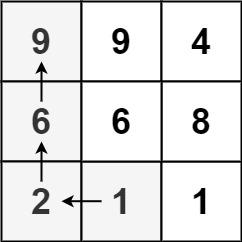
[1, 2, 6, 9]Example 2:
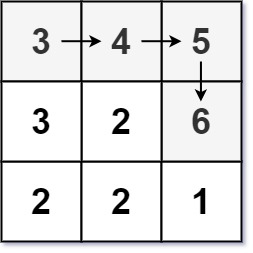
[3, 4, 5, 6]Example 3:
Input: matrix = [[1]]
Output: 1
Constraints:
m == matrix.lengthn == matrix[i].length1 <= m, n <= 2000 <= matrix[i][j] <= 231 - 1
Approaches
2 approaches with complexity analysis and trade-offs.
This approach explores every possible increasing path starting from every cell in the matrix. For each cell, it performs a Depth First Search (DFS) to find the longest path originating from it. The overall maximum length found among all starting cells is the answer.
Algorithm
- Initialize a global variable
maxLengthto 0. - Create a main function that iterates through every cell
(i, j)of the matrix. - For each cell, call a recursive DFS helper function,
dfs(row, col), to compute the length of the longest increasing path starting at that cell. - Update
maxLength = max(maxLength, result from dfs). - The
dfs(row, col)function works as follows: a. InitializemaxPathFromCellto 1 (for the cell itself). b. Explore the four adjacent neighbors (up, down, left, right). c. For each neighbor(nextRow, nextCol)that is within the matrix boundaries and has a valuematrix[nextRow][nextCol] > matrix[row][col], make a recursive call:1 + dfs(nextRow, nextCol). d. UpdatemaxPathFromCellwith the maximum length found among all valid neighbors. e. ReturnmaxPathFromCell. - After iterating through all cells, return
maxLength.
Walkthrough
We define a main function that iterates through every cell (i, j) of the matrix. For each cell, it calls a recursive DFS helper function, dfs(row, col), to compute the length of the longest increasing path starting at (row, col). The main function keeps track of the maximum length found so far and updates it after each DFS call.
The dfs(row, col) function explores the four adjacent neighbors (up, down, left, right). For each neighbor (nextRow, nextCol) that is within the matrix boundaries and has a value greater than matrix[row][col], it makes a recursive call. The length of the path starting from (row, col) is 1 + max(length of paths from valid neighbors). The base case for the recursion is a cell from which no further increasing path can be formed; in this case, the path length is 1 (the cell itself).
This method is straightforward but highly inefficient because it repeatedly calculates the longest path for the same cells multiple times. For example, the longest path from cell A might be needed to calculate the path from cell B, and also later for the path from cell C.
class Solution { private int[][] dirs = {{0, 1}, {1, 0}, {0, -1}, {-1, 0}}; private int m, n; public int longestIncreasingPath(int[][] matrix) { if (matrix == null || matrix.length == 0) { return 0; } m = matrix.length; n = matrix[0].length; int maxLength = 0; for (int i = 0; i < m; i++) { for (int j = 0; j < n; j++) { maxLength = Math.max(maxLength, dfs(matrix, i, j)); } } return maxLength; } private int dfs(int[][] matrix, int row, int col) { int maxPath = 1; for (int[] dir : dirs) { int newRow = row + dir[0]; int newCol = col + dir[1]; if (newRow >= 0 && newRow < m && newCol >= 0 && newCol < n && matrix[newRow][newCol] > matrix[row][col]) { maxPath = Math.max(maxPath, 1 + dfs(matrix, newRow, newCol)); } } return maxPath; }}Complexity
Time
O((m*n) * 4^(m*n)) - This is a loose upper bound, but the complexity is exponential. From each cell, the search can branch out, and the same subproblems (finding the longest path from a particular cell) are solved repeatedly. This leads to an exponential number of function calls.
Space
O(m * n) - The space is dominated by the recursion stack depth, which in the worst case (a path that visits every cell) can be the total number of cells in the matrix.
Trade-offs
Pros
Simple to understand and implement.
Cons
Extremely inefficient due to a massive number of redundant computations.
Will result in a 'Time Limit Exceeded' (TLE) error for all but the smallest matrices.
Solutions
Solution
class Solution {private int m;private int n;private int[][] matrix;private int[][] f;public int longestIncreasingPath(int[][] matrix) { m = matrix.length; n = matrix[0].length; f = new int[m][n]; this.matrix = matrix; int ans = 0; for (int i = 0; i < m; ++i) { for (int j = 0; j < n; ++j) { ans = Math.max(ans, dfs(i, j)); } } return ans; }private int dfs(int i, int j) { if (f[i][j] != 0) { return f[i][j]; } int[] dirs = {-1, 0, 1, 0, -1}; for (int k = 0; k < 4; ++k) { int x = i + dirs[k]; int y = j + dirs[k + 1]; if (x >= 0 && x < m && y >= 0 && y < n && matrix[x][y] > matrix[i][j]) { f[i][j] = Math.max(f[i][j], dfs(x, y)); } } return ++f[i][j]; }}Video walkthrough
Newsletter
One sharp idea, every week
System design and interview prep — short enough to finish.
No spam. Unsubscribe anytime.
Practice
Same difficulty — related problems to reinforce the pattern.