
Lowest Common Ancestor of a Binary Search Tree
MedPrompt
Given a binary search tree (BST), find the lowest common ancestor (LCA) node of two given nodes in the BST.
According to the definition of LCA on Wikipedia: “The lowest common ancestor is defined between two nodes p and q as the lowest node in T that has both p and q as descendants (where we allow a node to be a descendant of itself).”
Example 1:
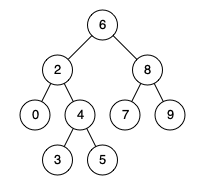
Input: root = [6,2,8,0,4,7,9,null,null,3,5], p = 2, q = 8
Output: 6
Explanation: The LCA of nodes 2 and 8 is 6.
Example 2:
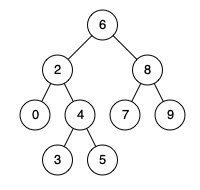
Input: root = [6,2,8,0,4,7,9,null,null,3,5], p = 2, q = 4
Output: 2
Explanation: The LCA of nodes 2 and 4 is 2, since a node can be a descendant of itself according to the LCA definition.
Example 3:
Input: root = [2,1], p = 2, q = 1
Output: 2
Constraints:
- The number of nodes in the tree is in the range
[2, 105]. -109 <= Node.val <= 109- All
Node.valare unique. p != qpandqwill exist in the BST.
Approaches
2 approaches with complexity analysis and trade-offs.
This approach uses a recursive depth-first search to traverse the binary search tree and find the lowest common ancestor. It doesn't utilize the BST property and treats it as a regular binary tree.
Algorithm
- If root is null or equals either p or q, return root
- Recursively search in left subtree
- Recursively search in right subtree
- If both left and right searches return non-null values, current node is LCA
- Otherwise, return the non-null value from either left or right
Walkthrough
The recursive approach works by traversing the tree and checking if the current node is either p or q. If we find either p or q, we return that node. If we get non-null values from both left and right subtrees, the current node is the LCA. If we get a non-null value from only one side, we propagate that up.
class Solution { public TreeNode lowestCommonAncestor(TreeNode root, TreeNode p, TreeNode q) { // Base case: if root is null or equals either p or q if (root == null || root == p || root == q) { return root; } // Recursively search in left and right subtrees TreeNode left = lowestCommonAncestor(root.left, p, q); TreeNode right = lowestCommonAncestor(root.right, p, q); // If both left and right are non-null, root is the LCA if (left != null && right != null) { return root; } // Return non-null value return left != null ? left : right; }}Complexity
Time
O(N) where N is the number of nodes in the tree as we might need to visit all nodes
Space
O(H) where H is the height of the tree due to recursive call stack
Trade-offs
Pros
Works for any binary tree, not just BST
Simple to understand and implement
Can be extended to find LCA of more than two nodes
Cons
Doesn't utilize BST properties
Uses more space due to recursive calls
Visits unnecessary nodes
Solutions
Solution
/** * Definition for a binary tree node. * public class TreeNode { * public int val; * public TreeNode left; * public TreeNode right; * public TreeNode(int x) { val = x; } * } */ public class Solution { public TreeNode LowestCommonAncestor ( TreeNode root , TreeNode p , TreeNode q ) { while ( true ) { if ( root . val < Math . Min ( p . val , q . val )) { root = root . right ; } else if ( root . val > Math . Max ( p . val , q . val )) { root = root . left ; } else { return root ; } } } }Video walkthrough
Newsletter
One sharp idea, every week
System design and interview prep — short enough to finish.
No spam. Unsubscribe anytime.
Practice
Same difficulty — related problems to reinforce the pattern.