
Maximum Building Height
HardPrompt
You want to build n new buildings in a city. The new buildings will be built in a line and are labeled from 1 to n.
However, there are city restrictions on the heights of the new buildings:
- The height of each building must be a non-negative integer.
- The height of the first building must be
0. - The height difference between any two adjacent buildings cannot exceed
1.
Additionally, there are city restrictions on the maximum height of specific buildings. These restrictions are given as a 2D integer array restrictions where restrictions[i] = [idi, maxHeighti] indicates that building idi must have a height less than or equal to maxHeighti.
It is guaranteed that each building will appear at most once in restrictions, and building 1 will not be in restrictions.
Return the maximum possible height of the tallest building.
Example 1:
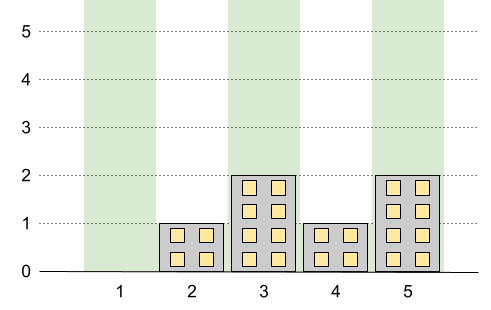
Input: n = 5, restrictions = [[2,1],[4,1]]
Output: 2
Explanation: The green area in the image indicates the maximum allowed height for each building.
We can build the buildings with heights [0,1,2,1,2], and the tallest building has a height of 2.
Example 2:
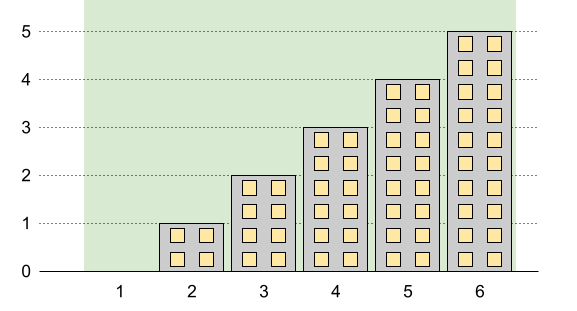
Input: n = 6, restrictions = []
Output: 5
Explanation: The green area in the image indicates the maximum allowed height for each building.
We can build the buildings with heights [0,1,2,3,4,5], and the tallest building has a height of 5.
Example 3:
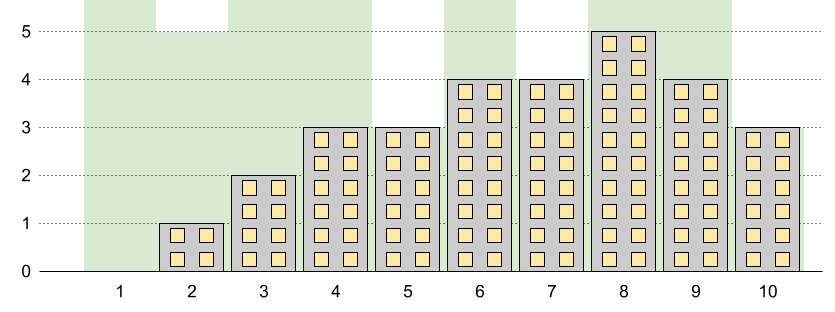
Input: n = 10, restrictions = [[5,3],[2,5],[7,4],[10,3]]
Output: 5
Explanation: The green area in the image indicates the maximum allowed height for each building.
We can build the buildings with heights [0,1,2,3,3,4,4,5,4,3], and the tallest building has a height of 5.
Constraints:
2 <= n <= 1090 <= restrictions.length <= min(n - 1, 105)2 <= idi <= nidiis unique.0 <= maxHeighti <= 109
Approaches
2 approaches with complexity analysis and trade-offs.
This approach calculates the maximum possible height for every single building from 1 to n. It first determines an initial upper bound for each building's height based on all restrictions. Then, it uses dynamic programming with two passes (one forward, one backward) over all n buildings to enforce the adjacency constraint (|h[i] - h[i-1]| <= 1). The final maximum height is the largest value in the resulting height array.
Algorithm
- Initialize an array
max_hof sizen+1. - For
ifrom 1 ton:- Set
max_h[i] = i - 1(constraint from building 1). - For each restriction
[id, h]inrestrictions:- Update
max_h[i] = min(max_h[i], h + abs(i - id)).
- Update
- Set
- Perform a forward pass. For
ifrom 2 ton:max_h[i] = min(max_h[i], max_h[i-1] + 1).
- Perform a backward pass. For
ifromn-1down to 1:max_h[i] = min(max_h[i], max_h[i+1] + 1).
- The result is the maximum value in the
max_harray.
Walkthrough
First, we create an array max_h of size n+1 to store the maximum possible height for each building. We initialize max_h[i] for each building i by considering all restrictions. The height of building i is limited by its distance from building 1 (h[1]=0) and from every restricted building j.
h[i] <= h[1] + |i-1| = i-1.h[i] <= maxHeight_j + |i - id_j|for each restrictionj.
So, for each i from 1 to n, we calculate max_h[i] = min(i-1, min_j(restrictions[j][1] + |i - restrictions[j][0]|)). This step takes O(n*k) time.
The max_h array now holds upper bounds, but it might not represent a valid sequence of building heights because the adjacency rule might be violated (e.g., max_h[i] and max_h[i+1] could differ by more than 1).
To enforce the adjacency rule, we perform two passes:
- Forward pass: Iterate from
i = 2ton. Updatemax_h[i] = min(max_h[i], max_h[i-1] + 1). This ensures that no building is too tall compared to its left neighbor. - Backward pass: Iterate from
i = n-1down to1. Updatemax_h[i] = min(max_h[i], max_h[i+1] + 1). This ensures no building is too tall compared to its right neighbor.
After these two passes, the max_h array represents the highest possible valid height profile. The final answer is the maximum value in the max_h array.
// This approach is too slow and will cause Time Limit Exceeded (TLE)// due to n being up to 10^9. It's for conceptual understanding.class Solution { public int maxBuilding(int n, int[][] restrictions) { if (n == 1) return 0; long[] max_h = new long[n + 1]; // Initialize max_h with upper bounds from all restrictions for (int i = 1; i <= n; i++) { max_h[i] = (long)i - 1; for (int[] r : restrictions) { max_h[i] = Math.min(max_h[i], (long)r[1] + Math.abs(i - r[0])); } } // Forward pass to enforce adjacency from left for (int i = 2; i <= n; i++) { max_h[i] = Math.min(max_h[i], max_h[i - 1] + 1); } // Backward pass to enforce adjacency from right for (int i = n - 1; i >= 1; i--) { max_h[i] = Math.min(max_h[i], max_h[i + 1] + 1); } // Find the maximum height long tallest = 0; for (int i = 1; i <= n; i++) { tallest = Math.max(tallest, max_h[i]); } return (int) tallest; }}Complexity
Time
O(n * k), where `n` is the number of buildings and `k` is the number of restrictions. Calculating the initial height bounds for `n` buildings against `k` restrictions takes O(n*k). The subsequent two passes take O(n).
Space
O(n), where `n` is the number of buildings. This is required to store the height array for all buildings.
Trade-offs
Pros
Conceptually simple and directly models the problem's constraints.
Cons
The time complexity of O(n * k) is too slow given
ncan be up to 10<sup>9</sup>, which will lead to a 'Time Limit Exceeded' error.The space complexity of O(n) is also too high and will cause a 'Memory Limit Exceeded' error for large
n.
Solutions
Solution
class Solution {public int maxBuilding(int n, int[][] restrictions) { List<int[]> r = new ArrayList<>(); r.addAll(Arrays.asList(restrictions)); r.add(new int[]{1, 0}); Collections.sort(r, (a, b)->a[0] - b[0]); if (r.get(r.size() - 1)[0] != n) { r.add(new int[]{n, n - 1}); } int m = r.size(); for (int i = 1; i < m; ++i) { int[] a = r.get(i - 1), b = r.get(i); b[1] = Math.min(b[1], a[1] + b[0] - a[0]); } for (int i = m - 2; i > 0; --i) { int[] a = r.get(i), b = r.get(i + 1); a[1] = Math.min(a[1], b[1] + b[0] - a[0]); } int ans = 0; for (int i = 0; i < m - 1; ++i) { int[] a = r.get(i), b = r.get(i + 1); int t = (a[1] + b[1] + b[0] - a[0]) / 2; ans = Math.max(ans, t); } return ans; }}Video walkthrough
Newsletter
One sharp idea, every week
System design and interview prep — short enough to finish.
No spam. Unsubscribe anytime.
Practice
Same difficulty — related problems to reinforce the pattern.