
Maximum Good Subtree Score
HardPrompt
You are given an undirected tree rooted at node 0 with n nodes numbered from 0 to n - 1. Each node i has an integer value vals[i], and its parent is given by par[i].
A subset of nodes within the subtree of a node is called good if every digit from 0 to 9 appears at most once in the decimal representation of the values of the selected nodes.
The score of a good subset is the sum of the values of its nodes.
Define an array maxScore of length n, where maxScore[u] represents the maximum possible sum of values of a good subset of nodes that belong to the subtree rooted at node u, including u itself and all its descendants.
Return the sum of all values in maxScore.
Since the answer may be large, return it modulo 109 + 7.
Example 1:
Input: vals = [2,3], par = [-1,0]
Output: 8
Explanation:
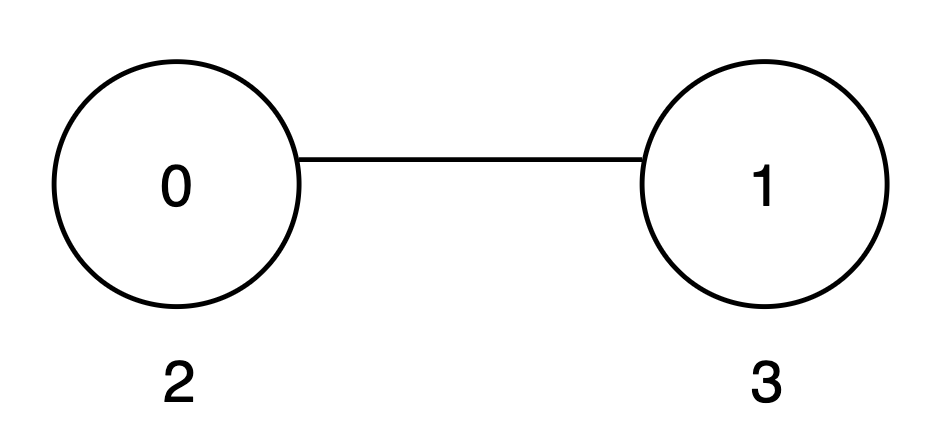
- The subtree rooted at node 0 includes nodes
{0, 1}. The subset{2, 3}is good as the digits 2 and 3 appear only once. The score of this subset is2 + 3 = 5. - The subtree rooted at node 1 includes only node
{1}. The subset{3}is good. The score of this subset is 3. - The
maxScorearray is[5, 3], and the sum of all values inmaxScoreis5 + 3 = 8. Thus, the answer is 8.
Example 2:
Input: vals = [1,5,2], par = [-1,0,0]
Output: 15
Explanation:
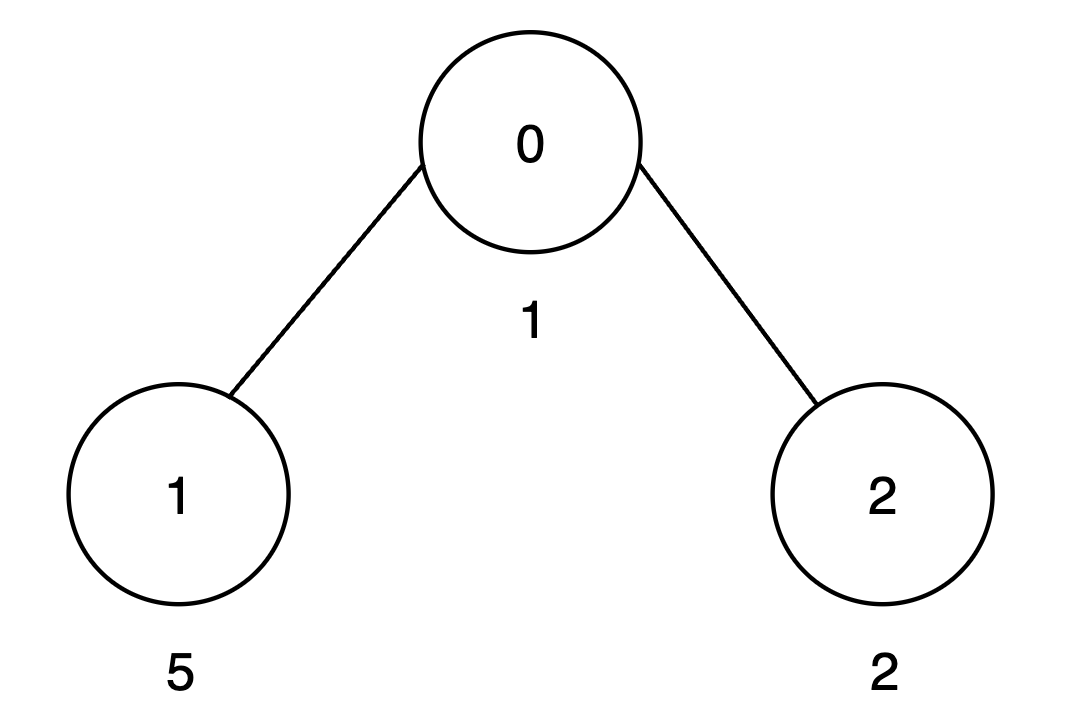
- The subtree rooted at node 0 includes nodes
{0, 1, 2}. The subset{1, 5, 2}is good as the digits 1, 5 and 2 appear only once. The score of this subset is1 + 5 + 2 = 8. - The subtree rooted at node 1 includes only node
{1}. The subset{5}is good. The score of this subset is 5. - The subtree rooted at node 2 includes only node
{2}. The subset{2}is good. The score of this subset is 2. - The
maxScorearray is[8, 5, 2], and the sum of all values inmaxScoreis8 + 5 + 2 = 15. Thus, the answer is 15.
Example 3:
Input: vals = [34,1,2], par = [-1,0,1]
Output: 42
Explanation:
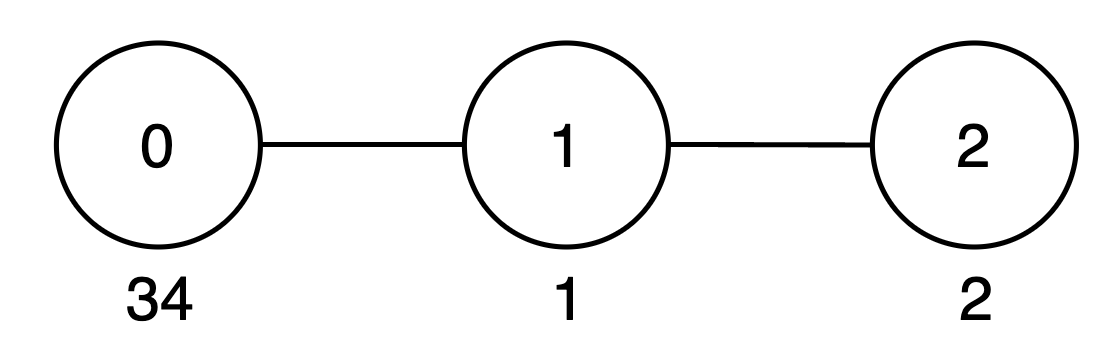
- The subtree rooted at node 0 includes nodes
{0, 1, 2}. The subset{34, 1, 2}is good as the digits 3, 4, 1 and 2 appear only once. The score of this subset is34 + 1 + 2 = 37. - The subtree rooted at node 1 includes node
{1, 2}. The subset{1, 2}is good as the digits 1 and 2 appear only once. The score of this subset is1 + 2 = 3. - The subtree rooted at node 2 includes only node
{2}. The subset{2}is good. The score of this subset is 2. - The
maxScorearray is[37, 3, 2], and the sum of all values inmaxScoreis37 + 3 + 2 = 42. Thus, the answer is 42.
Example 4:
Input: vals = [3,22,5], par = [-1,0,1]
Output: 18
Explanation:
- The subtree rooted at node 0 includes nodes
{0, 1, 2}. The subset{3, 22, 5}is not good, as digit 2 appears twice. Therefore, the subset{3, 5}is valid. The score of this subset is3 + 5 = 8. - The subtree rooted at node 1 includes nodes
{1, 2}. The subset{22, 5}is not good, as digit 2 appears twice. Therefore, the subset{5}is valid. The score of this subset is 5. - The subtree rooted at node 2 includes
{2}. The subset{5}is good. The score of this subset is 5. - The
maxScorearray is[8, 5, 5], and the sum of all values inmaxScoreis8 + 5 + 5 = 18. Thus, the answer is 18.
Constraints:
1 <= n == vals.length <= 5001 <= vals[i] <= 109par.length == npar[0] == -10 <= par[i] < nforiin[1, n - 1]- The input is generated such that the parent array
parrepresents a valid tree.
Approaches
2 approaches with complexity analysis and trade-offs.
This approach directly follows the problem definition. For each node u in the tree, we first identify all nodes in its subtree. Then, we exhaustively generate every possible subset of these nodes. For each subset, we verify if it meets the "good" criteria (no repeated digits across all selected node values). If it is good, we compute its score. The maximum score found among all good subsets for the subtree of u is maxScore[u]. Finally, we sum up maxScore[u] for all nodes u.
Algorithm
- For each node
ufrom0ton-1:- Determine the set of all nodes in the subtree of
u, let's call itS_u. - Generate all
2^|S_u|subsets ofS_u. - For each subset, check if it is a "good" subset:
- A subset is good if the combined set of digits from the values of all its nodes contains each digit from 0-9 at most once.
- This means any node with a value containing repeated digits (e.g., 11, 232) cannot be in a good subset with any other node, and also that the digit sets of any two chosen nodes must be disjoint.
- If a subset is good, calculate its score (the sum of values of its nodes).
- Keep track of the maximum score found among all good subsets. This will be
maxScore[u].
- Determine the set of all nodes in the subtree of
- After computing
maxScore[u]for allu, sum them up to get the final answer.
Walkthrough
The brute-force method involves a straightforward, yet computationally intensive, process for each node in the tree.
-
Tree Traversal and Subtree Identification: First, we need to represent the tree, for example, using an adjacency list built from the
pararray. Then, for every nodeufrom0ton-1, we perform a traversal (like DFS or BFS) starting fromuto find all nodes that are part of its subtree. -
Subset Generation and Validation: Once we have the list of nodes in
u's subtree, we generate all possible subsets. For each subset, we must check its validity:- We maintain a bitmask,
totalDigitsMask, to keep track of the digits used so far. - For each node in the current subset, we compute the digit mask of its value. A number with repeated digits (e.g., 33, 121) is invalid on its own.
- If a node's value is valid, we check if its digit mask has any bits in common with
totalDigitsMask. If it does, there's a digit conflict, and the subset is not good. - If there are no conflicts, we update
totalDigitsMaskby OR-ing it with the node's digit mask.
- We maintain a bitmask,
-
Score Calculation: If a subset is validated as good, we calculate its score by summing the
valsof all its nodes. We keep track of the maximum score seen for the current subtreeu. -
Final Summation: This process is repeated for every node in the tree. The final result is the sum of all calculated
maxScorevalues, taken modulo10^9 + 7.
Due to the 2^k complexity of generating subsets for a subtree of size k (where k can be up to n), this approach is not feasible for the given constraints.
Complexity
Time
O(N * 2^N * N * log(V)), where N is the number of nodes and V is the maximum value in `vals`. For each of the N nodes, we might have a subtree of size up to N. Generating and checking all `2^N` subsets takes `O(2^N * N * log(V))`. This is prohibitively slow.
Space
O(N) to store the nodes of a subtree during processing and for the recursion stack.
Trade-offs
Pros
Simple to conceptualize and implement.
Correctly solves the problem for very small inputs.
Cons
Extremely inefficient due to its exponential time complexity.
Will not pass the time limits for the given constraints (
nup to 500).
A more efficient solution uses dynamic programming on the tree. We can perform a post-order traversal (DFS) from the root. For each node u, we compute a DP table that maps each possible digit mask (represented as a 10-bit integer) to the maximum score achievable for a good subset with that exact digit mask within u's subtree.
The DP state for a node u is an array dp_u of size 1024, where dp_u[mask] is the max score. When processing a node u, we first initialize its DP table based on its own value. Then, for each child c, we recursively compute its DP table dp_c and merge it into dp_u. The merge operation combines scores from u's currently processed subtree part and the child's subtree, considering all valid disjoint digit mask combinations. This merge step is akin to a subset convolution and can be performed in O(3^10) time. After processing all children, maxScore[u] is the maximum value in dp_u. The total answer is the sum of all maxScore values.
Algorithm
- Preprocessing:
- Convert the parent array
parinto an adjacency list representation of the tree. - For each node
i, compute a bitmask representing the unique digits invals[i]. Ifvals[i]contains any repeated digits (e.g., 112), mark it as invalid (e.g., with a mask of -1).
- Convert the parent array
- DFS with Dynamic Programming:
- Use a post-order traversal (DFS) to solve the problem from leaves up to the root.
- For each node
u, we compute a DP table,dp[u], which is an array of size 1024.dp[u][mask]stores the maximum score of a good subset inu's subtree that has a combined digit mask ofmask. - The
dfs(u)function returns this DP table for its subtree.
- Base Case (in DFS):
- For a node
u, initialize its DP tabledp_u. Setdp_u[0] = 0(empty set). Ifvals[u]has a valid digit maskm_u, setdp_u[m_u] = vals[u].
- For a node
- Recursive Step (in DFS):
- For each child
cofu, recursively calldfs(c)to get its DP tabledp_c. - Merge
dp_cintodp_u. The merge operation combines the results from the two subproblems. A new tablenew_dpis created wherenew_dp[m]is the maximum score for a combined maskm. This is calculated asmax(dp_u[m1] + dp_c[m2])over all disjointm1,m2such thatm1 | m2 = m. - This merge can be done in
O(3^10)time by iterating through all masksmand their submasksm1.
- For each child
- Result Calculation:
- After all children of
uhave been processed, the finaldp_utable for the subtree atuis ready. maxScore[u]is the maximum value in thedp_utable.- Add
maxScore[u]to a running total sum, modulo10^9 + 7.
- After all children of
- Final Answer: The final answer is the total sum after the DFS traversal completes.
Walkthrough
This approach leverages dynamic programming on trees to efficiently solve the problem.
First, we preprocess the input. We build an adjacency list for the tree. For each node's value, we compute a 10-bit mask representing its unique digits. If a value has repeated digits (e.g., 55), it's considered invalid and cannot be combined with other nodes.
We use a DFS function, dfs(u, parent), which returns a DP table for the subtree rooted at u. This table is an array of long of size 1024, where dp[mask] stores the maximum score for a good subset using digits specified by mask.
Inside dfs(u, parent):
- Initialization: We create a DP table
dp_ufor nodeu. We initializedp_u[0] = 0(representing an empty subset with score 0). Ifvals[u]has a valid digit maskm_u, we setdp_u[m_u] = vals[u]. All other entries are initialized to a sentinel value like -1. - Recursion and Merging: We iterate through each child
cofu. We make a recursive calldfs(c, u)to get the DP tabledp_cfor the child's subtree. Then, we mergedp_cintodp_u. The merge function creates a new DP table by combining subsets fromu's part andc's part. For each possible resulting maskm, we find the best combination of a submaskm1fromdp_uand a submaskm2fromdp_csuch thatm1andm2are disjoint andm1 | m2 = m. The new score would bedp_u[m1] + dp_c[m2]. This is done for all possible resulting masks. - Finalizing
maxScore[u]: After all children are merged,dp_uis final.maxScore[u]is the maximum value in this table. We add this to a global sum. - The function returns the final
dp_utable.
Here is a code snippet for the merge logic:
private long[] merge(long[] dp1, long[] dp2) { long[] newDp = new long[1024]; Arrays.fill(newDp, -1L); for (int mask = 0; mask < 1024; mask++) { // Iterate over all submasks of the current mask. // This loop structure efficiently visits all submasks. for (int submask = mask; ; submask = (submask - 1) & mask) { int otherSubmask = mask ^ submask; if (dp1[submask] != -1 && dp2[otherSubmask] != -1) { long currentScore = dp1[submask] + dp2[otherSubmask]; if (newDp[mask] < currentScore) { newDp[mask] = currentScore; } } if (submask == 0) { break; // End loop after processing the empty submask. } } } return newDp;}The main function initiates the DFS from the root (node 0) and returns the accumulated total sum.
Complexity
Time
O(N * 3^10). The DFS visits each of the N nodes once. At each node, it merges results from its children. A merge operation takes O(3^10) time because for each of the `2^10` possible final masks, we iterate through all its submasks. The total number of (mask, submask) pairs across all masks is `3^10`.
Space
O(N * 2^10) in the worst-case scenario of a skewed tree (like a path), where the recursion depth is N. Each recursive call stores a DP table of size 1024.
Trade-offs
Pros
Efficient enough to solve the problem within the given constraints.
Systematically builds the solution from subproblems, which is a powerful technique.
Cons
The implementation can be complex, especially the merge step.
The time complexity has a large constant factor (
3^10), but it's manageable for the given constraints.
Video walkthrough
Newsletter
One sharp idea, every week
System design and interview prep — short enough to finish.
No spam. Unsubscribe anytime.
Practice
Same difficulty — related problems to reinforce the pattern.