
Maximum Number of Visible Points
HardPrompt
You are given an array points, an integer angle, and your location, where location = [posx, posy] and points[i] = [xi, yi] both denote integral coordinates on the X-Y plane.
Initially, you are facing directly east from your position. You cannot move from your position, but you can rotate. In other words, posx and posy cannot be changed. Your field of view in degrees is represented by angle, determining how wide you can see from any given view direction. Let d be the amount in degrees that you rotate counterclockwise. Then, your field of view is the inclusive range of angles [d - angle/2, d + angle/2].
You can see some set of points if, for each point, the angle formed by the point, your position, and the immediate east direction from your position is in your field of view.
There can be multiple points at one coordinate. There may be points at your location, and you can always see these points regardless of your rotation. Points do not obstruct your vision to other points.
Return the maximum number of points you can see.
Example 1:
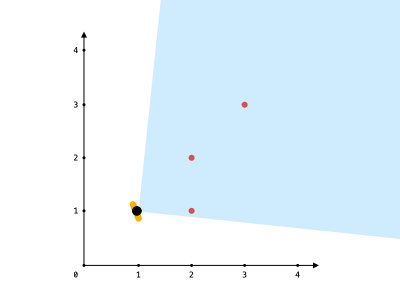
Input: points = [[2,1],[2,2],[3,3]], angle = 90, location = [1,1]
Output: 3
Explanation: The shaded region represents your field of view. All points can be made visible in your field of view, including [3,3] even though [2,2] is in front and in the same line of sight.
Example 2:
Input: points = [[2,1],[2,2],[3,4],[1,1]], angle = 90, location = [1,1]
Output: 4
Explanation: All points can be made visible in your field of view, including the one at your location.
Example 3:
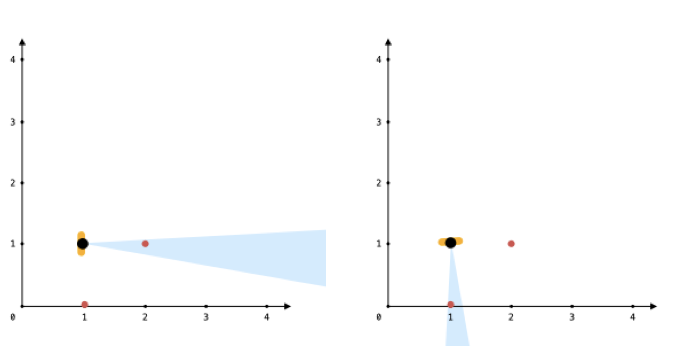
Input: points = [[1,0],[2,1]], angle = 13, location = [1,1]
Output: 1
Explanation: You can only see one of the two points, as shown above.
Constraints:
1 <= points.length <= 105points[i].length == 2location.length == 20 <= angle < 3600 <= posx, posy, xi, yi <= 100
Approaches
2 approaches with complexity analysis and trade-offs.
This is an optimized approach that avoids the O(N^2) complexity. It involves calculating the angle for each point, sorting these angles, and then using a sliding window technique to find the maximum number of points that can fit within the given angle range. The circular nature of angles is handled by duplicating the angle list.
Algorithm
-
- Separate points at the observer's
locationfrom other points. Count them inpointsAtLocation.
- Separate points at the observer's
-
- For each point not at the location, calculate its angle relative to the observer using
Math.atan2, convert to degrees, and normalize to[0, 360).
- For each point not at the location, calculate its angle relative to the observer using
-
- Store these angles in a list.
-
- Sort the list of angles in ascending order.
-
- To handle the circular nature of angles, create a new extended list. This list contains the original sorted angles followed by a copy of each angle with 360 added to it.
-
- Initialize two pointers,
start = 0andend = 0, for the sliding window, andmaxPoints = 0.
- Initialize two pointers,
-
- Iterate with the
endpointer from the beginning to the end of the extended list.
- Iterate with the
-
- Inside the loop, move the
startpointer forward as long as the angular distance between the points atendandstartis greater than the givenangle(angles.get(end) - angles.get(start) > angle).
- Inside the loop, move the
-
- The current number of points in the window is
end - start + 1. UpdatemaxPoints = max(maxPoints, end - start + 1).
- The current number of points in the window is
-
- After the loop, the final answer is
maxPoints + pointsAtLocation.
- After the loop, the final answer is
Walkthrough
Similar to the first approach, we first handle points at the observer's location and calculate the angles for all other points, normalizing them to [0, 360). The key insight is that if we sort the angles, we can efficiently find the number of points in any given angular range.
The problem is on a circle, so a view window might "wrap around" from 360 to 0 degrees (e.g., from 350 to 20 degrees). To handle this easily, we create an extended list of angles. We take our sorted list of angles a1, a2, ..., aN and append a second copy of each angle incremented by 360: a1+360, a2+360, ..., aN+360. This transforms the circular problem into a linear one.
Now, we can apply a sliding window (two-pointer) approach on this new, extended list. We use a start pointer and an end pointer, both initialized to the beginning. We iterate the end pointer through the extended list. For each position of end, we advance the start pointer until the angle at start is within the allowed angle degrees from the angle at end (i.e., angles.get(end) - angles.get(start) <= angle). The number of points in the current valid window is end - start + 1. We keep track of the maximum window size found. This maximum size is the maximum number of points visible in any single rotation. We add the count of points at the observer's location to get the final answer.
import java.util.ArrayList;import java.util.Collections;import java.util.List; class Solution { public int visiblePoints(List<List<Integer>> points, int angle, List<Integer> location) { List<Double> angles = new ArrayList<>(); int pointsAtLocation = 0; int locX = location.get(0); int locY = location.get(1); for (List<Integer> p : points) { int pX = p.get(0); int pY = p.get(1); if (pX == locX && pY == locY) { pointsAtLocation++; } else { angles.add(calculateAngle(locY, locX, pY, pX)); } } Collections.sort(angles); // To handle wrap-around, duplicate the angles array with +360 List<Double> circularAngles = new ArrayList<>(angles); for (double ang : angles) { circularAngles.add(ang + 360.0); } int maxPoints = 0; if (angles.isEmpty()) { return pointsAtLocation; } int start = 0; for (int end = 0; end < circularAngles.size(); end++) { while (circularAngles.get(end) - circularAngles.get(start) > angle) { start++; } maxPoints = Math.max(maxPoints, end - start + 1); } return maxPoints + pointsAtLocation; } private double calculateAngle(int y1, int x1, int y2, int x2) { double angleRad = Math.atan2(y2 - y1, x2 - x1); double angleDeg = Math.toDegrees(angleRad); if (angleDeg < 0) { angleDeg += 360; } return angleDeg; }}Complexity
Time
O(N log N), where N is the number of points not at the observer's location. The sorting step is the bottleneck. Calculating angles takes O(N), and the sliding window part takes O(N) as each pointer traverses the list only once.
Space
O(N), where N is the number of points not at the observer's location. Space is needed for the initial angles list and the extended list for the sliding window.
Trade-offs
Pros
Highly efficient with O(N log N) time complexity, suitable for large inputs.
The sliding window on a duplicated array is a standard and elegant technique for circular array problems.
Cons
Requires extra O(N) space for the duplicated list of angles.
Slightly more complex to conceptualize and implement compared to the brute-force solution.
Solutions
Solution
class Solution { public int visiblePoints ( List < List < Integer >> points , int angle , List < Integer > location ) { List < Double > v = new ArrayList <>(); int x = location . get ( 0 ), y = location . get ( 1 ); int same = 0 ; for ( List < Integer > p : points ) { int xi = p . get ( 0 ), yi = p . get ( 1 ); if ( xi == x && yi == y ) { ++ same ; continue ; } v . add ( Math . atan2 ( yi - y , xi - x )); } Collections . sort ( v ); int n = v . size (); for ( int i = 0 ; i < n ; ++ i ) { v . add ( v . get ( i ) + 2 * Math . PI ); } int mx = 0 ; Double t = angle * Math . PI / 180 ; for ( int i = 0 , j = 0 ; j < 2 * n ; ++ j ) { while ( i < j && v . get ( j ) - v . get ( i ) > t ) { ++ i ; } mx = Math . max ( mx , j - i + 1 ); } return mx + same ; } }Video walkthrough
Newsletter
One sharp idea, every week
System design and interview prep — short enough to finish.
No spam. Unsubscribe anytime.
Practice
Same difficulty — related problems to reinforce the pattern.