
Maximum Points After Collecting Coins From All Nodes
HardPrompt
There exists an undirected tree rooted at node 0 with n nodes labeled from 0 to n - 1. You are given a 2D integer array edges of length n - 1, where edges[i] = [ai, bi] indicates that there is an edge between nodes ai and bi in the tree. You are also given a 0-indexed array coins of size n where coins[i] indicates the number of coins in the vertex i, and an integer k.
Starting from the root, you have to collect all the coins such that the coins at a node can only be collected if the coins of its ancestors have been already collected.
Coins at nodei can be collected in one of the following ways:
- Collect all the coins, but you will get
coins[i] - kpoints. Ifcoins[i] - kis negative then you will loseabs(coins[i] - k)points. - Collect all the coins, but you will get
floor(coins[i] / 2)points. If this way is used, then for all thenodejpresent in the subtree ofnodei,coins[j]will get reduced tofloor(coins[j] / 2).
Return the maximum points you can get after collecting the coins from all the tree nodes.
Example 1:

Input: edges = [[0,1],[1,2],[2,3]], coins = [10,10,3,3], k = 5
Output: 11
Explanation:
Collect all the coins from node 0 using the first way. Total points = 10 - 5 = 5.
Collect all the coins from node 1 using the first way. Total points = 5 + (10 - 5) = 10.
Collect all the coins from node 2 using the second way so coins left at node 3 will be floor(3 / 2) = 1. Total points = 10 + floor(3 / 2) = 11.
Collect all the coins from node 3 using the second way. Total points = 11 + floor(1 / 2) = 11.
It can be shown that the maximum points we can get after collecting coins from all the nodes is 11.
Example 2:
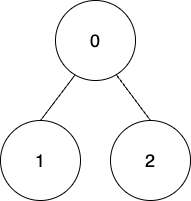
Input: edges = [[0,1],[0,2]], coins = [8,4,4], k = 0
Output: 16
Explanation:
Coins will be collected from all the nodes using the first way. Therefore, total points = (8 - 0) + (4 - 0) + (4 - 0) = 16.
Constraints:
n == coins.length2 <= n <= 1050 <= coins[i] <= 104edges.length == n - 10 <= edges[i][0], edges[i][1] < n0 <= k <= 104
Approaches
2 approaches with complexity analysis and trade-offs.
This approach uses a simple recursive function to explore all possible choices at each node. For every node, we recursively calculate the maximum points obtainable from its subtree for both possible actions:
- Take
coins[i] - kpoints. - Take
floor(coins[i] / 2)points and halve the coins in the entire subtree.
The function will take the current node, its parent, and the number of times its coin value has been halved by its ancestors as parameters. It will make two recursive calls for each child, corresponding to the two choices at the current node, and sum up the results. The maximum of the two choices is returned.
Algorithm
- Build an adjacency list for the tree from the
edgesarray. - Define a recursive function
solve(u, parent, h)which computes the maximum points from the subtree atu, givenhprior halvings. - Inside
solve(u, parent, h):- Calculate the current coin value at
u:current_coins = coins[u] >> h. - Calculate the score for Option 1:
(current_coins - k) + sum(solve(v, u, h))for all childrenv. - Calculate the score for Option 2:
(current_coins / 2) + sum(solve(v, u, h + 1))for all childrenv. - Return the maximum of the two scores.
- Calculate the current coin value at
- Start the recursion with
solve(0, -1, 0).
Walkthrough
The core of this approach is a recursive function, let's call it solve(u, parent, h). This function calculates the maximum points we can get from the subtree rooted at node u, given that the coin values in this subtree have already been halved h times due to decisions made at u's ancestors.
The recursion works as follows:
- First, we need to represent the tree. An adjacency list is a suitable choice. We build it from the input
edges. - The recursive function
solve(u, parent, h):- Calculates the current coin value for node
u:current_coins = coins[u] >> h. Note that>> his equivalent tofloor(c / 2^h). - Option 1: We choose to get
current_coins - kpoints from nodeu. The number of halvings for its children's subtrees remainsh. We recursively callsolve(v, u, h)for each childvofuand sum up the results. - Option 2: We choose to get
floor(current_coins / 2)points from nodeu. The number of halvings for its children's subtrees becomesh + 1. We recursively callsolve(v, u, h + 1)for each childvofuand sum up the results. - The function returns
max(points1, points2).
- Calculates the current coin value for node
- The initial call would be
solve(0, -1, 0).
A crucial observation is that after a certain number of halvings, the coin value becomes 0. Since coins[i] <= 10000, which is less than 2^14, after 14 halvings, any coin value will be 0. So, we can cap the number of halvings h at a reasonable value, say 14. If h exceeds this cap, we can treat it as if it's at the cap, as further halvings won't change the coin value (it's already 0). This slightly prunes the recursion tree but doesn't change the fundamental exponential complexity.
import java.util.*; class Solution { private List<Integer>[] adj; private int[] coins; private int k; private final int MAX_HALVINGS = 14; // log2(10000) is approx 13.3, so 14 is safe public int maximumPoints(int[][] edges, int[] coins, int k) { int n = coins.length; this.adj = new ArrayList[n]; for (int i = 0; i < n; i++) { adj[i] = new ArrayList<>(); } for (int[] edge : edges) { adj[edge[0]].add(edge[1]); adj[edge[1]].add(edge[0]); } this.coins = coins; this.k = k; return (int) solve(0, -1, 0); } private long solve(int u, int parent, int h) { // Cap the number of halvings if (h >= MAX_HALVINGS) { // After enough halvings, coins are 0. // Option 1: -k points. Option 2: 0 points. Max is 0 (since k>=0). // This applies to the whole subtree, so total points from here is 0. return 0; } long current_coins = coins[u] >> h; // Option 1: Collect coins[u] - k long points1 = current_coins - k; for (int v : adj[u]) { if (v != parent) { points1 += solve(v, u, h); } } // Option 2: Collect floor(coins[u] / 2) long points2 = current_coins / 2; for (int v : adj[u]) { if (v != parent) { points2 += solve(v, u, h + 1); } } return Math.max(points1, points2); }}Complexity
Time
O(2^N) in the worst case. At each node, the recursion branches into two possibilities. For a tree of depth `N`, this can lead to an exponential number of calls. Even with capping the number of halvings, the number of calls is very large without memoization.
Space
O(N) for the recursion stack in the worst case (for a skewed tree) and for storing the adjacency list.
Trade-offs
Pros
Simple to understand and implement.
Correctly models the problem's state transitions.
Cons
Extremely inefficient due to recomputing solutions for the same subproblems (
(node, h)pairs).Leads to a Time Limit Exceeded (TLE) error on larger test cases due to its exponential time complexity.
The brute-force approach is inefficient because it repeatedly solves the same subproblems. We can optimize this by using memoization, a form of dynamic programming. We'll store the results of our recursive function calls in a 2D array and reuse them when the same subproblem is encountered again.
The state of our DP is defined by (u, h), representing the maximum points obtainable from the subtree rooted at node u, given that its coin value (and all coins in its subtree) has been halved h times by its ancestors.
Algorithm
- Build an adjacency list for the tree.
- Initialize a memoization table
memo[n][MAX_HALVINGS]with a value indicating 'not computed'. - Define a recursive function
solve(u, parent, h):- If
h >= MAX_HALVINGS, return 0, as coin values will be 0. - If
memo[u][h]is already computed, return it. - Calculate
current_coins = coins[u] >> h. - Calculate
points1 = (current_coins - k) + sum(solve(v, u, h))for all childrenv. - Calculate
points2 = (current_coins / 2) + sum(solve(v, u, h + 1))for all childrenv. - Store
max(points1, points2)inmemo[u][h]and return it.
- If
- Start the recursion with
solve(0, -1, 0).
Walkthrough
This approach enhances the recursive solution by adding a memoization table, memo[u][h], to store the result of solve(u, parent, h). This avoids redundant computations and drastically improves performance.
The logic is almost identical to the brute-force approach, with the addition of memoization:
- Build the adjacency list for the tree.
- Initialize a 2D array
memoof sizen x MAX_HALVINGSwith a special value (e.g.,null) to indicate that a state has not been computed yet.MAX_HALVINGScan be set to a small constant like 14, sincelog2(10000) < 14. After 14 halvings, any coin value becomes 0. - The recursive function
solve(u, parent, h):- First, check if the result for state
(u, h)is already in our memoization table. Ifmemo[u][h]is notnull, return the stored result. - Cap the number of halvings
h. Ifhis too large, the points from the entire subtree will be 0 (sincek >= 0). - Calculate the current coin value for node
u:current_coins = coins[u] >> h. - Option 1: Calculate points for taking
current_coins - k. Recursively callsolve(v, u, h)for all childrenv. - Option 2: Calculate points for taking
floor(current_coins / 2). Recursively callsolve(v, u, h + 1)for all childrenv. - Store the result
max(points1, points2)inmemo[u][h]before returning it.
- First, check if the result for state
- The initial call is
solve(0, -1, 0).
This top-down DP approach explores the problem using a post-order traversal (DFS), calculating the optimal points for subtrees before calculating it for the parent.
import java.util.*; class Solution { private List<Integer>[] adj; private int[] coins; private int k; private Long[][] memo; private final int MAX_HALVINGS = 14; // log2(10000) is approx 13.3, so 14 is safe public int maximumPoints(int[][] edges, int[] coins, int k) { int n = coins.length; this.adj = new ArrayList[n]; for (int i = 0; i < n; i++) { adj[i] = new ArrayList<>(); } for (int[] edge : edges) { adj[edge[0]].add(edge[1]); adj[edge[1]].add(edge[0]); } this.coins = coins; this.k = k; this.memo = new Long[n][MAX_HALVINGS]; return (int) solve(0, -1, 0); } private long solve(int u, int parent, int h) { if (h >= MAX_HALVINGS) { return 0; } if (memo[u][h] != null) { return memo[u][h]; } long current_coins = coins[u] >> h; // Option 1: Collect coins[u] - k long points1 = current_coins - k; for (int v : adj[u]) { if (v != parent) { points1 += solve(v, u, h); } } // Option 2: Collect floor(coins[u] / 2) long points2 = current_coins / 2; for (int v : adj[u]) { if (v != parent) { points2 += solve(v, u, h + 1); } } return memo[u][h] = Math.max(points1, points2); }}Complexity
Time
O(N * log(max(coins))). The number of states is `N * MAX_HALVINGS`. Each state `(u, h)` is computed once. To compute a state, we iterate over the children of `u`. The total work across all states is proportional to the sum of degrees of all nodes, which is `O(N)`. So, the total time is `O(N * MAX_HALVINGS)`. Since `MAX_HALVINGS` is related to `log(max(coins))`, the complexity is `O(N * log(max(coins)))`.
Space
O(N * log(max(coins))). This is dominated by the memoization table `memo` of size `N * MAX_HALVINGS`. The recursion stack depth can go up to `O(N)` in the worst case (a skewed tree).
Trade-offs
Pros
Highly efficient and guaranteed to pass within time limits.
Solves the problem by breaking it down into a limited number of unique subproblems.
The use of memoization avoids exponential complexity.
Cons
Requires extra space for the memoization table.
The concept might be slightly more complex to grasp than simple recursion.
Solutions
Solution
class Solution {private int k;private int[] coins;private Integer[][] f;private List<Integer>[] g;public int maximumPoints(int[][] edges, int[] coins, int k) { this.k = k; this.coins = coins; int n = coins.length; f = new Integer[n][15]; g = new List[n]; Arrays.setAll(g, i->new ArrayList<>()); for (var e : edges) { int a = e[0], b = e[1]; g[a].add(b); g[b].add(a); } return dfs(0, -1, 0); }private int dfs(int i, int fa, int j) { if (f[i][j] != null) { return f[i][j]; } int a = (coins[i] >> j) - k; int b = coins[i] >> (j + 1); for (int c : g[i]) { if (c != fa) { a += dfs(c, i, j); if (j < 14) { b += dfs(c, i, j + 1); } } } return f[i][j] = Math.max(a, b); }}class Solution {public: int maximumPoints(vector<vector<int>> &edges, vector<int> &coins, int k) { int n = coins.size(); int f[n][15]; memset(f, -1, sizeof(f)); vector<int> g[n]; for (auto &e : edges) { int a = e[0], b = e[1]; g[a].emplace_back(b); g[b].emplace_back(a); } function<int(int, int, int)> dfs = [&](int i, int fa, int j) { if (f[i][j] != -1) { return f[i][j]; } int a = (coins[i] >> j) - k; int b = coins[i] >> (j + 1); for (int c : g[i]) { if (c != fa) { a += dfs(c, i, j); if (j < 14) { b += dfs(c, i, j + 1); } } } return f[i][j] = max(a, b); }; return dfs(0, -1, 0); }};class Solution: def maximumPoints(self, edges: List[List[int]], coins: List[int], k: int) -> int: @ cache def dfs(i: int, fa: int, j: int) -> int: a = (coins[i] >> j) - k b = coins[i] >> (j + 1) for c in g[i]: if c != fa: a += dfs(c, i, j) if j < 14: b += dfs(c, i, j + 1) return max(a, b) n = len(coins) g = [[] for _ in range(n)] for a, b in edges: g[a]. append(b) g[b]. append(a) ans = dfs(0, - 1, 0) dfs . cache_clear() return ansVideo walkthrough
Newsletter
One sharp idea, every week
System design and interview prep — short enough to finish.
No spam. Unsubscribe anytime.
Practice
Same difficulty — related problems to reinforce the pattern.