
Maximum Profit in Job Scheduling
HardPrompt
We have n jobs, where every job is scheduled to be done from startTime[i] to endTime[i], obtaining a profit of profit[i].
You're given the startTime, endTime and profit arrays, return the maximum profit you can take such that there are no two jobs in the subset with overlapping time range.
If you choose a job that ends at time X you will be able to start another job that starts at time X.
Example 1:
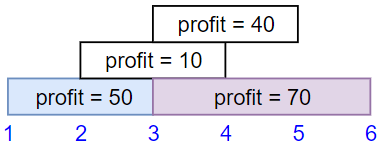
Input: startTime = [1,2,3,3], endTime = [3,4,5,6], profit = [50,10,40,70]
Output: 120
Explanation: The subset chosen is the first and fourth job.
Time range [1-3]+[3-6] , we get profit of 120 = 50 + 70.
Example 2:
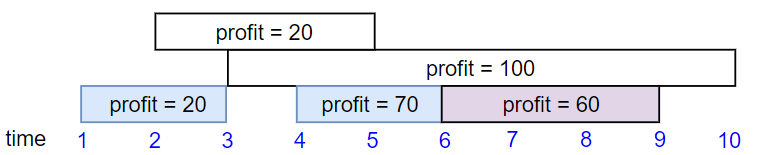
Input: startTime = [1,2,3,4,6], endTime = [3,5,10,6,9], profit = [20,20,100,70,60]
Output: 150
Explanation: The subset chosen is the first, fourth and fifth job.
Profit obtained 150 = 20 + 70 + 60.
Example 3:
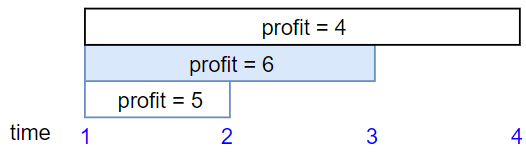
Input: startTime = [1,1,1], endTime = [2,3,4], profit = [5,6,4]
Output: 6
Constraints:
1 <= startTime.length == endTime.length == profit.length <= 5 * 1041 <= startTime[i] < endTime[i] <= 1091 <= profit[i] <= 104
Approaches
3 approaches with complexity analysis and trade-offs.
This approach explores all possible valid subsets of jobs. For each job, we make a decision: either to include it in our set or to skip it. This generates a decision tree of possibilities. We then find the path in this tree that yields the maximum total profit. While simple to understand, it is highly inefficient.
Algorithm
- Create a
Jobclass to encapsulatestartTime,endTime, andprofit. - Create an array of
Jobobjects from the input arrays. - Sort the
Jobarray based onstartTimeto process jobs in chronological order. - Define a recursive function
solve(index)that calculates the maximum profit from jobsindexton-1. - In
solve(index):- Base Case: If
indexis out of bounds, return 0. - Recursive Step: Explore two choices for
jobs[index]:- Exclude: The profit is
solve(index + 1). - Include: The profit is
jobs[index].profitplus the result ofsolve(nextIndex), wherenextIndexis the first job that starts afterjobs[index]ends.
- Exclude: The profit is
- Return the maximum of the two choices.
- Base Case: If
- The initial call is
solve(0).
Walkthrough
The brute-force method systematically checks every combination of jobs. We can model this using recursion.
First, we combine the startTime, endTime, and profit arrays into a single structure, a Job object, for easier handling. To make the decision process more structured, we sort these jobs based on their startTime.
A recursive function, let's call it findMaxProfit(index), is the core of this approach. This function calculates the maximum profit obtainable from the sub-array of jobs starting from index.
For any given job[index], we face two choices:
- Skip the job: We don't take
jobs[index]. The maximum profit is then whatever we can make from the remaining jobs, which is found by recursively callingfindMaxProfit(index + 1). - Take the job: We add
jobs[index].profitto our total. Since we cannot take any overlapping jobs, we must then find the first subsequent job that starts at or after the current job'sendTime. Let's say this is atnextIndex. We then add the result offindMaxProfit(nextIndex)to our current job's profit.
The function returns the maximum profit from these two choices. The process starts with findMaxProfit(0).
class Solution { class Job { int start, end, profit; Job(int start, int end, int profit) { this.start = start; this.end = end; this.profit = profit; } } public int jobScheduling(int[] startTime, int[] endTime, int[] profit) { int n = startTime.length; Job[] jobs = new Job[n]; for (int i = 0; i < n; i++) { jobs[i] = new Job(startTime[i], endTime[i], profit[i]); } Arrays.sort(jobs, (a, b) -> a.start - b.start); return findMaxProfit(jobs, 0); } private int findMaxProfit(Job[] jobs, int index) { if (index >= jobs.length) { return 0; } // Option 1: Exclude current job int profit1 = findMaxProfit(jobs, index + 1); // Option 2: Include current job // Find the next non-overlapping job by linear scan int nextIndex = jobs.length; for (int j = index + 1; j < jobs.length; j++) { if (jobs[j].start >= jobs[index].end) { nextIndex = j; break; } } int profit2 = jobs[index].profit + findMaxProfit(jobs, nextIndex); return Math.max(profit1, profit2); }}Complexity
Time
O(n * 2^n). The recursion tree can have up to 2^n nodes. In each node, we might do a linear scan to find the next job, which takes O(n) time. Sorting takes an initial O(n log n). The overall complexity is dominated by the exponential nature of the recursion.
Space
O(n), for the recursion call stack depth in the worst case.
Trade-offs
Pros
Simple to conceptualize and implement.
Directly translates the problem statement into a recursive structure.
Cons
Extremely inefficient due to its exponential time complexity.
Will result in a 'Time Limit Exceeded' error on most platforms for the given constraints.
Performs a large number of redundant computations for the same subproblems.
This approach improves upon the brute-force recursion by eliminating redundant calculations. The recursive function often recalculates the maximum profit for the same subset of remaining jobs. By storing (memoizing) the result for each subproblem (i.e., for each starting index), we can look it up instead of recomputing it. This technique is known as top-down dynamic programming and significantly improves efficiency.
Algorithm
- Create and sort an array of
Jobobjects bystartTime. - Create a memoization array
memoof sizen, initialized to a value like -1. - Define a recursive function
solve(index, memo). - In
solve(index, memo):- Base Case: If
index >= n, return 0. - Memoization Check: If
memo[index]is not -1, return the stored value. - Recursive Step:
- Exclude: Calculate profit by calling
solve(index + 1, memo). - Include: Calculate profit as
jobs[index].profit + solve(nextIndex, memo). FindnextIndex(the first job starting after the current one ends) efficiently using binary search.
- Exclude: Calculate profit by calling
- Store the maximum of the two options in
memo[index]before returning.
- Base Case: If
Walkthrough
The key observation to optimize the brute-force approach is that the subproblem findMaxProfit(index) is solved multiple times with the same input. We can avoid these re-computations by storing the result the first time we solve it and reusing it later.
We use a memoization array, memo, where memo[i] stores the maximum profit that can be obtained from the jobs in the range [i, n-1]. The array is initialized with -1 to signify that no subproblem has been solved yet.
The recursive function findMaxProfit(index, memo) is modified as follows:
- Before any computation, it checks
memo[index]. If a value is already stored, it returns it immediately. - If not, it computes the result just like the brute-force approach.
- To further optimize, finding the next non-overlapping job is done using binary search on the sorted
startTimes, which reduces this step's complexity from O(n) to O(log n). - Once the result is computed, it's stored in
memo[index]before being returned.
class Solution { class Job { int start, end, profit; Job(int start, int end, int profit) { this.start = start; this.end = end; this.profit = profit; } } public int jobScheduling(int[] startTime, int[] endTime, int[] profit) { int n = startTime.length; Job[] jobs = new Job[n]; for (int i = 0; i < n; i++) { jobs[i] = new Job(startTime[i], endTime[i], profit[i]); } Arrays.sort(jobs, (a, b) -> a.start - b.start); int[] memo = new int[n]; Arrays.fill(memo, -1); return findMaxProfit(jobs, 0, memo); } private int findMaxProfit(Job[] jobs, int index, int[] memo) { if (index >= jobs.length) { return 0; } if (memo[index] != -1) { return memo[index]; } // Option 1: Exclude current job int profit1 = findMaxProfit(jobs, index + 1, memo); // Option 2: Include current job int nextIndex = findNextJob(jobs, jobs[index].end, index + 1); int profit2 = jobs[index].profit + findMaxProfit(jobs, nextIndex, memo); return memo[index] = Math.max(profit1, profit2); } // Using binary search to find the next non-overlapping job private int findNextJob(Job[] jobs, int lastEndTime, int startIndex) { int low = startIndex, high = jobs.length - 1; int nextIndex = jobs.length; while (low <= high) { int mid = low + (high - low) / 2; if (jobs[mid].start >= lastEndTime) { nextIndex = mid; high = mid - 1; } else { low = mid + 1; } } return nextIndex; }}Complexity
Time
O(n log n). Sorting the jobs takes O(n log n). The recursive function is called once for each index `i`, and inside each call, we perform a binary search which takes O(log n). The total time is O(n log n) + O(n log n) = O(n log n).
Space
O(n), required for the memoization array and the recursion stack.
Trade-offs
Pros
Significantly more efficient than brute-force, with a polynomial time complexity.
Guaranteed to find the optimal solution.
The logic is a natural and intuitive extension of the recursive solution.
Cons
May cause a
StackOverflowErrorfor very deep recursion paths, though the problem constraints are generally manageable.Slightly higher overhead than the iterative bottom-up approach due to recursive function calls.
This is an iterative version of the dynamic programming solution, which avoids recursion and the associated risk of stack overflow. We build the solution from the ground up. A common and elegant way to implement this is to sort the jobs by their end times and calculate the maximum profit iteratively.
Algorithm
- Create and sort an array of
Jobobjects by theirendTime. - Create a DP array,
dp, of sizen.dp[i]will store the maximum profit achievable considering a subset of the firsti+1jobs. - Initialize
dp[0] = jobs[0].profit. - Iterate from
i = 1ton-1:- Calculate the profit if
jobs[i]is included:profitIncludingCurrent = jobs[i].profit. - Find the latest compatible job
j < i(wherejobs[j].endTime <= jobs[i].startTime) using binary search on theendTimes of jobs0toi-1. - If such a job
jexists, add its maximum profit:profitIncludingCurrent += dp[j]. - The maximum profit if
jobs[i]is excluded isdp[i-1]. - Set
dp[i] = max(profitIncludingCurrent, dp[i-1]).
- Calculate the profit if
- The final answer is
dp[n-1].
Walkthrough
The bottom-up DP approach builds the solution iteratively, which is often more efficient in practice and avoids recursion depth limits. A particularly clean implementation involves sorting the jobs by their endTime.
Let dp[i] be the maximum profit we can achieve by considering only the first i+1 jobs (from index 0 to i in the endTime-sorted array). We iterate through the sorted jobs and for each job i, we determine dp[i].
For each job i, we have two choices:
- Exclude
jobs[i]: If we don't take the current job, the maximum profit remains the same as the maximum profit achievable using the firstijobs. This value isdp[i-1](fori > 0). - Include
jobs[i]: The profit from this choice isjobs[i].profitplus the maximum profit from any non-overlapping previous jobs. A previous jobjis non-overlapping if it finishes beforejobs[i]starts (i.e.,jobs[j].endTime <= jobs[i].startTime). We need to find the maximum profit from all such compatible jobs. Since ourdparray is non-decreasing (becausedp[i]is always at leastdp[i-1]), we only need to find the latest compatible jobjand adddp[j]to our current profit. This latest compatible jobjcan be found efficiently using binary search on theendTimes of jobs0toi-1.
The recurrence relation becomes: dp[i] = max(dp[i-1], jobs[i].profit + dp[latest_compatible_job_index]).
The final answer is dp[n-1], which represents the maximum profit considering all jobs.
class Solution { class Job { int start, end, profit; Job(int start, int end, int profit) { this.start = start; this.end = end; this.profit = profit; } } public int jobScheduling(int[] startTime, int[] endTime, int[] profit) { int n = startTime.length; Job[] jobs = new Job[n]; for (int i = 0; i < n; i++) { jobs[i] = new Job(startTime[i], endTime[i], profit[i]); } // Sort jobs by end time Arrays.sort(jobs, (a, b) -> a.end - b.end); // dp[i] will be the maximum profit using jobs from 0 to i int[] dp = new int[n]; dp[0] = jobs[0].profit; for (int i = 1; i < n; i++) { int profitIncludingCurrent = jobs[i].profit; int lastCompatibleJobIndex = -1; // Binary search to find the latest job that finishes before the current one starts int low = 0, high = i - 1; while (low <= high) { int mid = low + (high - low) / 2; if (jobs[mid].end <= jobs[i].start) { lastCompatibleJobIndex = mid; low = mid + 1; } else { high = mid - 1; } } if (lastCompatibleJobIndex != -1) { profitIncludingCurrent += dp[lastCompatibleJobIndex]; } // dp[i] is the max of including this job or not including it int profitExcludingCurrent = dp[i - 1]; dp[i] = Math.max(profitIncludingCurrent, profitExcludingCurrent); } return dp[n - 1]; }}Complexity
Time
O(n log n). Sorting by `endTime` takes O(n log n). The main loop runs `n` times, and each iteration involves a binary search that takes O(log n) time. The total time complexity is dominated by these two parts, resulting in O(n log n).
Space
O(n), for storing the `Job` objects and the `dp` array.
Trade-offs
Pros
Highly efficient and considered the standard optimal solution.
Avoids recursion, eliminating the risk of stack overflow and reducing function call overhead.
Iterative approach can have better performance due to cache locality.
Cons
The logic, especially the binary search on a growing prefix of end times, can be slightly less intuitive to grasp initially compared to the top-down approach.
Solutions
Solution
class Solution {private int[][] jobs;private int[] f;private int n;public int jobScheduling(int[] startTime, int[] endTime, int[] profit) { n = profit.length; jobs = new int[n][3]; for (int i = 0; i < n; ++i) { jobs[i] = new int[]{startTime[i], endTime[i], profit[i]}; } Arrays.sort(jobs, (a, b)->a[0] - b[0]); f = new int[n]; return dfs(0); }private int dfs(int i) { if (i >= n) { return 0; } if (f[i] != 0) { return f[i]; } int e = jobs[i][1], p = jobs[i][2]; int j = search(jobs, e, i + 1); int ans = Math.max(dfs(i + 1), p + dfs(j)); f[i] = ans; return ans; }private int search(int[][] jobs, int x, int i) { int left = i, right = n; while (left < right) { int mid = (left + right) >> 1; if (jobs[mid][0] >= x) { right = mid; } else { left = mid + 1; } } return left; }}class Solution {public: int jobScheduling(vector<int> &startTime, vector<int> &endTime, vector<int> &profit) { int n = profit.size(); vector<tuple<int, int, int>> jobs(n); for (int i = 0; i < n; ++i) jobs[i] = {startTime[i], endTime[i], profit[i]}; sort(jobs.begin(), jobs.end()); vector<int> f(n); function<int(int)> dfs = [&](int i) -> int { if (i >= n) return 0; if (f[i]) return f[i]; auto [_, e, p] = jobs[i]; tuple<int, int, int> t{e, 0, 0}; int j = lower_bound(jobs.begin() + i + 1, jobs.end(), t, [&](auto &l, auto &r) -> bool { return get<0>(l) < get<0>(r); }) - jobs.begin(); int ans = max(dfs(i + 1), p + dfs(j)); f[i] = ans; return ans; }; return dfs(0); }};class Solution: def jobScheduling(self, startTime: List[int], endTime: List[int], profit: List[int]) -> int: @ cache def dfs(i): if i >= n: return 0 _, e, p = jobs[i] j = bisect_left(jobs, e, lo=i + 1, key=lambda x: x[0]) return max(dfs(i + 1), p + dfs(j)) jobs = sorted(zip(startTime, endTime, profit)) n = len(profit) return dfs(0)Video walkthrough
Newsletter
One sharp idea, every week
System design and interview prep — short enough to finish.
No spam. Unsubscribe anytime.
Practice
Same difficulty — related problems to reinforce the pattern.