
Maximum Running Time of N Computers
HardPrompt
You have n computers. You are given the integer n and a 0-indexed integer array batteries where the ith battery can run a computer for batteries[i] minutes. You are interested in running all n computers simultaneously using the given batteries.
Initially, you can insert at most one battery into each computer. After that and at any integer time moment, you can remove a battery from a computer and insert another battery any number of times. The inserted battery can be a totally new battery or a battery from another computer. You may assume that the removing and inserting processes take no time.
Note that the batteries cannot be recharged.
Return the maximum number of minutes you can run all the n computers simultaneously.
Example 1:

Input: n = 2, batteries = [3,3,3]
Output: 4
Explanation:
Initially, insert battery 0 into the first computer and battery 1 into the second computer.
After two minutes, remove battery 1 from the second computer and insert battery 2 instead. Note that battery 1 can still run for one minute.
At the end of the third minute, battery 0 is drained, and you need to remove it from the first computer and insert battery 1 instead.
By the end of the fourth minute, battery 1 is also drained, and the first computer is no longer running.
We can run the two computers simultaneously for at most 4 minutes, so we return 4.
Example 2:
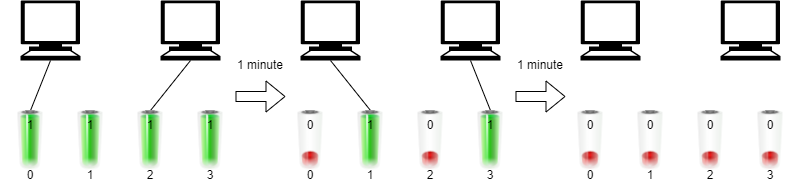
Input: n = 2, batteries = [1,1,1,1]
Output: 2
Explanation:
Initially, insert battery 0 into the first computer and battery 2 into the second computer.
After one minute, battery 0 and battery 2 are drained so you need to remove them and insert battery 1 into the first computer and battery 3 into the second computer.
After another minute, battery 1 and battery 3 are also drained so the first and second computers are no longer running.
We can run the two computers simultaneously for at most 2 minutes, so we return 2.
Constraints:
1 <= n <= batteries.length <= 1051 <= batteries[i] <= 109
Approaches
2 approaches with complexity analysis and trade-offs.
A standard approach for problems that ask to maximize a value is to binary search for the answer. We can guess a time T and then check if it's possible to run all n computers for this duration. The key insight is that if we can run the computers for T minutes, we can also run them for any duration less than T. This monotonicity allows us to use binary search.
The check function, canRun(T), determines feasibility. To run n computers for T minutes, we need a total of n * T minutes of power. Each battery b_i can contribute at most min(b_i, T) minutes. Thus, we can run for T minutes if the sum of contributions from all batteries is at least the required amount.
Algorithm
- The problem asks for the maximum possible running time. This structure suggests that we can use binary search on the answer. If we can run all computers for a time
T, we can certainly run them for any timeT' < T. This monotonic property allows for binary search. - We need to define a function, let's call it
canRun(time), that returnstrueif it's possible to runncomputers simultaneously fortimeminutes, andfalseotherwise. - To determine if
canRun(time)is true, we consider the total power contribution from all batteries. For a target duration oftime, a single battery with capacitybcan contribute at mostmin(b, time)to the total power supply. This is because a battery cannot supply more power than its capacity (b), and its contribution is capped attimesince it can only power one computer at a time. - The total power required to run
ncomputers fortimeminutes isn * time. - Therefore, the condition for
canRun(time)to be true is:sum(min(battery, time) for battery in batteries) >= n * time. - We can binary search for the largest
timethat satisfies this condition.
Binary Search Steps:
- Define a search range
[low, high].lowcan be0. A safe upper bound forhighcan be the sum of all battery capacities divided byn, or simply a very large number like10^14to be safe. - While
low <= high: a. Calculatemid = low + (high - low) / 2. b. Check ifcanRun(mid)is true. c. If it is,midis a possible answer. We try for a larger time, so we setans = midandlow = mid + 1. d. If it's not,midis too large. We need to try a smaller time, so we sethigh = mid - 1. - The final value stored in
answill be the maximum possible time.
Walkthrough
class Solution { public long maxRunTime(int n, int[] batteries) { long low = 0; long high = 0; for (int b : batteries) { high += b; } // A reasonable upper bound for the search space. // The total time cannot exceed the average time if all power is pooled. high /= n; long ans = 0; while (low <= high) { long mid = low + (high - low) / 2; if (canRun(n, batteries, mid)) { ans = mid; low = mid + 1; } else { high = mid - 1; } } return ans; } // Checks if we can run n computers for a given 'time'. private boolean canRun(int n, int[] batteries, long time) { if (time == 0) return true; long totalPowerSupplied = 0; // Each battery can supply at most 'time' minutes of power to the system. for (int b : batteries) { totalPowerSupplied += Math.min((long)b, time); } // The total power supplied must be at least the total power required. return totalPowerSupplied >= (long)n * time; }}Complexity
Time
O(m * log H), where `m` is the number of batteries and `H` is the range of the search space for the answer (from 0 to `sum(batteries)/n`). The `canRun` function takes O(m) time, and it's called O(log H) times by the binary search.
Space
O(1), as we only use a few variables to store the search boundaries and the answer.
Trade-offs
Pros
Conceptually straightforward and a common pattern for optimization problems.
Guaranteed to find the optimal solution due to the monotonic nature of the
canRunfunction.
Cons
Slightly less efficient than the greedy approach due to the repeated scanning of the batteries array within the binary search loop.
A more efficient solution uses a greedy approach. The intuition is that if we have more batteries than computers, the smallest batteries will inevitably be depleted. We can treat these smallest batteries as a collective power bank. The n largest batteries can be assigned to the n computers. Then, we use the power from the collective bank to sequentially 'level up' the charge of the computers, starting from the one with the least powerful battery. We continue this process until we run out of extra power or have leveled all computers to the same battery level. The final level represents the maximum running time.
Algorithm
- Sort the
batteriesarray in ascending order. - If there are more batteries than computers (
m > n), them-nsmallest batteries can be considered an 'extra' power source. Sum their capacities into a variableextraPower. - The remaining
nlargest batteries are our primary power sources, one for each computer. Let's call themliveBatteries(which arebatteries[m-n]tobatteries[m-1]in the sorted array). - The core idea is to use
extraPowerto 'level up' theliveBatteriesso they all last for the same amount of time. We iterate through theliveBatteriesfrom smallest to largest. - For each
ifrom0ton-2, we calculate the power needed to raise the firsti+1batteries (which are all conceptually at the level ofliveBatteries[i]) to the level of the next battery,liveBatteries[i+1]. The power needed is(i+1) * (liveBatteries[i+1] - liveBatteries[i]). - If
extraPoweris sufficient, we subtract the needed amount and proceed to the next battery. - If
extraPoweris insufficient, we cannot level up toliveBatteries[i+1]. The maximum time is the current levelliveBatteries[i]plus the remainingextraPowerdistributed evenly among thei+1computers. The result isliveBatteries[i] + extraPower / (i+1). - If the loop completes, it means we have successfully leveled all
nbatteries to the capacity of the largest one,liveBatteries[n-1]. Any remainingextraPowercan be distributed evenly among allncomputers. The result isliveBatteries[n-1] + extraPower / n.
Walkthrough
import java.util.Arrays; class Solution { public long maxRunTime(int n, int[] batteries) { // Sort batteries to easily identify the smallest and largest ones. Arrays.sort(batteries); int m = batteries.length; // The first m-n batteries are considered extra. Sum their power. long extraPower = 0; for (int i = 0; i < m - n; i++) { extraPower += batteries[i]; } // The n largest batteries are at indices m-n to m-1. // We will try to level them up using the extra power. for (int i = m - n; i < m - 1; i++) { // Number of computers we are currently leveling up. long numComputers = i - (m - n) + 1; // Difference in power to the next level. long diff = batteries[i+1] - batteries[i]; // Power needed to bring all 'numComputers' to the next level. long needed = numComputers * diff; if (extraPower < needed) { // Not enough extra power to reach the next level. // Distribute the remaining extra power evenly. return batteries[i] + extraPower / numComputers; } // Sufficient power, so we level up and decrease extra power. extraPower -= needed; } // If we exit the loop, all n computers have been leveled to the // capacity of the largest battery. Distribute any remaining extra power. return batteries[m-1] + extraPower / n; }}Complexity
Time
O(m log m), where `m` is the number of batteries. The complexity is dominated by the initial sorting of the `batteries` array. The subsequent loops run in O(m) time.
Space
O(log m) or O(1), depending on the implementation of the sorting algorithm. `Arrays.sort` in Java for primitives uses a dual-pivot quicksort which has an average space complexity of O(log m).
Trade-offs
Pros
This is the most efficient approach, with a time complexity dominated by sorting.
It uses constant extra space (if the sort is in-place).
Cons
The greedy logic can be less intuitive to come up with compared to the binary search approach.
Solutions
Solution
class Solution {public long maxRunTime(int n, int[] batteries) { long l = 0, r = 0; for (int x : batteries) { r += x; } while (l < r) { long mid = (l + r + 1) >> 1; long s = 0; for (int x : batteries) { s += Math.min(mid, x); } if (s >= n * mid) { l = mid; } else { r = mid - 1; } } return l; }}class Solution {public: long long maxRunTime(int n, vector<int> &batteries) { long long l = 0, r = 0; for (int x : batteries) { r += x; } while (l < r) { long long mid = (l + r + 1) >> 1; long long s = 0; for (int x : batteries) { s += min(1LL * x, mid); } if (s >= n * mid) { l = mid; } else { r = mid - 1; } } return l; }};class Solution: def maxRunTime(self, n: int, batteries: List[int]) -> int: l, r = 0, sum(batteries) while l < r: mid = (l + r + 1) >> 1 if sum(min(x, mid) for x in batteries) >= n * mid: l = mid else: r = mid - 1 return lVideo walkthrough
Newsletter
One sharp idea, every week
System design and interview prep — short enough to finish.
No spam. Unsubscribe anytime.
Practice
Same difficulty — related problems to reinforce the pattern.