
Maximum Value Sum by Placing Three Rooks II
HardPrompt
You are given a m x n 2D array board representing a chessboard, where board[i][j] represents the value of the cell (i, j).
Rooks in the same row or column attack each other. You need to place three rooks on the chessboard such that the rooks do not attack each other.
Return the maximum sum of the cell values on which the rooks are placed.
Example 1:
Input: board = [[-3,1,1,1],[-3,1,-3,1],[-3,2,1,1]]
Output: 4
Explanation:
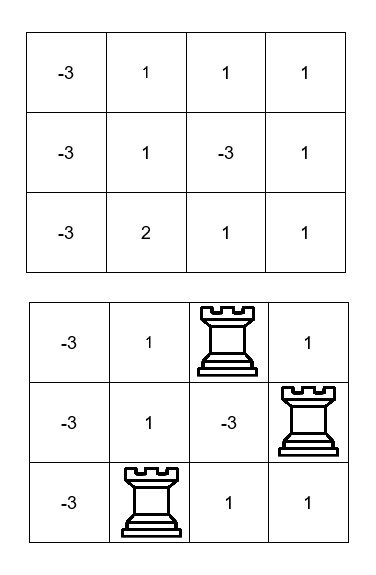
We can place the rooks in the cells (0, 2), (1, 3), and (2, 1) for a sum of 1 + 1 + 2 = 4.
Example 2:
Input: board = [[1,2,3],[4,5,6],[7,8,9]]
Output: 15
Explanation:
We can place the rooks in the cells (0, 0), (1, 1), and (2, 2) for a sum of 1 + 5 + 9 = 15.
Example 3:
Input: board = [[1,1,1],[1,1,1],[1,1,1]]
Output: 3
Explanation:
We can place the rooks in the cells (0, 2), (1, 1), and (2, 0) for a sum of 1 + 1 + 1 = 3.
Constraints:
3 <= m == board.length <= 5003 <= n == board[i].length <= 500-109 <= board[i][j] <= 109
Approaches
3 approaches with complexity analysis and trade-offs.
This approach uses brute force by systematically checking every possible valid placement of three rooks. Since the rooks cannot attack each other, they must be in distinct rows and distinct columns. The algorithm iterates through all possible combinations of three distinct rows. For each combination of rows, it then finds the optimal placement of rooks in three distinct columns to maximize the sum.
Algorithm
- Initialize a variable
maxSumto a very small number. - Iterate through all possible combinations of three distinct rows
r1,r2, andr3from0tom-1. This can be done with three nested loops. - For each combination of three rows, we solve a subproblem: find the maximum sum by picking three rooks, one from each of these rows, such that they are in distinct columns.
- Let the three chosen rows be
r1,r2,r3. We define three arraysA[c] = board[r1][c],B[c] = board[r2][c], andC[c] = board[r3][c]forcfrom0ton-1. - The subproblem is now to find
max_{i, j, k are distinct} (A[i] + B[j] + C[k]). - This subproblem can be solved in
O(n)time. A simple way is to find the top 3 columns for each of the three rows. Let's say for rowr1, the top 3 columns arec11, c12, c13. Similarly forr2andr3. Then, we can check all3*3*3 = 27combinations of these top columns, and for each combination where the column indices are distinct, we calculate the sum and update the maximum. - After checking all combinations of three rows,
maxSumwill hold the result.
Walkthrough
The core idea is to break down the problem by first choosing the rows for the three rooks. There are O(m^3) ways to choose three distinct rows. For each set of three rows, say r1, r2, and r3, we need to choose three distinct columns c1, c2, and c3 to maximize board[r1][c1] + board[r2][c2] + board[r3][c3] (or any permutation of columns). This is an assignment problem on a 3 x n matrix, which can be solved efficiently.
For a fixed set of three rows, we can find the best combination of three columns in O(n) time. One way to do this is to find the columns with the top few largest values for each of the three rows and then test their combinations. For instance, finding the top 3 columns for each of the three rows takes O(n). Then, we can check the 3 * 3 * 3 = 27 possible pairings to find the one with distinct columns that yields the maximum sum.
Combining these, the total time complexity becomes O(m^3 * n).
class Solution { public long maximumValueSum(int[][] board) { int m = board.length; int n = board[0].length; long maxSum = 0; if (m < 3 || n < 3) { return 0; } for (int r1 = 0; r1 < m; r1++) { for (int r2 = r1 + 1; r2 < m; r2++) { for (int r3 = r2 + 1; r3 < m; r3++) { // For fixed r1, r2, r3, find max sum with distinct columns long currentMax = findMaxSumForThreeRows(board, r1, r2, r3); maxSum = Math.max(maxSum, currentMax); } } } return maxSum; } private long findMaxSumForThreeRows(int[][] board, int r1, int r2, int r3) { int n = board[0].length; // Find top 3 columns for each row Pair[] top_r1 = getTopN(board[r1], 3); Pair[] top_r2 = getTopN(board[r2], 3); Pair[] top_r3 = getTopN(board[r3], 3); long max = 0; for (Pair p1 : top_r1) { for (Pair p2 : top_r2) { for (Pair p3 : top_r3) { if (p1.index != p2.index && p1.index != p3.index && p2.index != p3.index) { max = Math.max(max, p1.value + p2.value + p3.value); } } } } return max; } private Pair[] getTopN(int[] row, int N) { java.util.PriorityQueue<Pair> pq = new java.util.PriorityQueue<>((a, b) -> Long.compare(a.value, b.value)); for (int i = 0; i < row.length; i++) { pq.offer(new Pair(row[i], i)); if (pq.size() > N) { pq.poll(); } } Pair[] result = new Pair[pq.size()]; int i = 0; while(!pq.isEmpty()) { result[i++] = pq.poll(); } return result; } class Pair { long value; int index; Pair(long value, int index) { this.value = value; this.index = index; } }}Complexity
Time
O(m^3 * n)
Space
O(n)
Trade-offs
Pros
The logic is straightforward and easy to understand.
It correctly explores all valid configurations of rooks.
Cons
The time complexity is very high, making it impractical for the given constraints.
It is highly inefficient as it recomputes information repeatedly.
This approach improves upon the brute-force method by reducing the number of nested loops. Instead of iterating through three rows, we iterate through all possible pairs of two rows. For each pair of rows, we determine the best possible third rook and the best columns for the chosen two rows. This reduces one dimension of the search space, leading to a better time complexity.
Algorithm
- The problem is symmetric with respect to rows and columns. Assume
m <= nwithout loss of generality, and we will iterate over rows. Ifn < m, we can transpose the board or iterate over columns instead. - Precompute for each column
c, the top 3 values and their corresponding row indices. This takesO(m*n)time. - Initialize
maxSumto a very small number. - Iterate through all pairs of distinct rows
r1andr2. This isO(m^2)combinations. - For each pair of rows
(r1, r2), we want to find the best third rook(r3, c3)and the best columnsc1, c2for rowsr1, r2. - The sum is
board[r1][c1] + board[r2][c2] + board[r3][c3]. We can rearrange this asboard[r1][c1] + board[r2][c2] + max_{r3' \notin \{r1,r2\}} board[r3'][c3], wherec1, c2, c3must be distinct. - For the fixed
r1, r2, create a third arrayCwhereC[c] = max_{k \notin \{r1,r2\}} board[k][c]. This array can be constructed inO(n)using the precomputed column-wise top-3 values. - Now, solve the 3-array sum problem for
A=board[r1],B=board[r2], andC. This can be done inO(n)time. - Update
maxSumwith the result from the subproblem. - The total time complexity will be
O(m*n + m^2 * n) = O(m^2 * n).
Walkthrough
We fix two rows, r1 and r2, for the first two rooks. There are O(m^2) such pairs. For each pair, we need to select two distinct columns c1 and c2 for these rooks, and a third rook at (r3, c3) where r3 is not r1 or r2, and c3 is not c1 or c2.
The problem for a fixed (r1, r2) is to maximize board[r1][c1] + board[r2][c2] + board[r3][c3]. This can be viewed as a 3-array sum problem. Let A[c] = board[r1][c], B[c] = board[r2][c], and C[c] = max_{k \notin \{r1,r2\}} board[k][c]. We need to find max_{i,j,k \text{ distinct}} (A[i] + B[j] + C[k]).
To compute the array C efficiently, we can precompute the top 3 values for each column of the board. This precomputation takes O(m*n). Then, for each pair (r1, r2), we can construct C in O(n) time. The 3-array sum problem can be solved in O(n). Thus, the total complexity is dominated by iterating through pairs of rows, resulting in O(m^2 * n).
// This is a conceptual illustration. A full implementation would be lengthy.// The core logic relies on solving the 3-array sum problem efficiently.class Solution { // Assuming a helper function solve3ArraySum(long[] A, long[] B, long[] C) exists, // which solves max(A[i] + B[j] + C[k]) over distinct i,j,k in O(n) time. public long maximumValueSum(int[][] board) { int m = board.length; int n = board[0].length; long maxSum = 0; // Precompute top 3 values for each column // colTop3[c] would store pairs of (value, rowIndex) Pair[][] colTop3 = new Pair[n][3]; // ... O(m*n) precomputation logic ... for (int r1 = 0; r1 < m; r1++) { for (int r2 = r1 + 1; r2 < m; r2++) { long[] A = new long[n]; long[] B = new long[n]; long[] C = new long[n]; for(int c=0; c<n; c++) { A[c] = board[r1][c]; B[c] = board[r2][c]; // Build C[c] using precomputed colTop3 // Find max in col c, excluding r1 and r2 long maxVal = Long.MIN_VALUE; for(Pair p : colTop3[c]) { if (p.index != r1 && p.index != r2) { maxVal = p.value; break; } } C[c] = maxVal; } // maxSum = Math.max(maxSum, solve3ArraySum(A, B, C)); } } return maxSum; } // Pair class and solve3ArraySum implementation would be needed.}Complexity
Time
O(m^2 * n) (assuming m <= n)
Space
O(m*n) or O(n) depending on precomputation strategy.
Trade-offs
Pros
Significantly more efficient than the
O(m^3 * n)brute-force approach.Reduces the problem to a well-defined subproblem (3-array sum).
Cons
Still too slow for the given constraints of
m, n <= 500.The implementation is more complex than the brute-force approach.
This is the most efficient approach, which uses dynamic programming and a clever partitioning of the problem. Instead of fixing the rooks themselves, we fix the row of one of the rooks and realize that the other two must be on opposite sides of it (one in a row with a smaller index, one with a larger index). This insight allows us to precompute necessary maximums and solve the problem in linear time with respect to the number of cells.
Algorithm
- The key idea is to iterate through the row of the middle rook. Any placement of three rooks in distinct rows
r_a < r_b < r_ccan be categorized by its middle rowr_b. - We iterate a row index
rfrom1tom-2. Thisrwill be the row of one of the rooks. - For each
r, one rook must be in a rowr_top < rand another in a rowr_bottom > r. - Precompute two tables:
top[m][n]andbottom[m][n].top[r][c]stores the maximum value in columncfor all rows abover(i.e.,max_{i<r} board[i][c]).bottom[r][c]stores the maximum value in columncfor all rows belowr(i.e.,max_{i>r} board[i][c]).- These tables can be filled in
O(m*n)time using dynamic programming.
- For each middle row
r:- We have three arrays to consider:
A[c] = top[r][c],B[c] = board[r][c], andC[c] = bottom[r][c]. - The problem reduces to finding
max_{c1, c2, c3 are distinct} (A[c1] + B[c2] + C[c3]). - This 3-array sum problem can be solved in
O(n)time.
- We have three arrays to consider:
- To solve the 3-array sum problem in
O(n):- Iterate through the column
c2for the middle rook (from arrayB). - For each
c2, we need to findmax_{c1, c3 != c2, c1 != c3} (A[c1] + C[c3]). - This can be done in
O(1)if we have precomputed prefix and suffix top-2 values for arraysAandC. - The prefix/suffix top-2 precomputation for
AandCtakesO(n)for eachr.
- Iterate through the column
- The total time complexity is
O(m*n)for the initialtop/bottomprecomputation, plusmiterations of anO(n)subproblem, leading to a total ofO(m*n).
Walkthrough
The algorithm iterates through each possible row r (from 1 to m-2) that could serve as the row for the middle rook. For a fixed r, one rook must be placed in a row i < r and the other in a row j > r. The columns for these three rooks, c_i, c_r, c_j, must be distinct.
To find the optimal placement for a given r, we want to maximize board[i][c_i] + board[r][c_r] + board[j][c_j]. This can be decoupled as (max_{i<r} board[i][c_i]) + board[r][c_r] + (max_{j>r} board[j][c_j]).
We can precompute top[r][c] = max_{i<r} board[i][c] and bottom[r][c] = max_{j>r} board[j][c] for all r, c in O(m*n).
Now, for each middle row r, we solve: max_{c1,c2,c3 distinct} (top[r][c1] + board[r][c2] + bottom[r][c3]). This is a 3-array sum problem that can be solved in O(n). We iterate through c2 from 0 to n-1. For each c2, we need to find the best c1 and c3 from the remaining columns. This subproblem max_{c1,c3 != c2, c1!=c3} (top[r][c1] + bottom[r][c3]) can be solved in O(1) by precomputing prefix/suffix top-2 values for the top[r] and bottom[r] arrays.
Since we do this for each of the m rows, the total time complexity is O(m*n).
class Solution { class Pair { long val; int idx; Pair(long val, int idx) { this.val = val; this.idx = idx; } } public long maximumValueSum(int[][] board) { int m = board.length; int n = board[0].length; long[][] top = new long[m][n]; for (int c = 0; c < n; c++) top[0][c] = Long.MIN_VALUE; for (int r = 1; r < m; r++) { for (int c = 0; c < n; c++) { top[r][c] = Math.max(top[r - 1][c], board[r - 1][c]); } } long[][] bottom = new long[m][n]; for (int c = 0; c < n; c++) bottom[m - 1][c] = Long.MIN_VALUE; for (int r = m - 2; r >= 0; r--) { for (int c = 0; c < n; c++) { bottom[r][c] = Math.max(bottom[r + 1][c], board[r + 1][c]); } } long maxSum = 0; for (int r = 1; r < m - 1; r++) { maxSum = Math.max(maxSum, solve3ArraySum(top[r], board[r], bottom[r])); } return maxSum; } private long solve3ArraySum(long[] A, int[] B_int, long[] C) { int n = A.length; long[] B = new long[n]; for(int i=0; i<n; i++) B[i] = B_int[i]; Pair[] prefA = getPrefixTop2(A); Pair[] suffA = getSuffixTop2(A); Pair[] prefC = getPrefixTop2(C); Pair[] suffC = getSuffixTop2(C); long max = 0; for (int j = 1; j < n - 1; j++) { Pair topA1 = prefA[j - 1]; Pair topA2 = suffA[j + 1]; Pair topC1 = prefC[j - 1]; Pair topC2 = suffC[j + 1]; long currentMax = 0; if (topA1.idx != topC1.idx) { currentMax = Math.max(currentMax, topA1.val + topC1.val); } if (topA1.idx != topC2.idx) { currentMax = Math.max(currentMax, topA1.val + topC2.val); } if (topA2.idx != topC1.idx) { currentMax = Math.max(currentMax, topA2.val + topC1.val); } if (topA2.idx != topC2.idx) { currentMax = Math.max(currentMax, topA2.val + topC2.val); } max = Math.max(max, B[j] + currentMax); } return max; } private Pair[] getPrefixTop2(long[] arr) { // Simplified logic, real one needs top 2 int n = arr.length; Pair[] res = new Pair[n]; res[0] = new Pair(arr[0], 0); for (int i = 1; i < n; i++) { if (arr[i] > res[i - 1].val) { res[i] = new Pair(arr[i], i); } else { res[i] = res[i - 1]; } } return res; } private Pair[] getSuffixTop2(long[] arr) { // Simplified logic, real one needs top 2 int n = arr.length; Pair[] res = new Pair[n]; res[n - 1] = new Pair(arr[n - 1], n - 1); for (int i = n - 2; i >= 0; i--) { if (arr[i] > res[i + 1].val) { res[i] = new Pair(arr[i], i); } else { res[i] = res[i + 1]; } } return res; }}Note: The provided Java code for the O(m*n) approach is a simplified illustration. A full implementation of getPrefixTop2 and solve3ArraySum would need to handle finding and merging the top two distinct elements, which adds complexity.
Complexity
Time
O(m*n)
Space
O(m*n) for the precomputed `top` and `bottom` tables.
Trade-offs
Pros
Optimal time complexity, making it very fast for the given constraints.
The DP state transition is clean and builds upon precomputed values efficiently.
Cons
The implementation is complex, requiring careful handling of indices and edge cases.
Requires significant auxiliary space for the precomputed tables.
Video walkthrough
Newsletter
One sharp idea, every week
System design and interview prep — short enough to finish.
No spam. Unsubscribe anytime.
Practice
Same difficulty — related problems to reinforce the pattern.