
Minimize the Maximum Edge Weight of Graph
MedPrompt
You are given two integers, n and threshold, as well as a directed weighted graph of n nodes numbered from 0 to n - 1. The graph is represented by a 2D integer array edges, where edges[i] = [Ai, Bi, Wi] indicates that there is an edge going from node Ai to node Bi with weight Wi.
You have to remove some edges from this graph (possibly none), so that it satisfies the following conditions:
- Node 0 must be reachable from all other nodes.
- The maximum edge weight in the resulting graph is minimized.
- Each node has at most
thresholdoutgoing edges.
Return the minimum possible value of the maximum edge weight after removing the necessary edges. If it is impossible for all conditions to be satisfied, return -1.
Example 1:
Input: n = 5, edges = [[1,0,1],[2,0,2],[3,0,1],[4,3,1],[2,1,1]], threshold = 2
Output: 1
Explanation:
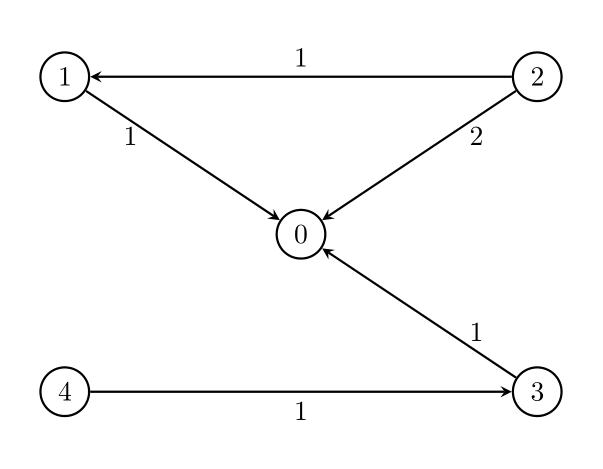
Remove the edge 2 -> 0. The maximum weight among the remaining edges is 1.
Example 2:
Input: n = 5, edges = [[0,1,1],[0,2,2],[0,3,1],[0,4,1],[1,2,1],[1,4,1]], threshold = 1
Output: -1
Explanation:
It is impossible to reach node 0 from node 2.
Example 3:
Input: n = 5, edges = [[1,2,1],[1,3,3],[1,4,5],[2,3,2],[3,4,2],[4,0,1]], threshold = 1
Output: 2
Explanation:
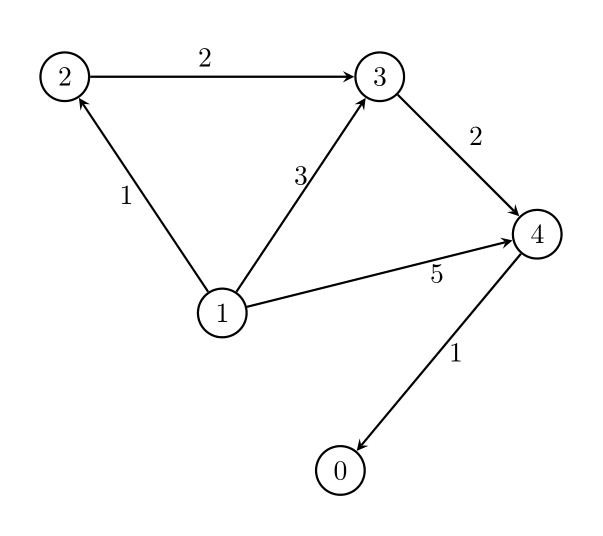
Remove the edges 1 -> 3 and 1 -> 4. The maximum weight among the remaining edges is 2.
Example 4:
Input: n = 5, edges = [[1,2,1],[1,3,3],[1,4,5],[2,3,2],[4,0,1]], threshold = 1
Output: -1
Constraints:
2 <= n <= 1051 <= threshold <= n - 11 <= edges.length <= min(105, n * (n - 1) / 2).edges[i].length == 30 <= Ai, Bi < nAi != Bi1 <= Wi <= 106- There may be multiple edges between a pair of nodes, but they must have unique weights.
Approaches
2 approaches with complexity analysis and trade-offs.
This problem has a monotonic property: if we can find a valid subgraph with a maximum edge weight of W, we can certainly also find one for any maximum weight W' > W (since the set of allowed edges only grows). This property allows us to use binary search on the answer (the maximum allowed weight). We can efficiently search for the smallest possible value of max_w for which a valid subgraph exists.
Algorithm
- Binary Search on the Answer: The problem asks to minimize a maximum value, which suggests binary search on the answer. The range of possible answers is from 1 to the maximum possible weight (10^6).
- Define Search Range: Initialize
low = 0,high = 10^6 + 1, andans = -1. - Binary Search Loop: While
low <= high: a. Calculatemid = low + (high - low) / 2as the candidate for the maximum allowed weight. b. Call a helper functioncheck(mid)to determine if it's possible to satisfy the conditions withmidas the maximum weight. c. Ifcheck(mid)returnstrue, it meansmidis a possible answer. We store it and try for an even smaller maximum weight by settinghigh = mid - 1. d. Ifcheck(mid)returnsfalse,midis too small. We need to allow larger weights, so we setlow = mid + 1. - Return Result: After the loop,
answill hold the minimum maximum weight found, or -1 if no solution is possible. check(max_w)function: This function is identical to the one in the Linear Scan approach. It builds a reversed graph with edges of weight<= max_wand runs a traversal from node 0 to check if allnnodes are reachable.
Walkthrough
The core of this approach is the binary search framework combined with the same check(max_w) function from the previous approach. The binary search dramatically reduces the number of times we need to call the check function.
Instead of checking every unique weight, we check the middle value mid of our current search range [low, high].
- If
check(mid)is true, we know that a solution exists formax_w = mid. This meansmidis a potential answer, and there might be an even better (smaller) one. So, we recordmidas our current best answer and narrow our search to the lower half:high = mid - 1. - If
check(mid)is false, it's impossible to satisfy the conditions with the currentmax_w. We must allow edges with higher weights, so we narrow our search to the upper half:low = mid + 1.
This process continues until low > high, at which point we have found the minimum max_w that works.
The logic for the check(max_w) function remains the same: it verifies that if we only consider edges with weight at most max_w, it's possible for all nodes to reach node 0. As explained before, the threshold constraint is implicitly satisfied if reachability is met, because we can always construct a subgraph (a spanning arborescence) where each node's out-degree is at most 1.
import java.util.*; class Solution { public int minimizeMaxWeight(int n, int[][] edges, int threshold) { int low = 0, high = 1000001; // Weights are 1 to 10^6. Range [0, 10^6+1] is safe. int ans = -1; while (low <= high) { int mid = low + (high - low) / 2; if (check(n, edges, mid)) { ans = mid; high = mid - 1; // Try for an even smaller max weight } else { low = mid + 1; // Need to allow larger weights } } return ans; } private boolean check(int n, int[][] edges, int maxWeight) { // Build the reversed graph with edges having weight <= maxWeight List<List<Integer>> adj = new ArrayList<>(); for (int i = 0; i < n; i++) { adj.add(new ArrayList<>()); } for (int[] edge : edges) { if (edge[2] <= maxWeight) { // Add reversed edge: v -> u for original u -> v adj.get(edge[1]).add(edge[0]); } } // Run BFS from node 0 on the reversed graph to check reachability Queue<Integer> q = new LinkedList<>(); boolean[] visited = new boolean[n]; int count = 0; q.offer(0); visited[0] = true; count++; while (!q.isEmpty()) { int u = q.poll(); for (int v : adj.get(u)) { if (!visited[v]) { visited[v] = true; q.offer(v); count++; } } } // If all n nodes are visited, a valid subgraph exists return count == n; }}Complexity
Time
O((V + E) * log(W_max)), where V is the number of nodes, E is the number of edges, and W_max is the maximum possible edge weight. The `log(W_max)` factor comes from the binary search, and the `(V + E)` factor is the cost of the `check` function (building the graph and running BFS).
Space
O(V + E), where V is the number of nodes (n) and E is the number of edges. This space is used for the adjacency list representation of the graph and the data structures for BFS (queue and visited array).
Trade-offs
Pros
Highly efficient and passes within the time limits.
Effectively reduces the search space for the answer.
Cons
Slightly more complex to reason about than a simple linear scan.
Video walkthrough
Newsletter
One sharp idea, every week
System design and interview prep — short enough to finish.
No spam. Unsubscribe anytime.
Practice
Same difficulty — related problems to reinforce the pattern.