
Minimum Area Rectangle
MedPrompt
You are given an array of points in the X-Y plane points where points[i] = [xi, yi].
Return the minimum area of a rectangle formed from these points, with sides parallel to the X and Y axes. If there is not any such rectangle, return 0.
Example 1:
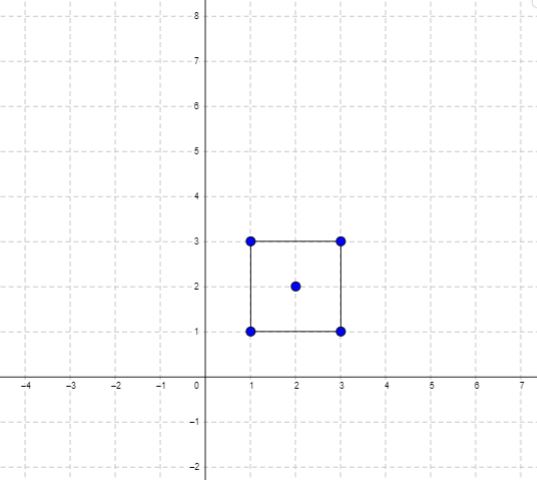
Input: points = [[1,1],[1,3],[3,1],[3,3],[2,2]]
Output: 4
Example 2:
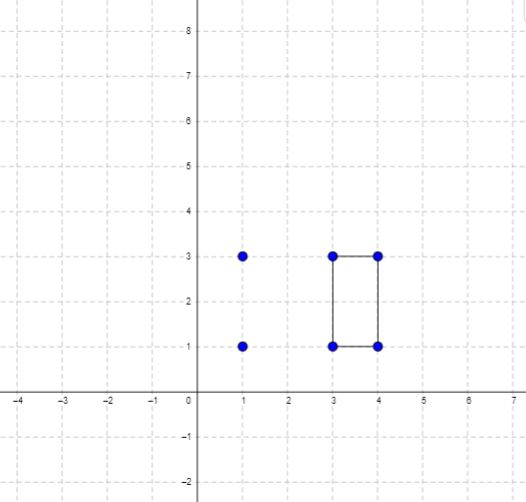
Input: points = [[1,1],[1,3],[3,1],[3,3],[4,1],[4,3]]
Output: 2
Constraints:
1 <= points.length <= 500points[i].length == 20 <= xi, yi <= 4 * 104- All the given points are unique.
Approaches
3 approaches with complexity analysis and trade-offs.
This approach iterates through all possible combinations of three points from the input array. For each triplet, it checks if they can form three corners of a rectangle with sides parallel to the X and Y axes. If they do, it calculates the coordinates of the required fourth point and checks for its existence.
Algorithm
- Store all points in a
HashSetfor efficientO(1)average time lookups. - Initialize
minAreatoInteger.MAX_VALUE. - Use three nested loops to iterate through all unique triplets of points
(p1, p2, p3). - For each triplet, check if they can form a right-angled corner. For example, if
p1andp2are aligned vertically (p1.x == p2.x) andp1andp3are aligned horizontally (p1.y == p3.y), they form a right angle atp1. - If they do, the fourth point
p4would have coordinates(p3.x, p2.y). - Check if
p4exists in theHashSet. - If
p4exists, calculate the areaabs((p1.x - p3.x) * (p1.y - p2.y))and updateminArea. - This check must be performed for all three points in the triplet acting as the corner.
- After checking all triplets, if
minAreais stillInteger.MAX_VALUE, return 0. Otherwise, returnminArea.
Walkthrough
First, to allow for quick lookups, all the given points are stored in a HashSet. A point (x, y) can be stored as a string "x,y" or by encoding it into a single integer x * 40001 + y since coordinates are non-negative and y <= 40000.
The algorithm then uses three nested loops to pick three distinct points, p1(x1, y1), p2(x2, y2), and p3(x3, y3). For each triplet, we check if they form a right-angled corner. For example, if p1 and p2 are aligned vertically (x1 == x2) and p1 and p3 are aligned horizontally (y1 == y3), then they form a right angle at p1. The fourth point required to complete the rectangle would be p4(x3, y2). We then check if p4 exists in our HashSet. If it does, we have found a valid rectangle. We calculate its area as |x1 - x3| * |y1 - y2| and update our minimum area found so far. This process is repeated for all possible triplets and all possible corner configurations within the triplet.
import java.util.HashSet;import java.util.Set; class Solution { public int minAreaRect(int[][] points) { Set<Integer> pointSet = new HashSet<>(); for (int[] point : points) { pointSet.add(point[0] * 40001 + point[1]); } int minArea = Integer.MAX_VALUE; int n = points.length; for (int i = 0; i < n; i++) { for (int j = i + 1; j < n; j++) { for (int k = j + 1; k < n; k++) { int[] p1 = points[i]; int[] p2 = points[j]; int[] p3 = points[k]; // Check all 3 possibilities for the corner point minArea = Math.min(minArea, check(p1, p2, p3, pointSet)); minArea = Math.min(minArea, check(p2, p1, p3, pointSet)); minArea = Math.min(minArea, check(p3, p1, p2, pointSet)); } } } return minArea == Integer.MAX_VALUE ? 0 : minArea; } private int check(int[] p1, int[] p2, int[] p3, Set<Integer> pointSet) { int x1 = p1[0], y1 = p1[1]; int x2 = p2[0], y2 = p2[1]; int x3 = p3[0], y3 = p3[1]; // Check if p2 and p3 form a right angle at p1 if (x1 == x2 && y1 == y3) { // Fourth point is (x3, y2) if (pointSet.contains(x3 * 40001 + y2)) { return Math.abs(x1 - x3) * Math.abs(y1 - y2); } } return Integer.MAX_VALUE; }}Complexity
Time
`O(N^3)`. Three nested loops run through the points, and the operations inside are constant time on average (due to `HashSet`).
Space
`O(N)` to store the points in a `HashSet`.
Trade-offs
Pros
More efficient than a naive
O(N^4)approach.Conceptually simple to understand as a brute-force improvement.
Cons
O(N^3)is too slow for the given constraints (N <= 500), likely resulting in a 'Time Limit Exceeded' error.The implementation logic can be complex with many cases to check for each triplet.
This approach improves upon brute-force by organizing the points. It groups points by their x-coordinate into columns. Then, it iterates through each column, finds all possible vertical edges (pairs of points), and looks for matching vertical edges in other columns to form rectangles.
Algorithm
- Create a
Map<Integer, List<Integer>>calledcolumnsto group points by x-coordinate. - Iterate through the input
pointsand populatecolumns. - Get the unique x-coordinates from
columns.keySet()and sort them. - Initialize
minAreatoInteger.MAX_VALUEand aMap<String, Integer>calledlastX. - Iterate through the sorted x-coordinates (
x). - For each
x, get the list of y-coordinatesyListand sort it. - Use two nested loops to iterate through all pairs
(y1, y2)inyListwherey1 < y2. - Create a key for the pair, e.g.,
String key = y1 + "," + y2;. - If
lastXcontainskey, retrieve the previous x-coordinatex_prev = lastX.get(key). - Calculate the area
(x - x_prev) * (y2 - y1)and updateminArea. - Update
lastXwith the currentx:lastX.put(key, x). - After the loops, if
minAreaisInteger.MAX_VALUE, return 0, else returnminArea.
Walkthrough
First, we process the input points and group them by their x-coordinate. A HashMap<Integer, List<Integer>> is a suitable data structure, mapping an x-coordinate to a list of y-coordinates present at that x. For each list of y-coordinates in the map, we sort it. This makes it easier to find pairs and compare them later. We then iterate through the unique x-coordinates in sorted order. For each x, we iterate through all pairs of y-coordinates (y1, y2) in its sorted list. This pair of points (x, y1) and (x, y2) forms a vertical line segment. To find a rectangle, we need to find another x-coordinate, x_prev, that also has points at y1 and y2. To do this efficiently, we use another HashMap<String, Integer>, let's call it lastX. This map will store the most recently seen x-coordinate for a given vertical edge defined by a pair (y1, y2). If we find a match in lastX, we've found a rectangle. By iterating x in sorted order, we ensure that (x - x_prev) is the smallest possible width for any rectangle ending at x with that specific vertical edge, which is key to finding the minimum area.
import java.util.ArrayList;import java.util.Collections;import java.util.HashMap;import java.util.List;import java.util.Map; class Solution { public int minAreaRect(int[][] points) { Map<Integer, List<Integer>> columns = new HashMap<>(); for (int[] p : points) { columns.computeIfAbsent(p[0], k -> new ArrayList<>()).add(p[1]); } List<Integer> xCoords = new ArrayList<>(columns.keySet()); Collections.sort(xCoords); int minArea = Integer.MAX_VALUE; Map<String, Integer> lastX = new HashMap<>(); for (int x : xCoords) { List<Integer> yList = columns.get(x); Collections.sort(yList); for (int i = 0; i < yList.size(); i++) { for (int j = i + 1; j < yList.size(); j++) { int y1 = yList.get(i); int y2 = yList.get(j); String key = y1 + "," + y2; if (lastX.containsKey(key)) { int prevX = lastX.get(key); int area = (x - prevX) * (y2 - y1); minArea = Math.min(minArea, area); } lastX.put(key, x); } } } return minArea == Integer.MAX_VALUE ? 0 : minArea; }}Complexity
Time
`O(N^2)`. Let `C` be the number of columns. Pre-processing takes at most `O(N log N)`. The main loop iterates through all pairs of points that share an x-coordinate. The total number of such pairs is `sum(k_i^2)`, where `k_i` is the number of points in column `i`. This sum can be up to `O(N^2)` in the worst case.
Space
`O(N^2)`. The `columns` map takes `O(N)` space. However, the `lastX` map can store up to `O(N^2)` pairs of y-coordinates in the worst case, making the space complexity quadratic.
Trade-offs
Pros
More structured than brute-force.
Can be faster than
O(N^2)on certain data distributions (e.g., sparse points).
Cons
The worst-case space complexity of
O(N^2)is significant and worse than otherO(N^2)time solutions.
This is a highly efficient and elegant approach. It iterates through all pairs of points and considers them as potential diagonals of a rectangle. For any two points p1(x1, y1) and p2(x2, y2) to be a diagonal, the other two corners of the rectangle must be p3(x1, y2) and p4(x2, y1). The algorithm simply checks if these two required points exist.
Algorithm
- Create a
HashSetto store all points for fast lookups. A point(x, y)can be encoded as a single integer or string. - Populate the
HashSetwith all points from the input array. - Initialize
minAreatoInteger.MAX_VALUE. - Use a nested loop to iterate through all pairs of points
p1(x1, y1)andp2(x2, y2). - Inside the loop, if
p1andp2are aligned (x1 == x2ory1 == y2), skip to the next pair as they cannot form a diagonal. - Check if the other two corners,
(x1, y2)and(x2, y1), exist in theHashSet. - If both points exist, calculate the area:
area = Math.abs(x1 - x2) * Math.abs(y1 - y2). - Update
minArea = Math.min(minArea, area). - After the loops complete, if
minAreais stillInteger.MAX_VALUE, return 0. Otherwise, returnminArea.
Walkthrough
The core idea is that any two diagonally opposite points (x1, y1) and (x2, y2) in a rectangle (with sides parallel to axes) uniquely define the other two points: (x1, y2) and (x2, y1). To implement this, we first need a way to quickly check for the existence of a point. A HashSet is perfect for this, providing average O(1) time complexity for lookups. We pre-populate the HashSet with all the points from the input array. To store a 2D point in a 1D set, we can encode it into a single integer (e.g., x * 40001 + y, since y <= 40000). The algorithm then uses two nested loops to iterate through every unique pair of points, p1 and p2. For each pair p1(x1, y1) and p2(x2, y2), we check if they can form a diagonal. This is true if they are not aligned horizontally or vertically, i.e., x1 != x2 and y1 != y2. If they form a potential diagonal, we construct the coordinates of the other two required points: p3(x1, y2) and p4(x2, y1). We then query our HashSet to see if both p3 and p4 exist. If both points are found, we have identified a rectangle and calculate its area, updating the minimum area found so far.
import java.util.HashSet;import java.util.Set; class Solution { public int minAreaRect(int[][] points) { Set<Integer> pointSet = new HashSet<>(); for (int[] point : points) { // Encode point (x, y) into a single integer. // Since y <= 40000, we can use a multiplier of 40001. pointSet.add(point[0] * 40001 + point[1]); } int minArea = Integer.MAX_VALUE; int n = points.length; for (int i = 0; i < n; i++) { for (int j = i + 1; j < n; j++) { int[] p1 = points[i]; int[] p2 = points[j]; int x1 = p1[0], y1 = p1[1]; int x2 = p2[0], y2 = p2[1]; // Check if they can form a diagonal (not aligned) if (x1 == x2 || y1 == y2) { continue; } // Check if the other two corners exist // p3 is (x1, y2) and p4 is (x2, y1) if (pointSet.contains(x1 * 40001 + y2) && pointSet.contains(x2 * 40001 + y1)) { int area = Math.abs(x1 - x2) * Math.abs(y1 - y2); minArea = Math.min(minArea, area); } } } return minArea == Integer.MAX_VALUE ? 0 : minArea; }}Complexity
Time
`O(N^2)`. We have two nested loops to iterate through all pairs of points, which is `O(N^2)`. The operations inside the loop (set lookups, arithmetic) are constant time on average.
Space
`O(N)`. We use a `HashSet` to store all `N` points.
Trade-offs
Pros
Optimal time complexity for this problem.
Simple and clean implementation.
Efficient
O(N)space complexity.
Cons
This is the standard and best solution for the given constraints, so there are no significant cons.
Solutions
Solution
class Solution {public int minAreaRect(int[][] points) { TreeMap<Integer, List<Integer>> d = new TreeMap<>(); for (var p : points) { int x = p[0], y = p[1]; d.computeIfAbsent(x, k->new ArrayList<>()).add(y); } Map<Integer, Integer> pos = new HashMap<>(); int ans = 1 << 30; for (var e : d.entrySet()) { int x = e.getKey(); var ys = e.getValue(); Collections.sort(ys); int n = ys.size(); for (int i = 0; i < n; ++i) { int y1 = ys.get(i); for (int j = i + 1; j < n; ++j) { int y2 = ys.get(j); int p = y1 * 40001 + y2; if (pos.containsKey(p)) { ans = Math.min(ans, (x - pos.get(p)) * (y2 - y1)); } pos.put(p, x); } } } return ans == 1 << 30 ? 0 : ans; }}class Solution {public: int minAreaRect(vector<vector<int>> &points) { map<int, vector<int>> d; for (auto &p : points) { int x = p[0], y = p[1]; d[x].emplace_back(y); } unordered_map<int, int> pos; int ans = 1 << 30; for (auto &[x, ys] : d) { sort(ys.begin(), ys.end()); int n = ys.size(); for (int i = 0; i < n; ++i) { int y1 = ys[i]; for (int j = i + 1; j < n; ++j) { int y2 = ys[j]; int p = y1 * 40001 + y2; if (pos.count(p)) { ans = min(ans, (x - pos[p]) * (y2 - y1)); } pos[p] = x; } } } return ans == 1 << 30 ? 0 : ans; }};class Solution: def minAreaRect(self, points: List[List[int]]) -> int: d = defaultdict(list) for x, y in points: d[x]. append(y) pos = {} ans = inf for x in sorted(d): ys = d[x] ys . sort() n = len(ys) for i, y1 in enumerate(ys): for y2 in ys[i + 1:]: if (y1, y2) in pos: ans = min(ans, (x - pos[(y1, y2)]) * (y2 - y1)) pos[(y1, y2)] = x return 0 if ans == inf else ansVideo walkthrough
Newsletter
One sharp idea, every week
System design and interview prep — short enough to finish.
No spam. Unsubscribe anytime.
Practice
Same difficulty — related problems to reinforce the pattern.