
Minimum Cost for Cutting Cake I
MedPrompt
There is an m x n cake that needs to be cut into 1 x 1 pieces.
You are given integers m, n, and two arrays:
horizontalCutof sizem - 1, wherehorizontalCut[i]represents the cost to cut along the horizontal linei.verticalCutof sizen - 1, whereverticalCut[j]represents the cost to cut along the vertical linej.
In one operation, you can choose any piece of cake that is not yet a 1 x 1 square and perform one of the following cuts:
- Cut along a horizontal line
iat a cost ofhorizontalCut[i]. - Cut along a vertical line
jat a cost ofverticalCut[j].
After the cut, the piece of cake is divided into two distinct pieces.
The cost of a cut depends only on the initial cost of the line and does not change.
Return the minimum total cost to cut the entire cake into 1 x 1 pieces.
Example 1:
Input: m = 3, n = 2, horizontalCut = [1,3], verticalCut = [5]
Output: 13
Explanation:
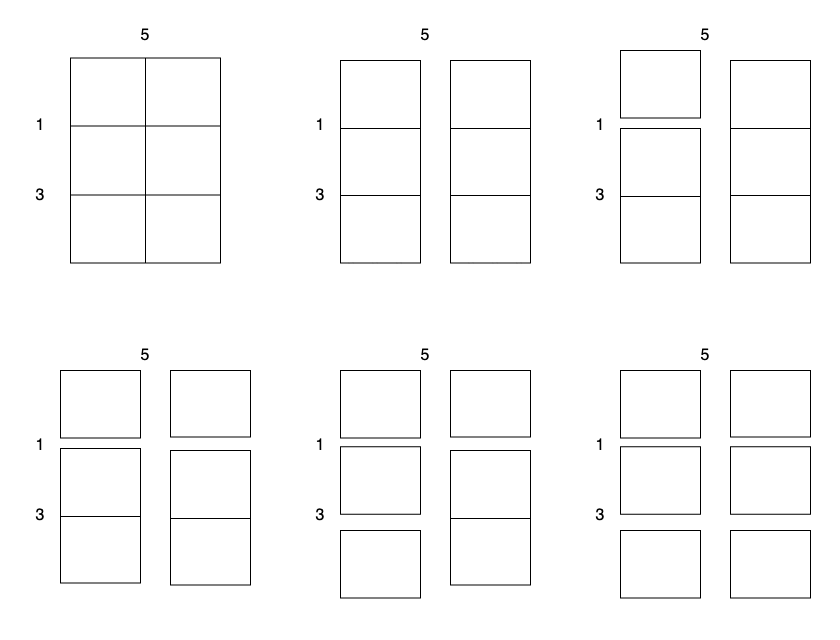
- Perform a cut on the vertical line 0 with cost 5, current total cost is 5.
- Perform a cut on the horizontal line 0 on
3 x 1subgrid with cost 1. - Perform a cut on the horizontal line 0 on
3 x 1subgrid with cost 1. - Perform a cut on the horizontal line 1 on
2 x 1subgrid with cost 3. - Perform a cut on the horizontal line 1 on
2 x 1subgrid with cost 3.
The total cost is 5 + 1 + 1 + 3 + 3 = 13.
Example 2:
Input: m = 2, n = 2, horizontalCut = [7], verticalCut = [4]
Output: 15
Explanation:
- Perform a cut on the horizontal line 0 with cost 7.
- Perform a cut on the vertical line 0 on
1 x 2subgrid with cost 4. - Perform a cut on the vertical line 0 on
1 x 2subgrid with cost 4.
The total cost is 7 + 4 + 4 = 15.
Constraints:
1 <= m, n <= 20horizontalCut.length == m - 1verticalCut.length == n - 11 <= horizontalCut[i], verticalCut[i] <= 103
Approaches
2 approaches with complexity analysis and trade-offs.
This approach attempts to solve the problem by exploring all possible sequences of cuts. A recursive function is defined to calculate the minimum cost from a given state, where the state is defined by which cuts have already been performed. To optimize the plain recursion, memoization (a top-down dynamic programming technique) is used to store and reuse the results of subproblems that have already been solved.
Algorithm
- Define a recursive function, say
solve(hMask, vMask), wherehMaskandvMaskare bitmasks representing the horizontal and vertical cuts that have already been made. - The base case for the recursion is when all cuts are made (i.e., all bits in
hMaskandvMaskare set). In this case, the cost is 0. - In the recursive step, calculate the current number of horizontal pieces (
hPieces = popcount(hMask) + 1) and vertical pieces (vPieces = popcount(vMask) + 1). - Iterate through all possible next cuts (both horizontal and vertical) that haven't been made yet.
- For each available horizontal cut
i, calculate the cost ashorizontalCut[i] * vPiecesand recursively callsolvewith the updatedhMask. - For each available vertical cut
j, calculate the cost asverticalCut[j] * hPiecesand recursively callsolvewith the updatedvMask. - The function returns the minimum cost found among all possible next cuts.
- Use a 2D array for memoization,
memo[hMask][vMask], to store the results of subproblems and avoid redundant calculations.
Walkthrough
The state of our recursive function can be defined by the set of cuts that have already been made. We can use two integer bitmasks, hMask and vMask, to keep track of the horizontal and vertical cuts performed. solve(hMask, vMask) would then compute the minimum additional cost to cut the cake completely, given the cuts represented by the masks have been made.
The number of horizontal pieces is Integer.bitCount(hMask) + 1, and the number of vertical pieces is Integer.bitCount(vMask) + 1. When we decide to make a new horizontal cut i, its cost will be horizontalCut[i] multiplied by the current number of vertical pieces. Similarly, a new vertical cut j costs verticalCut[j] multiplied by the current number of horizontal pieces.
The recursion explores every possible next cut, adds its cost to the result of the subsequent recursive call, and finds the minimum among all choices. However, with m, n <= 20, the number of states (2^(m-1) * 2^(n-1)) is prohibitively large, leading to a Time Limit Exceeded (TLE) error.
// This is a conceptual implementation and will result in Time Limit Exceeded.class Solution { long[][] memo; int m, n; int[] horizontalCut, verticalCut; public long minimumCost(int m, int n, int[] horizontalCut, int[] verticalCut) { this.m = m; this.n = n; this.horizontalCut = horizontalCut; this.verticalCut = verticalCut; // The state space 2^(m-1) * 2^(n-1) is too large for the given constraints. // For example, if m=20, n=20, we'd need a memo table of size 2^19 * 2^19. // This code is for demonstration of the concept. // memo = new long[1 << (m - 1)][1 << (n - 1)]; // for (long[] row : memo) Arrays.fill(row, -1); return solve(0, 0); } private long solve(int hMask, int vMask) { if (hMask == (1 << (m - 1)) - 1 && vMask == (1 << (n - 1)) - 1) { return 0; } // if (memo[hMask][vMask] != -1) return memo[hMask][vMask]; long minCost = Long.MAX_VALUE; int hPieces = Integer.bitCount(hMask) + 1; int vPieces = Integer.bitCount(vMask) + 1; // Try making an unmade horizontal cut for (int i = 0; i < m - 1; i++) { if ((hMask & (1 << i)) == 0) { long currentCost = (long) horizontalCut[i] * vPieces; minCost = Math.min(minCost, currentCost + solve(hMask | (1 << i), vMask)); } } // Try making an unmade vertical cut for (int j = 0; j < n - 1; j++) { if ((vMask & (1 << j)) == 0) { long currentCost = (long) verticalCut[j] * hPieces; minCost = Math.min(minCost, currentCost + solve(hMask, vMask | (1 << j))); } } // return memo[hMask][vMask] = minCost; return minCost; }}Complexity
Time
O((m+n) * 2^(m+n)). There are `2^(m+n-2)` states, and for each state, we iterate through up to `m+n-2` possible cuts.
Space
O(2^(m+n)). The memoization table would have `2^(m-1) * 2^(n-1)` states. This is infeasible for the given constraints.
Trade-offs
Pros
It is a systematic way to explore the entire search space, guaranteeing an optimal solution if it runs to completion.
The logic is a direct translation of the problem definition into a recursive structure.
Cons
The time complexity is exponential, making it too slow for the given constraints.
The space complexity is also exponential due to the memoization table, which is not feasible for the given constraints.
Solutions
Solution
class Solution {public int minimumCost(int m, int n, int[] horizontalCut, int[] verticalCut) { Arrays.sort(horizontalCut); Arrays.sort(verticalCut); int ans = 0; int i = m - 2, j = n - 2; int h = 1, v = 1; while (i >= 0 || j >= 0) { if (j < 0 || (i >= 0 && horizontalCut[i] > verticalCut[j])) { ans += horizontalCut[i--] * v; ++h; } else { ans += verticalCut[j--] * h; ++v; } } return ans; }}Video walkthrough
Newsletter
One sharp idea, every week
System design and interview prep — short enough to finish.
No spam. Unsubscribe anytime.
Practice
Same difficulty — related problems to reinforce the pattern.