
Minimum Cost to Make at Least One Valid Path in a Grid
HardPrompt
Given an m x n grid. Each cell of the grid has a sign pointing to the next cell you should visit if you are currently in this cell. The sign of grid[i][j] can be:
1which means go to the cell to the right. (i.e go fromgrid[i][j]togrid[i][j + 1])2which means go to the cell to the left. (i.e go fromgrid[i][j]togrid[i][j - 1])3which means go to the lower cell. (i.e go fromgrid[i][j]togrid[i + 1][j])4which means go to the upper cell. (i.e go fromgrid[i][j]togrid[i - 1][j])
Notice that there could be some signs on the cells of the grid that point outside the grid.
You will initially start at the upper left cell (0, 0). A valid path in the grid is a path that starts from the upper left cell (0, 0) and ends at the bottom-right cell (m - 1, n - 1) following the signs on the grid. The valid path does not have to be the shortest.
You can modify the sign on a cell with cost = 1. You can modify the sign on a cell one time only.
Return the minimum cost to make the grid have at least one valid path.
Example 1:
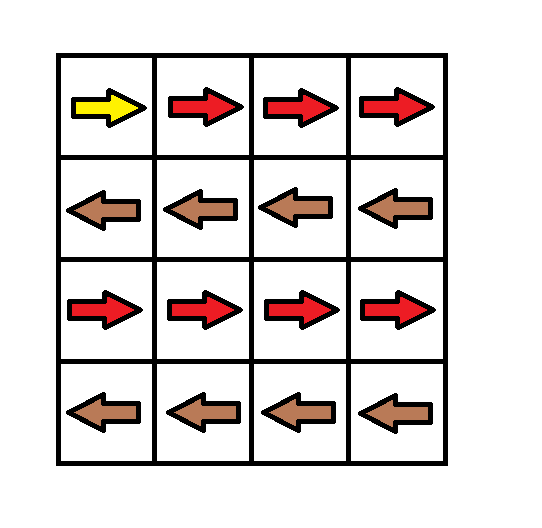
Input: grid = [[1,1,1,1],[2,2,2,2],[1,1,1,1],[2,2,2,2]]
Output: 3
Explanation: You will start at point (0, 0).
The path to (3, 3) is as follows. (0, 0) --> (0, 1) --> (0, 2) --> (0, 3) change the arrow to down with cost = 1 --> (1, 3) --> (1, 2) --> (1, 1) --> (1, 0) change the arrow to down with cost = 1 --> (2, 0) --> (2, 1) --> (2, 2) --> (2, 3) change the arrow to down with cost = 1 --> (3, 3)
The total cost = 3.
Example 2:
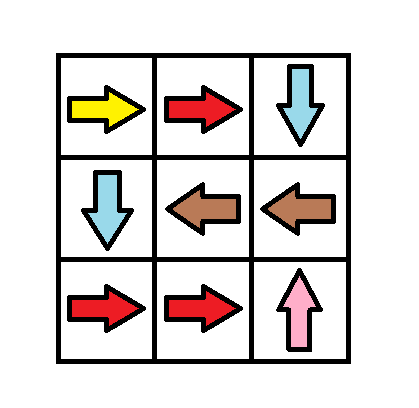
Input: grid = [[1,1,3],[3,2,2],[1,1,4]]
Output: 0
Explanation: You can follow the path from (0, 0) to (2, 2).
Example 3:
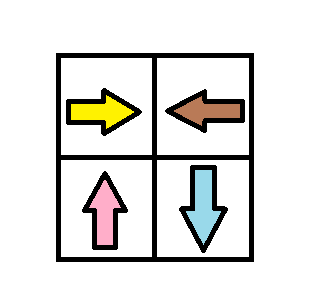
Input: grid = [[1,2],[4,3]]
Output: 1
Constraints:
m == grid.lengthn == grid[i].length1 <= m, n <= 1001 <= grid[i][j] <= 4
Approaches
3 approaches with complexity analysis and trade-offs.
This problem can be modeled as finding the shortest path in a weighted graph. The grid cells are the vertices, and possible moves between adjacent cells are the edges. A move that follows the grid's sign has a weight of 0, while a move that requires changing the sign has a weight of 1. The Bellman-Ford algorithm is a classic algorithm for finding the shortest paths from a single source vertex to all other vertices in a weighted digraph. While it's more general than needed here (it can handle negative edge weights), it provides a straightforward, albeit inefficient, solution.
Algorithm
- Initialize a
distarray of sizem x nwith infinity, and setdist[0][0] = 0. - Repeat
m * ntimes:- For each cell
(r, c)from(0, 0)to(m-1, n-1):- For each of the four possible directions
d(1 to 4):- Calculate the neighbor cell
(nr, nc). - If
(nr, nc)is within the grid boundaries:- Determine the
edge_cost: 0 ifdmatchesgrid[r][c], 1 otherwise. - Update the cost to the neighbor:
dist[nr][nc] = min(dist[nr][nc], dist[r][c] + edge_cost).
- Determine the
- Calculate the neighbor cell
- For each of the four possible directions
- For each cell
- Return
dist[m-1][n-1].
Walkthrough
We create a 2D array dist[m][n] to store the minimum cost to reach each cell (i, j) from the start (0, 0). Initialize all costs to infinity, except for dist[0][0], which is 0.
The algorithm works by repeatedly relaxing edges. We iterate m * n times (the total number of vertices). In each iteration, we traverse all cells (r, c) in the grid.
For each cell (r, c), we consider moving to its four neighbors (nr, nc).
The cost of an edge from (r, c) to (nr, nc) is 0 if the move aligns with the sign at grid[r][c], and 1 otherwise.
We "relax" the edge by updating the cost to the neighbor: dist[nr][nc] = min(dist[nr][nc], dist[r][c] + edge_cost).
After m * n - 1 iterations, dist[m-1][n-1] will hold the minimum cost to reach the destination. The extra iteration is to ensure convergence for the longest possible simple path.
The final answer is dist[m-1][n-1].
class Solution { public int minCost(int[][] grid) { int m = grid.length; int n = grid[0].length; int[][] dist = new int[m][n]; for (int i = 0; i < m; i++) { java.util.Arrays.fill(dist[i], Integer.MAX_VALUE); } dist[0][0] = 0; int[][] dirs = {{0, 1}, {0, -1}, {1, 0}, {-1, 0}}; // R, L, D, U -> map to 1, 2, 3, 4 boolean changed = true; // We can optimize by stopping if no distances change in an iteration. // A simple path has at most m*n-1 edges. for (int i = 0; i < m * n && changed; i++) { changed = false; for (int r = 0; r < m; r++) { for (int c = 0; c < n; c++) { if (dist[r][c] == Integer.MAX_VALUE) { continue; } for (int j = 0; j < 4; j++) { int nr = r + dirs[j][0]; int nc = c + dirs[j][1]; if (nr >= 0 && nr < m && nc >= 0 && nc < n) { int cost = (grid[r][c] == j + 1) ? 0 : 1; if (dist[r][c] + cost < dist[nr][nc]) { dist[nr][nc] = dist[r][c] + cost; changed = true; } } } } } } return dist[m - 1][n - 1]; }}Complexity
Time
`O((m*n)^2)`. The outer loop runs `m*n` times, and the inner loops iterate through all `m*n` cells and their 4 neighbors.
Space
`O(m*n)` to store the `dist` array.
Trade-offs
Pros
Relatively simple to understand and implement.
Correctly solves the problem.
Cons
Very inefficient due to its high time complexity. It re-evaluates all
m*ncells in each of them*niterations.
Solutions
Solution
class Solution { public int minCost ( int [][] grid ) { int m = grid . length , n = grid [ 0 ]. length ; boolean [][] vis = new boolean [ m ][ n ]; Deque < int []> q = new ArrayDeque <>(); q . offer ( new int [] { 0 , 0 , 0 }); int [][] dirs = { { 0 , 0 }, { 0 , 1 }, { 0 , - 1 }, { 1 , 0 }, {- 1 , 0 } }; while (! q . isEmpty ()) { int [] p = q . poll (); int i = p [ 0 ], j = p [ 1 ], d = p [ 2 ]; if ( i == m - 1 && j == n - 1 ) { return d ; } if ( vis [ i ][ j ]) { continue ; } vis [ i ][ j ] = true ; for ( int k = 1 ; k <= 4 ; ++ k ) { int x = i + dirs [ k ][ 0 ], y = j + dirs [ k ][ 1 ]; if ( x >= 0 && x < m && y >= 0 && y < n ) { if ( grid [ i ][ j ] == k ) { q . offerFirst ( new int [] { x , y , d }); } else { q . offer ( new int [] { x , y , d + 1 }); } } } } return - 1 ; } }Video walkthrough
Newsletter
One sharp idea, every week
System design and interview prep — short enough to finish.
No spam. Unsubscribe anytime.
Practice
Same difficulty — related problems to reinforce the pattern.