
Minimum Cost to Set Cooking Time
MedPrompt
A generic microwave supports cooking times for:
- at least
1second. - at most
99minutes and99seconds.
To set the cooking time, you push at most four digits. The microwave normalizes what you push as four digits by prepending zeroes. It interprets the first two digits as the minutes and the last two digits as the seconds. It then adds them up as the cooking time. For example,
- You push
954(three digits). It is normalized as0954and interpreted as9minutes and54seconds. - You push
0008(four digits). It is interpreted as0minutes and8seconds. - You push
8090. It is interpreted as80minutes and90seconds. - You push
8130. It is interpreted as81minutes and30seconds.
You are given integers startAt, moveCost, pushCost, and targetSeconds. Initially, your finger is on the digit startAt. Moving the finger above any specific digit costs moveCost units of fatigue. Pushing the digit below the finger once costs pushCost units of fatigue.
There can be multiple ways to set the microwave to cook for targetSeconds seconds but you are interested in the way with the minimum cost.
Return the minimum cost to set targetSeconds seconds of cooking time.
Remember that one minute consists of 60 seconds.
Example 1:
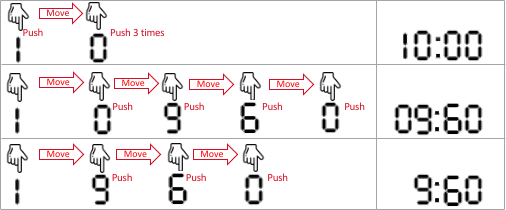
Input: startAt = 1, moveCost = 2, pushCost = 1, targetSeconds = 600
Output: 6
Explanation: The following are the possible ways to set the cooking time.
- 1 0 0 0, interpreted as 10 minutes and 0 seconds.
  The finger is already on digit 1, pushes 1 (with cost 1), moves to 0 (with cost 2), pushes 0 (with cost 1), pushes 0 (with cost 1), and pushes 0 (with cost 1).
  The cost is: 1 + 2 + 1 + 1 + 1 = 6. This is the minimum cost.
- 0 9 6 0, interpreted as 9 minutes and 60 seconds. That is also 600 seconds.
  The finger moves to 0 (with cost 2), pushes 0 (with cost 1), moves to 9 (with cost 2), pushes 9 (with cost 1), moves to 6 (with cost 2), pushes 6 (with cost 1), moves to 0 (with cost 2), and pushes 0 (with cost 1).
  The cost is: 2 + 1 + 2 + 1 + 2 + 1 + 2 + 1 = 12.
- 9 6 0, normalized as 0960 and interpreted as 9 minutes and 60 seconds.
  The finger moves to 9 (with cost 2), pushes 9 (with cost 1), moves to 6 (with cost 2), pushes 6 (with cost 1), moves to 0 (with cost 2), and pushes 0 (with cost 1).
  The cost is: 2 + 1 + 2 + 1 + 2 + 1 = 9.
Example 2:

Input: startAt = 0, moveCost = 1, pushCost = 2, targetSeconds = 76
Output: 6
Explanation: The optimal way is to push two digits: 7 6, interpreted as 76 seconds.
The finger moves to 7 (with cost 1), pushes 7 (with cost 2), moves to 6 (with cost 1), and pushes 6 (with cost 2). The total cost is: 1 + 2 + 1 + 2 = 6
Note other possible ways are 0076, 076, 0116, and 116, but none of them produces the minimum cost.
Constraints:
0 <= startAt <= 91 <= moveCost, pushCost <= 1051 <= targetSeconds <= 6039
Approaches
2 approaches with complexity analysis and trade-offs.
This approach involves generating every possible sequence of digits that can be typed into the microwave, checking if it results in the targetSeconds, and calculating the cost if it does. Since the input is at most four digits, we can generate all number strings corresponding to numbers from 0 to 9999.
Algorithm
- Initialize
minCostto a very large value. - Create a helper function
calculateCost(string, startAt, moveCost, pushCost)to compute the cost of typing a sequence of digits. - Loop through all possible numerical inputs
ifrom 0 to 9999. These represent all possible typed strings of up to 4 digits. - For each
i:- The microwave normalizes this input by prepending zeros to make it 4 digits. The first two digits become minutes and the last two become seconds. This is equivalent to
minutes = i / 100andseconds = i % 100. - Check if the interpreted
minutesandsecondsare valid (i.e., not exceeding 99). Ifminutes > 99orseconds > 99, this input is invalid, so we skip it. - Calculate the total time in seconds:
totalSeconds = minutes * 60 + seconds. - If
totalSecondsequalstargetSeconds:- This input
iis a valid way to set the time. - Convert
ito its string representation,timeStr. - Calculate the cost of typing
timeStrusing the helper function. - Update
minCostwith the minimum cost found so far.
- This input
- The microwave normalizes this input by prepending zeros to make it 4 digits. The first two digits become minutes and the last two become seconds. This is equivalent to
- After checking all numbers up to 9999, return
minCost.
Walkthrough
The core idea is to simulate the process from the user's perspective: trying every possible input. We can iterate through all numbers from 0 to 9999, which covers all inputs from one to four digits (e.g., 8, 76, 954, 1000). For each number, we determine the time it sets on the microwave based on the given normalization and interpretation rules. If this time matches the targetSeconds, we calculate the cost of typing that number and update our overall minimum cost. This method is exhaustive and guarantees finding a solution if one exists within the 4-digit input limit.
Complexity
Time
O(1) - The main loop runs a fixed number of times (10,000 iterations). Inside the loop, all operations (arithmetic, string conversion, and cost calculation for a string of at most 4 characters) take constant time. While technically O(1), the constant factor is large compared to the optimal approach.
Space
O(1) - The space required is constant as we only need a few variables to store the minimum cost and loop counters.
Trade-offs
Pros
The logic is straightforward and directly models the problem of trying all inputs.
It is guaranteed to find the minimum cost because it explores the entire search space of possible inputs.
Cons
This approach is inefficient as it checks a large number of possibilities (10,000 inputs), most of which will not result in the
targetSeconds.
Solutions
Solution
class Solution {public int minCostSetTime(int startAt, int moveCost, int pushCost, int targetSeconds) { int m = targetSeconds / 60; int s = targetSeconds % 60; return Math.min(f(m, s, startAt, moveCost, pushCost), f(m - 1, s + 60, startAt, moveCost, pushCost)); }private int f(int m, int s, int prev, int moveCost, int pushCost) { if (m < 0 || m > 99 || s < 0 || s > 99) { return Integer.MAX_VALUE; } int[] arr = new int[]{m / 10, m % 10, s / 10, s % 10}; int i = 0; for (; i < 4 && arr[i] == 0; ++i) ; int t = 0; for (; i < 4; ++i) { if (arr[i] != prev) { t += moveCost; } t += pushCost; prev = arr[i]; } return t; }}Video walkthrough
Newsletter
One sharp idea, every week
System design and interview prep — short enough to finish.
No spam. Unsubscribe anytime.
Practice
Same difficulty — related problems to reinforce the pattern.