
Minimum Difficulty of a Job Schedule
HardPrompt
You want to schedule a list of jobs in d days. Jobs are dependent (i.e To work on the ith job, you have to finish all the jobs j where 0 <= j < i).
You have to finish at least one task every day. The difficulty of a job schedule is the sum of difficulties of each day of the d days. The difficulty of a day is the maximum difficulty of a job done on that day.
You are given an integer array jobDifficulty and an integer d. The difficulty of the ith job is jobDifficulty[i].
Return the minimum difficulty of a job schedule. If you cannot find a schedule for the jobs return -1.
Example 1:
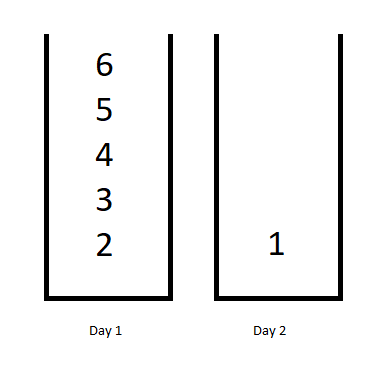
Input: jobDifficulty = [6,5,4,3,2,1], d = 2
Output: 7
Explanation: First day you can finish the first 5 jobs, total difficulty = 6.
Second day you can finish the last job, total difficulty = 1.
The difficulty of the schedule = 6 + 1 = 7
Example 2:
Input: jobDifficulty = [9,9,9], d = 4
Output: -1
Explanation: If you finish a job per day you will still have a free day. you cannot find a schedule for the given jobs.
Example 3:
Input: jobDifficulty = [1,1,1], d = 3
Output: 3
Explanation: The schedule is one job per day. total difficulty will be 3.
Constraints:
1 <= jobDifficulty.length <= 3000 <= jobDifficulty[i] <= 10001 <= d <= 10
Approaches
3 approaches with complexity analysis and trade-offs.
This problem has optimal substructure and overlapping subproblems, making it a good candidate for dynamic programming. A straightforward way to approach DP is through top-down recursion with memoization.
We can define a recursive function solve(i, d) that calculates the minimum difficulty to schedule jobs from index i to the end of the array within d days. To find the solution for the original problem, we would call solve(0, d).
In the function solve(i, d), we try all possible ways to schedule the jobs for the current day. We can schedule jobs from i to j, where j is a valid split point. The difficulty for this day would be the maximum job difficulty in the range [i, j]. The remaining jobs from j+1 to the end must then be scheduled in d-1 days. We recursively call our function for this subproblem: solve(j+1, d-1). We take the minimum over all possible split points j.
To avoid recomputing the same subproblem (i, d) multiple times, we use a 2D array memo to store the results. Before computing solve(i, d), we check if the result is already in our memoization table.
Algorithm
- Base Case: If the number of jobs
nis less than the number of daysd, it's impossible to schedule. Return -1. - Recursive Function: Define a function, say
solve(i, daysLeft), which computes the minimum difficulty to schedule jobs from indexiton-1indaysLeftdays. - Memoization: Use a 2D array,
memo[i][daysLeft], to store the results of subproblems to avoid re-computation. Initialize it with a value like -1. - Recursive Step:
- For the current day, we can take jobs from
itoj. The number of remaining jobsn - (j+1)must be at leastdaysLeft - 1. - The difficulty for the current day is
max(jobDifficulty[i...j]). - The difficulty for the remaining days is
solve(j+1, daysLeft - 1). - We iterate through all valid split points
j(fromiton - daysLeft) and find the minimum total difficulty:min(max(jobDifficulty[i...j]) + solve(j+1, daysLeft - 1)).
- For the current day, we can take jobs from
- Base Case for Recursion: If
daysLeftis 1, we must schedule all remaining jobs (iton-1) on this day. The difficulty ismax(jobDifficulty[i...n-1]). - Return Value: The final answer is the result of
solve(0, d). If the result is infinity (or a very large number used for initialization), it means no valid schedule was found, but our initial checkn < dshould handle this.
Walkthrough
class Solution { private int n; private int[] jobDifficulty; private int d; private int[][] memo; public int minDifficulty(int[] jobDifficulty, int d) { this.n = jobDifficulty.length; if (n < d) { return -1; } this.jobDifficulty = jobDifficulty; this.d = d; this.memo = new int[n][d + 1]; for (int i = 0; i < n; i++) { Arrays.fill(memo[i], -1); } return solve(0, d); } private int solve(int i, int daysLeft) { // If we have already computed this subproblem, return the stored result. if (memo[i][daysLeft] != -1) { return memo[i][daysLeft]; } // Base case: If only one day is left, we must do all remaining jobs. // The difficulty for this day is the max difficulty among the remaining jobs. if (daysLeft == 1) { int maxDifficulty = 0; for (int k = i; k < n; k++) { maxDifficulty = Math.max(maxDifficulty, jobDifficulty[k]); } return memo[i][daysLeft] = maxDifficulty; } int minTotalDifficulty = Integer.MAX_VALUE; int maxDifficultyCurrentDay = 0; // Iterate through all possible split points 'j'. // We must leave at least 'daysLeft - 1' jobs for the remaining days. for (int j = i; j <= n - daysLeft; j++) { maxDifficultyCurrentDay = Math.max(maxDifficultyCurrentDay, jobDifficulty[j]); int remainingDifficulty = solve(j + 1, daysLeft - 1); // If the subproblem is solvable if (remainingDifficulty != Integer.MAX_VALUE) { minTotalDifficulty = Math.min(minTotalDifficulty, maxDifficultyCurrentDay + remainingDifficulty); } } return memo[i][daysLeft] = minTotalDifficulty; }}Complexity
Time
O(n^2 * d). There are `n * d` states for our `solve(i, daysLeft)` function. For each state, we iterate from `i` to `n - daysLeft`, which can be up to `O(n)` iterations. Inside the loop, we do constant time work (as the recursive call's result will be memoized). Thus, the total time complexity is `O(n * d * n) = O(n^2 * d)`.
Space
O(n * d), where `n` is the number of jobs and `d` is the number of days. This is for the memoization table `memo`. The recursion stack depth is at most `d`.
Trade-offs
Pros
Relatively intuitive to formulate from the problem's recursive nature.
Correctly solves the problem within the given constraints.
Cons
The time and space complexity are not optimal.
Can lead to a
StackOverflowErrorfor very deep recursion, althoughdis small here, so it's not a major concern.
Solutions
Solution
class Solution {public int minDifficulty(int[] jobDifficulty, int d) { final int inf = 1 << 30; int n = jobDifficulty.length; int[][] f = new int[n + 1][d + 1]; for (var g : f) { Arrays.fill(g, inf); } f[0][0] = 0; for (int i = 1; i <= n; ++i) { for (int j = 1; j <= Math.min(d, i); ++j) { int mx = 0; for (int k = i; k > 0; --k) { mx = Math.max(mx, jobDifficulty[k - 1]); f[i][j] = Math.min(f[i][j], f[k - 1][j - 1] + mx); } } } return f[n][d] >= inf ? -1 : f[n][d]; }}Video walkthrough
Newsletter
One sharp idea, every week
System design and interview prep — short enough to finish.
No spam. Unsubscribe anytime.
Practice
Same difficulty — related problems to reinforce the pattern.