
Minimum Edge Reversals So Every Node Is Reachable
HardPrompt
There is a simple directed graph with n nodes labeled from 0 to n - 1. The graph would form a tree if its edges were bi-directional.
You are given an integer n and a 2D integer array edges, where edges[i] = [ui, vi] represents a directed edge going from node ui to node vi.
An edge reversal changes the direction of an edge, i.e., a directed edge going from node ui to node vi becomes a directed edge going from node vi to node ui.
For every node i in the range [0, n - 1], your task is to independently calculate the minimum number of edge reversals required so it is possible to reach any other node starting from node i through a sequence of directed edges.
Return an integer array answer, where answer[i] is the minimum number of edge reversals required so it is possible to reach any other node starting from node i through a sequence of directed edges.
Example 1:
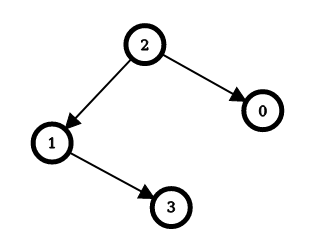
Input: n = 4, edges = [[2,0],[2,1],[1,3]]
Output: [1,1,0,2]
Explanation: The image above shows the graph formed by the edges.
For node 0: after reversing the edge [2,0], it is possible to reach any other node starting from node 0.
So, answer[0] = 1.
For node 1: after reversing the edge [2,1], it is possible to reach any other node starting from node 1.
So, answer[1] = 1.
For node 2: it is already possible to reach any other node starting from node 2.
So, answer[2] = 0.
For node 3: after reversing the edges [1,3] and [2,1], it is possible to reach any other node starting from node 3.
So, answer[3] = 2.
Example 2:
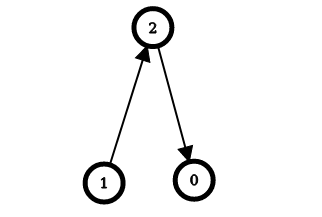
Input: n = 3, edges = [[1,2],[2,0]]
Output: [2,0,1]
Explanation: The image above shows the graph formed by the edges.
For node 0: after reversing the edges [2,0] and [1,2], it is possible to reach any other node starting from node 0.
So, answer[0] = 2.
For node 1: it is already possible to reach any other node starting from node 1.
So, answer[1] = 0.
For node 2: after reversing the edge [1, 2], it is possible to reach any other node starting from node 2.
So, answer[2] = 1.
Constraints:
2 <= n <= 105edges.length == n - 1edges[i].length == 20 <= ui == edges[i][0] < n0 <= vi == edges[i][1] < nui != vi- The input is generated such that if the edges were bi-directional, the graph would be a tree.
Approaches
2 approaches with complexity analysis and trade-offs.
This approach iterates through each node from 0 to n-1, treating each one as a potential root. For each potential root, it calculates the minimum number of edge reversals required to make all other nodes reachable.
Algorithm
- Create an adjacency list for the undirected version of the graph.
- Store the original directed edges in a
HashSetfor efficient lookups. - Iterate through each node
ifrom0ton-1.- For each
i, perform a Breadth-First Search (BFS) or Depth-First Search (DFS) starting fromi. - Initialize a
reversalscount to 0. - During the traversal from a node
uto a neighborv, check if the original edge wasv -> u. - If it was, increment the
reversalscount. - After the traversal is complete, store the total
reversalsinanswer[i].
- For each
- Return the
answerarray.
Walkthrough
To make all nodes reachable from a starting node i, the graph must form a directed tree rooted at i, where all edges point away from the root. The underlying undirected graph is a tree, so there's a unique path from i to any other node j. We need to ensure all edges on these paths are directed away from i.
The algorithm for each potential root i is as follows:
- Initialize a counter for reversals to zero.
- Perform a graph traversal (like BFS or DFS) starting from
ion the underlying undirected graph structure. - To do this, we first build an undirected adjacency list from the given directed edges. We also need a way to check the original direction of an edge, for example, by storing the directed edges in a
HashSetof pairs. - During the traversal, whenever we move from a node
uto a neighborv, we check the original direction of the edge between them. - If the original edge was
v -> u, it's pointing towards the rootiinstead of away from it. This edge must be reversed, so we increment the reversal counter. - After the traversal completes, the counter holds the total number of reversals needed for
ito be the root. This value is stored inanswer[i]. - This process is repeated for all
nnodes.
import java.util.*; class Solution { public int[] minEdgeReversals(int n, int[][] edges) { // Store original directed edges for quick lookup Set<String> originalEdges = new HashSet<>(); List<List<Integer>> adj = new ArrayList<>(); for (int i = 0; i < n; i++) { adj.add(new ArrayList<>()); } for (int[] edge : edges) { int u = edge[0]; int v = edge[1]; originalEdges.add(u + "," + v); adj.get(u).add(v); adj.get(v).add(u); } int[] answer = new int[n]; for (int i = 0; i < n; i++) { answer[i] = countReversalsForRoot(i, n, adj, originalEdges); } return answer; } private int countReversalsForRoot(int root, int n, List<List<Integer>> adj, Set<String> originalEdges) { int reversals = 0; Queue<Integer> queue = new LinkedList<>(); boolean[] visited = new boolean[n]; queue.offer(root); visited[root] = true; while (!queue.isEmpty()) { int u = queue.poll(); for (int v : adj.get(u)) { if (!visited[v]) { visited[v] = true; // We are traversing from u to v. // The edge should be u -> v. // If the original edge is v -> u, we need a reversal. if (originalEdges.contains(v + "," + u)) { reversals++; } queue.offer(v); } } } return reversals; }}Complexity
Time
O(N^2). For each of the `N` nodes, we perform a full graph traversal (BFS/DFS), which takes `O(N + E)` time. Since `E = N-1`, this is `O(N)`. Repeating this `N` times gives `O(N^2)`.
Space
O(N). We need `O(N)` space for the adjacency list, `O(N)` for the `HashSet` of edges, and `O(N)` for the BFS queue and `visited` array.
Trade-offs
Pros
Simple to understand and implement.
Correctly solves the problem by simulating the process for each node.
Cons
Inefficient due to re-computation. The
O(N^2)time complexity is too slow for the given constraints (n <= 10^5).
Solutions
Solution
class Solution {private List<int[]>[] g;private int[] ans;public int[] minEdgeReversals(int n, int[][] edges) { ans = new int[n]; g = new List[n]; Arrays.setAll(g, i->new ArrayList<>()); for (var e : edges) { int x = e[0], y = e[1]; g[x].add(new int[]{y, 1}); g[y].add(new int[]{x, -1}); } dfs(0, -1); dfs2(0, -1); return ans; }private void dfs(int i, int fa) { for (var ne : g[i]) { int j = ne[0], k = ne[1]; if (j != fa) { ans[0] += k < 0 ? 1 : 0; dfs(j, i); } } }private void dfs2(int i, int fa) { for (var ne : g[i]) { int j = ne[0], k = ne[1]; if (j != fa) { ans[j] = ans[i] + k; dfs2(j, i); } } }}Video walkthrough
Newsletter
One sharp idea, every week
System design and interview prep — short enough to finish.
No spam. Unsubscribe anytime.
Practice
Same difficulty — related problems to reinforce the pattern.