
Minimum Flips to Make a OR b Equal to c
MedPrompt
Given 3 positives numbers a, b and c. Return the minimum flips required in some bits of a and b to make ( a OR b == c ). (bitwise OR operation).
Flip operation consists of change any single bit 1 to 0 or change the bit 0 to 1 in their binary representation.
Example 1:
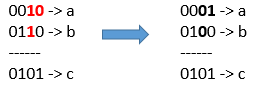
aExample 2:
Input: a = 4, b = 2, c = 7
Output: 1
Example 3:
Input: a = 1, b = 2, c = 3
Output: 0
Constraints:
1 <= a <= 10^91 <= b <= 10^91 <= c <= 10^9
Approaches
2 approaches with complexity analysis and trade-offs.
This approach first converts the integers into their binary string representations. To compare them bit by bit, the strings are padded with leading zeros to ensure they all have the same length. Then, we can iterate through the characters of the strings, representing the bits, and count the necessary flips based on the problem's logic.
Algorithm
- Convert the integers
a,b, andcto their binary string representations. - Determine the maximum length among the three binary strings.
- Pad the shorter binary strings with leading zeros to make all strings of equal length. This ensures a correct bit-by-bit comparison.
- Initialize a
flipscounter to zero. - Iterate through the strings from left to right (from the most significant bit to the least significant bit).
- In each position
i, examine the bits (characters)bit_a,bit_b, andbit_c. - Apply the flip logic:
- If
bit_cis '0', then bothbit_aandbit_bmust be '0'. Add 1 toflipsfor each ofbit_aorbit_bthat is '1'. - If
bit_cis '1', thenbit_aorbit_b(or both) must be '1'. If both are '0', a single flip is required. Add 1 toflips.
- If
- Return the total
flipscount.
Walkthrough
The core idea is to transform the problem from the domain of integer bitwise operations to string manipulation. By converting a, b, and c to binary strings, we can visually inspect each bit position.
For example, if a=2, b=6, c=5, their binary strings are "10", "110", and "101". The maximum length is 3. We pad the strings to get a="010", b="110", c="101". Now we can compare them position by position:
- Position 0 (MSB):
a='0',b='1',c='1'.0|1 = 1. This matchesc's bit. 0 flips. - Position 1:
a='1',b='1',c='0'.1|1 = 1. This does not matchc's bit. To make the result '0', bothaandbmust be '0'. We need to flipa's bit andb's bit. 2 flips. - Position 2 (LSB):
a='0',b='0',c='1'.0|0 = 0. This does not matchc's bit. To make the result '1', we need to flip eithera's bit orb's bit. 1 flip.
Total flips = 0 + 2 + 1 = 3.
class Solution { public int minFlips(int a, int b, int c) { String aStr = Integer.toBinaryString(a); String bStr = Integer.toBinaryString(b); String cStr = Integer.toBinaryString(c); int len = Math.max(aStr.length(), Math.max(bStr.length(), cStr.length())); // Pad strings with leading zeros aStr = String.format("%" + len + "s", aStr).replace(' ', '0'); bStr = String.format("%" + len + "s", bStr).replace(' ', '0'); cStr = String.format("%" + len + "s", cStr).replace(' ', '0'); int flips = 0; for (int i = 0; i < len; i++) { char bitA = aStr.charAt(i); char bitB = bStr.charAt(i); char bitC = cStr.charAt(i); if (bitC == '0') { if (bitA == '1') flips++; if (bitB == '1') flips++; } else { // bitC == '1' if (bitA == '0' && bitB == '0') { flips++; } } } return flips; }}Complexity
Time
O(log N), where N is the maximum value among a, b, and c. The complexity is dominated by the string conversion and the loop that iterates through the bits. This is asymptotically efficient, but carries significant overhead.
Space
O(log N), where N is the maximum value among a, b, and c. This space is used to store the binary string representations of the numbers.
Trade-offs
Pros
May be more intuitive for developers who are less comfortable with direct bitwise manipulation.
The logic is explicit and follows a clear, readable flow.
Cons
Inefficient use of memory due to the creation of intermediate strings.
Slower performance because of the overhead associated with string conversions and manipulations compared to direct integer arithmetic.
Solutions
Solution
class Solution {public int minFlips(int a, int b, int c) { int ans = 0; for (int i = 0; i < 30; ++i) { int x = a >> i & 1, y = b >> i & 1, z = c >> i & 1; if ((x | y) != z) { ans += x == 1 && y == 1 ? 2 : 1; } } return ans; }}Video walkthrough
Newsletter
One sharp idea, every week
System design and interview prep — short enough to finish.
No spam. Unsubscribe anytime.
Practice
Same difficulty — related problems to reinforce the pattern.