
Minimum Number of Vertices to Reach All Nodes
MedPrompt
Given a directed acyclic graph, with n vertices numbered from 0 to n-1, and an array edges where edges[i] = [fromi, toi] represents a directed edge from node fromi to node toi.
Find the smallest set of vertices from which all nodes in the graph are reachable. It's guaranteed that a unique solution exists.
Notice that you can return the vertices in any order.
Example 1:
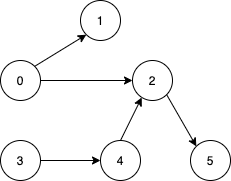
Input: n = 6, edges = [[0,1],[0,2],[2,5],[3,4],[4,2]]
Output: [0,3]
Explanation: It's not possible to reach all the nodes from a single vertex. From 0 we can reach [0,1,2,5]. From 3 we can reach [3,4,2,5]. So we output [0,3].
Example 2:
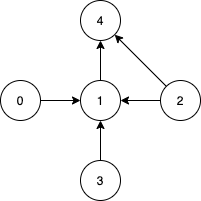
Input: n = 5, edges = [[0,1],[2,1],[3,1],[1,4],[2,4]]
Output: [0,2,3]
Explanation: Notice that vertices 0, 3 and 2 are not reachable from any other node, so we must include them. Also any of these vertices can reach nodes 1 and 4.
Constraints:
2 <= n <= 10^51 <= edges.length <= min(10^5, n * (n - 1) / 2)edges[i].length == 20 <= fromi, toi < n- All pairs
(fromi, toi)are distinct.
Approaches
2 approaches with complexity analysis and trade-offs.
This approach iterates through every node in the graph. For each node, it scans the entire list of edges to determine if there is any edge pointing to it. If no such edge is found after checking all edges, the node is considered a source vertex and is added to the result set.
Algorithm
- Initialize an empty list
result. - For each vertex
ifrom0ton-1:- Initialize a boolean flag
hasIncomingEdgetofalse. - For each edge
[u, v]in theedgeslist:- If
vis equal toi, sethasIncomingEdgetotrueand break the inner loop.
- If
- After the inner loop, if
hasIncomingEdgeisfalse, additoresult.
- Initialize a boolean flag
- Return
result.
Walkthrough
The core idea is to identify nodes that are not destinations in any of the directed edges. These nodes have an in-degree of zero.
- We initialize an empty list to store the result vertices.
- We then loop through each vertex
ifrom0ton-1. - Inside this loop, we assume the current vertex
ihas no incoming edges by using a flag, sayhasIncomingEdge, initialized tofalse. - We then start another loop that iterates through every edge in the
edgeslist. - In the inner loop, for each edge
[from, to], we check iftois equal to our current vertexi. - If we find such an edge, it means vertex
ihas an incoming edge. We sethasIncomingEdgetotrueand can break out of the inner loop since we've confirmed it's not a source. - After the inner loop finishes, we check the
hasIncomingEdgeflag. If it's stillfalse, it means no incoming edges were found for vertexi, so we addito our result list. - After checking all vertices from
0ton-1, the result list will contain all vertices with an in-degree of zero.
import java.util.ArrayList;import java.util.List; class Solution { public List<Integer> findSmallestSetOfVertices(int n, List<List<Integer>> edges) { List<Integer> result = new ArrayList<>(); for (int i = 0; i < n; i++) { boolean hasIncomingEdge = false; for (List<Integer> edge : edges) { if (edge.get(1) == i) { hasIncomingEdge = true; break; } } if (!hasIncomingEdge) { result.add(i); } } return result; }}Complexity
Time
O(n * E), where `n` is the number of vertices and `E` is the number of edges. For each of the `n` vertices, we may iterate through all `E` edges in the worst case.
Space
O(k), where `k` is the number of vertices with an in-degree of 0. In the worst case, `k` can be `n`, so the space complexity is O(n) for the result list.
Trade-offs
Pros
Simple to understand and implement without requiring any special data structures besides a list.
Works directly with the input edge list without needing to build a graph representation like an adjacency list.
Cons
Highly inefficient, especially for large graphs. The nested loop structure leads to a time complexity that is too slow for the given constraints.
Will likely result in a "Time Limit Exceeded" error on most competitive programming platforms.
Solutions
Solution
class Solution {public List<Integer> findSmallestSetOfVertices(int n, List<List<Integer>> edges) { var cnt = new int[n]; for (var e : edges) { ++cnt[e.get(1)]; } List<Integer> ans = new ArrayList<>(); for (int i = 0; i < n; ++i) { if (cnt[i] == 0) { ans.add(i); } } return ans; }}Video walkthrough
Newsletter
One sharp idea, every week
System design and interview prep — short enough to finish.
No spam. Unsubscribe anytime.
Practice
Same difficulty — related problems to reinforce the pattern.