
Number of Visible People in a Queue
HardPrompt
There are n people standing in a queue, and they numbered from 0 to n - 1 in left to right order. You are given an array heights of distinct integers where heights[i] represents the height of the ith person.
A person can see another person to their right in the queue if everybody in between is shorter than both of them. More formally, the ith person can see the jth person if i < j and min(heights[i], heights[j]) > max(heights[i+1], heights[i+2], ..., heights[j-1]).
Return an array answer of length n where answer[i] is the number of people the ith person can see to their right in the queue.
Example 1:
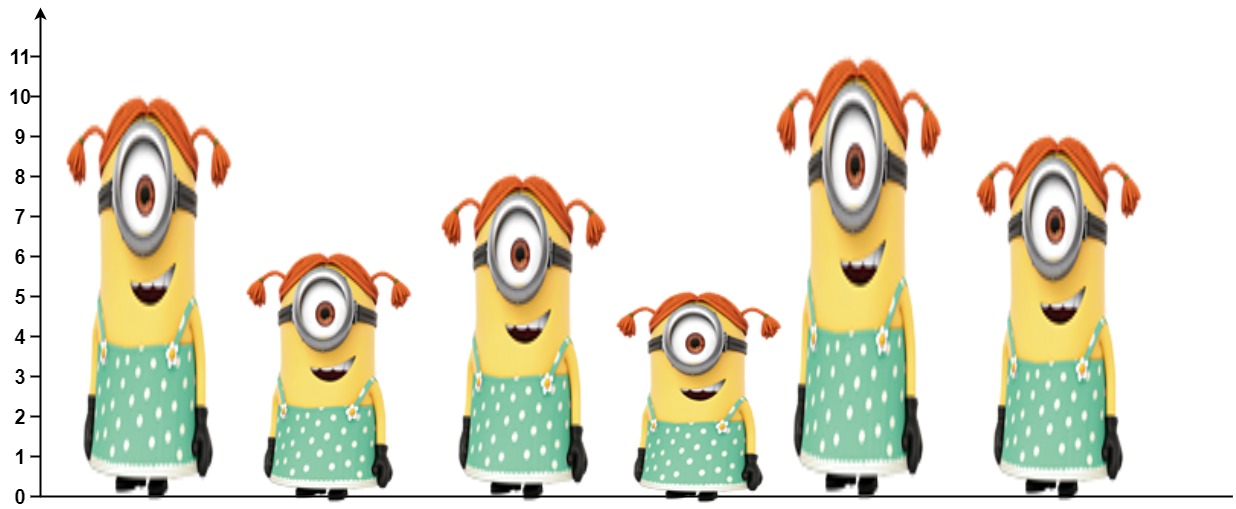
Input: heights = [10,6,8,5,11,9]
Output: [3,1,2,1,1,0]
Explanation:
Person 0 can see person 1, 2, and 4.
Person 1 can see person 2.
Person 2 can see person 3 and 4.
Person 3 can see person 4.
Person 4 can see person 5.
Person 5 can see no one since nobody is to the right of them.
Example 2:
Input: heights = [5,1,2,3,10]
Output: [4,1,1,1,0]
Constraints:
n == heights.length1 <= n <= 1051 <= heights[i] <= 105- All the values of
heightsare unique.
Approaches
2 approaches with complexity analysis and trade-offs.
This approach directly simulates the process for each person. We iterate through each person i from left to right. For each person i, we then scan all the people j to their right to count how many are visible. A key optimization is to stop scanning once we find a person taller than or equal to the current person i, as they will block the view of anyone further to the right.
Algorithm
- Create an integer array
answerof sizen, initialized to zeros. - Loop
ifrom0ton-1:- Initialize
count = 0. - Initialize
maxHeightOnRight = 0. - Loop
jfromi + 1ton-1:- Check if person
jis visible fromi. The condition ismin(heights[i], heights[j]) > maxHeightOnRight, wheremaxHeightOnRightstores the maximum height of people fromi+1toj-1. - If the condition is met, increment
count. - Update
maxHeightOnRight = max(maxHeightOnRight, heights[j]). - If a person
jis found such thatheights[j] >= heights[i], it meansicannot see anyone beyondj. So, we can break the inner loop.
- Check if person
answer[i] = count.
- Initialize
- Return
answer.
Walkthrough
We initialize an answer array of the same size as heights to store the results. The main logic consists of two nested loops. The outer loop iterates through each person i from 0 to n-1. The inner loop iterates through each person j to the right of i.
To apply the visibility rule min(heights[i], heights[j]) > max(heights[i+1], ..., heights[j-1]), we need the maximum height in the interval (i, j). Instead of recalculating this maximum for each j, we can maintain a running maximum of the heights encountered so far to the right of i. Let's call this maxHeightOnRight. For a fixed i, as we increment j, maxHeightOnRight at the beginning of the loop for j represents max(heights[i+1], ..., heights[j-1]).
If min(heights[i], heights[j]) > maxHeightOnRight, person j is visible to i, and we increment our count. After checking, we update maxHeightOnRight with heights[j] for the next iteration. A crucial optimization is that if we encounter a person j who is taller than or equal to person i, then person i cannot see anyone beyond j. This is because j will block the view. So, we can break the inner loop as soon as heights[j] is greater than or equal to heights[i].
class Solution { public int[] canSeePersonsCount(int[] heights) { int n = heights.length; int[] answer = new int[n]; for (int i = 0; i < n; i++) { int count = 0; int maxHeightOnRight = 0; for (int j = i + 1; j < n; j++) { if (Math.min(heights[i], heights[j]) > maxHeightOnRight) { count++; } if (heights[j] >= heights[i]) { break; } maxHeightOnRight = Math.max(maxHeightOnRight, heights[j]); } answer[i] = count; } return answer; }}Complexity
Time
O(N^2) in the worst case. The two nested loops give it a quadratic time complexity. For an input where heights are in descending order, the inner loop runs close to N times for each element of the outer loop.
Space
O(1) auxiliary space. We only use a few variables to keep track of counts and maximum heights. The output array `answer` is not considered part of the auxiliary space.
Trade-offs
Pros
The logic is straightforward and directly follows the problem definition.
It's easy to implement.
It has a very low auxiliary space complexity.
Cons
The O(N^2) time complexity makes it too slow for large inputs, as specified by the problem constraints (N up to 10^5). It will likely result in a 'Time Limit Exceeded' error.
A much more efficient solution can be achieved using a monotonic stack. By processing the people from right to left, we can determine the number of visible people for each person in a single pass. The stack is used to maintain a sequence of people to the right whose heights are in decreasing order. This structure allows for efficient calculation of visibility.
Algorithm
- Create an integer array
answerof sizen. - Create an empty stack (e.g.,
ArrayDeque) to store heights. - Loop
ifromn-1down to0:- Initialize
visibleCount = 0. - While the stack is not empty and
stack.peek() < heights[i]:- This means the person on top of the stack is shorter and visible.
- Pop from the stack.
- Increment
visibleCount.
- If the stack is not empty after the loop, it means there is a person taller than
heights[i]. This person is also visible.- Increment
visibleCount.
- Increment
- Store the result:
answer[i] = visibleCount. - Push
heights[i]onto the stack to maintain the monotonically decreasing property.
- Initialize
- Return
answer.
Walkthrough
This approach iterates through the heights array from right to left. A stack is used to keep track of the heights of people encountered so far. The stack will be maintained in a monotonically decreasing order from top to bottom (i.e., stack.peek() is the smallest element).
For each person i at heights[i], we determine how many people they can see to their right:
- We look at the people on the stack. These are people to the right of
i. As long as the person on top of the stack is shorter than personi(stack.peek() < heights[i]), personican see them. This is because any person betweeniand the one on the stack must be even shorter (otherwise the one on the stack would have been popped earlier). We pop these shorter people and count them. - After popping all shorter people, if the stack is not empty, the person at the top is the first person to the right of
iwho is taller than or equal toi. Personican see this one taller person, but no one beyond them. So, we increment the count by one more. - The total count is then the answer for person
i. - Finally, we push
heights[i]onto the stack. This preserves the monotonic property, as all smaller elements have been removed.
This process ensures that each person's height is pushed and popped at most once, leading to an overall linear time complexity.
import java.util.ArrayDeque;import java.util.Deque; class Solution { public int[] canSeePersonsCount(int[] heights) { int n = heights.length; int[] answer = new int[n]; // The stack will store heights in monotonically decreasing order from top to bottom. Deque<Integer> stack = new ArrayDeque<>(); for (int i = n - 1; i >= 0; i--) { int currentHeight = heights[i]; int visibleCount = 0; // Pop all people from the stack who are shorter than the current person. // The current person can see all of them. while (!stack.isEmpty() && stack.peek() < currentHeight) { stack.pop(); visibleCount++; } // If there's still a person on the stack, that person is taller // than or equal to the current person. The current person can see this one person. if (!stack.isEmpty()) { visibleCount++; } answer[i] = visibleCount; // Push the current person's height onto the stack. stack.push(currentHeight); } return answer; }}Complexity
Time
O(N). We iterate through the array once. Each element is pushed onto the stack exactly once and popped at most once. Thus, the total time spent on stack operations across all iterations is O(N).
Space
O(N). In the worst-case scenario (e.g., a strictly decreasing array of heights like `[5, 4, 3, 2, 1]`), the stack can hold up to `N` elements.
Trade-offs
Pros
Highly efficient with a linear time complexity of O(N).
It's the optimal solution for the given constraints.
Cons
The logic can be less intuitive to come up with compared to the brute-force approach.
It requires extra space for the stack, which can be up to O(N) in the worst case.
Solutions
Solution
class Solution {public int[] canSeePersonsCount(int[] heights) { int n = heights.length; int[] ans = new int[n]; Deque<Integer> stk = new ArrayDeque<>(); for (int i = n - 1; i >= 0; --i) { while (!stk.isEmpty() && stk.peek() < heights[i]) { stk.pop(); ++ans[i]; } if (!stk.isEmpty()) { ++ans[i]; } stk.push(heights[i]); } return ans; }}class Solution {public: vector<int> canSeePersonsCount(vector<int> &heights) { int n = heights.size(); vector<int> ans(n); stack<int> stk; for (int i = n - 1; ~i; --i) { while (stk.size() && stk.top() < heights[i]) { ++ans[i]; stk.pop(); } if (stk.size()) { ++ans[i]; } stk.push(heights[i]); } return ans; }};class Solution: def canSeePersonsCount(self, heights: List[int]) -> List[int]: n = len(heights) ans = [0] * n stk = [] for i in range(n - 1, - 1, - 1): while stk and stk[- 1] < heights[i]: ans[i] += 1 stk . pop() if stk: ans[i] += 1 stk . append(heights[i]) return ansVideo walkthrough
Newsletter
One sharp idea, every week
System design and interview prep — short enough to finish.
No spam. Unsubscribe anytime.
Practice
Same difficulty — related problems to reinforce the pattern.