
Number of Ways to Paint N × 3 Grid
HardPrompt
You have a grid of size n x 3 and you want to paint each cell of the grid with exactly one of the three colors: Red, Yellow, or Green while making sure that no two adjacent cells have the same color (i.e., no two cells that share vertical or horizontal sides have the same color).
Given n the number of rows of the grid, return the number of ways you can paint this grid. As the answer may grow large, the answer must be computed modulo 109 + 7.
Example 1:
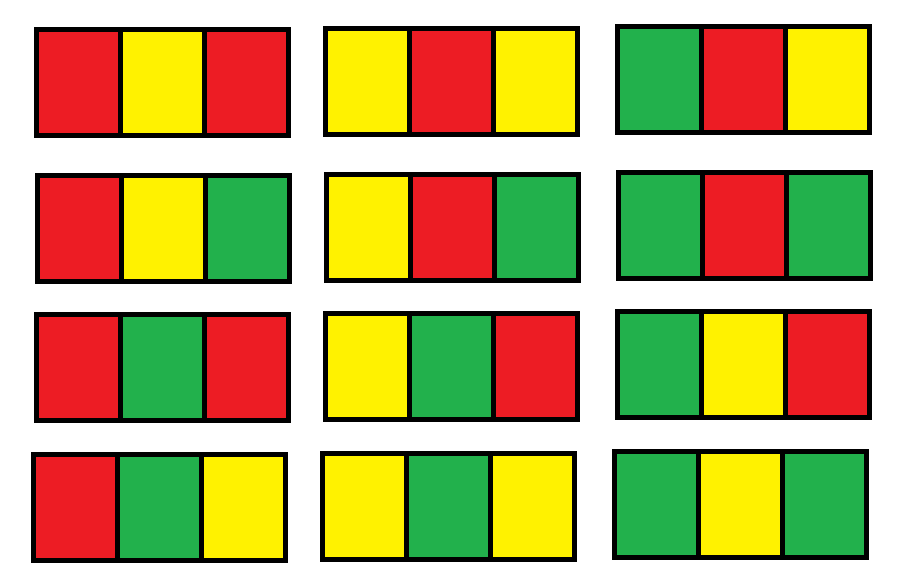
Input: n = 1
Output: 12
Explanation: There are 12 possible way to paint the grid as shown.
Example 2:
Input: n = 5000
Output: 30228214
Constraints:
n == grid.length1 <= n <= 5000
Approaches
3 approaches with complexity analysis and trade-offs.
This problem has optimal substructure and overlapping subproblems, making it a perfect candidate for dynamic programming. The core idea is that the number of ways to color any given row i depends solely on the valid colorings of the previous row, i-1.
First, we analyze the valid colorings for a single row. A row has 3 cells, and adjacent cells must have different colors. This gives rise to two types of color patterns:
- Two-Color Patterns (ABA type): The first and third cells are the same color, while the middle cell is different (e.g., Red-Yellow-Red). There are
3choices for the first color and2for the second, totaling3 * 2 = 6such patterns. - Three-Color Patterns (ABC type): All three cells have different colors (e.g., Red-Yellow-Green). There are
3 * 2 * 1 = 6such patterns.
For n=1, the total number of ways is 6 + 6 = 12.
Algorithm
- Define two DP arrays,
twoColorandthreeColor, of sizen+1. twoColor[i]will store the number of ways to paint the firstirows with thei-th row having a two-color (ABA) pattern.threeColor[i]will store the number of ways to paint the firstirows with thei-th row having a three-color (ABC) pattern.- Set the base cases for
i=1:twoColor[1] = 6andthreeColor[1] = 6. - Iterate from
i = 2tonand apply the following recurrence relations:twoColor[i] = (3 * twoColor[i-1] + 2 * threeColor[i-1]) % MODthreeColor[i] = (2 * twoColor[i-1] + 2 * threeColor[i-1]) % MOD
- The final answer is the sum of
twoColor[n]andthreeColor[n], moduloMOD.
Walkthrough
We can build a DP solution based on these two pattern types. We'll define DP states to count the number of ways to paint the grid up to row i ending with each pattern type.
Let:
twoColor[i]be the number of ways to paint ani x 3grid where rowihas a two-color (ABA) pattern.threeColor[i]be the number of ways to paint ani x 3grid where rowihas a three-color (ABC) pattern.
We can establish recurrence relations by analyzing how a pattern in row i can follow a pattern in row i-1 without violating the color constraints.
-
Transitions to a two-color pattern in row
i:- From a two-color pattern in row
i-1: There are 3 valid ways. - From a three-color pattern in row
i-1: There are 2 valid ways. - Thus,
twoColor[i] = 3 * twoColor[i-1] + 2 * threeColor[i-1].
- From a two-color pattern in row
-
Transitions to a three-color pattern in row
i:- From a two-color pattern in row
i-1: There are 2 valid ways. - From a three-color pattern in row
i-1: There are 2 valid ways. - Thus,
threeColor[i] = 2 * twoColor[i-1] + 2 * threeColor[i-1].
- From a two-color pattern in row
The implementation involves creating two arrays to store these counts and iterating from i=2 to n to fill them. The final result is the sum of the counts for row n.
class Solution { public int numOfWays(int n) { if (n == 0) { return 0; } long MOD = 1_000_000_007; long[] twoColor = new long[n + 1]; long[] threeColor = new long[n + 1]; // Base case for n = 1 twoColor[1] = 6; threeColor[1] = 6; for (int i = 2; i <= n; i++) { // Ways to form a two-color pattern in row i twoColor[i] = (3 * twoColor[i - 1] + 2 * threeColor[i - 1]) % MOD; // Ways to form a three-color pattern in row i threeColor[i] = (2 * twoColor[i - 1] + 2 * threeColor[i - 1]) % MOD; } return (int) ((twoColor[n] + threeColor[n]) % MOD); }}Complexity
Time
O(n) - We perform a single loop from `i=2` to `n`, with constant time operations inside.
Space
O(n) - We use two arrays of size `n+1` to store the DP states for each row.
Trade-offs
Pros
Conceptually straightforward and easy to follow.
Directly translates the recurrence relation into code.
Cons
Uses linear space, which is not optimal and can be improved.
Solutions
Solution
class Solution {public int numOfWays(int n) { int mod = (int)1 e9 + 7; long f0 = 6, f1 = 6; for (int i = 0; i < n - 1; ++i) { long g0 = (3 * f0 + 2 * f1) % mod; long g1 = (2 * f0 + 2 * f1) % mod; f0 = g0; f1 = g1; } return (int)(f0 + f1) % mod; }}Video walkthrough
Newsletter
One sharp idea, every week
System design and interview prep — short enough to finish.
No spam. Unsubscribe anytime.
Practice
Same difficulty — related problems to reinforce the pattern.