
Number Of Ways To Reconstruct A Tree
HardPrompt
You are given an array pairs, where pairs[i] = [xi, yi], and:
- There are no duplicates.
xi < yi
Let ways be the number of rooted trees that satisfy the following conditions:
- The tree consists of nodes whose values appeared in
pairs. - A pair
[xi, yi]exists inpairsif and only ifxiis an ancestor ofyioryiis an ancestor ofxi. - Note: the tree does not have to be a binary tree.
Two ways are considered to be different if there is at least one node that has different parents in both ways.
Return:
0ifways == 01ifways == 12ifways > 1
A rooted tree is a tree that has a single root node, and all edges are oriented to be outgoing from the root.
An ancestor of a node is any node on the path from the root to that node (excluding the node itself). The root has no ancestors.
Example 1:
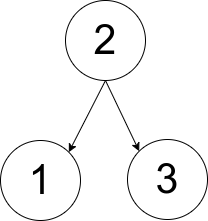
Input: pairs = [[1,2],[2,3]]
Output: 1
Explanation: There is exactly one valid rooted tree, which is shown in the above figure.
Example 2:
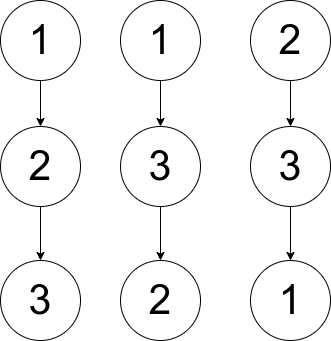
Input: pairs = [[1,2],[2,3],[1,3]]
Output: 2
Explanation: There are multiple valid rooted trees. Three of them are shown in the above figures.
Example 3:
Input: pairs = [[1,2],[2,3],[2,4],[1,5]]
Output: 0
Explanation: There are no valid rooted trees.
Constraints:
1 <= pairs.length <= 1051 <= xi < yi <= 500- The elements in
pairsare unique.
Approaches
2 approaches with complexity analysis and trade-offs.
This approach reconstructs the tree by first establishing a hierarchy of nodes based on their degrees (number of relationships). The node with the highest degree is the most likely candidate for the root. By sorting nodes by degree, we can greedily assign parents to children. The main drawback of this specific implementation is the use of List for storing neighbors, which makes lookups and subset checks inefficient.
Algorithm
- Graph Representation: Construct a graph where nodes are the numbers from
pairs. An edge exists between two nodes if they appear in a pair. Use an adjacency list representation, where for each node, we store a list of its neighbors. Also, compute the degree of each node. - Identify Nodes and Root: Find the total number of unique nodes,
n. A valid tree must have a single root that is an ancestor to all othern-1nodes. This means the root must have a degree ofn-1. If no such node exists, no tree is possible, so return0. - Sort Nodes: Create a list of all nodes and sort them in descending order based on their degrees. This helps in establishing a hierarchy, as ancestors generally have more descendants and thus a higher degree.
- Greedy Tree Construction: Iterate through the sorted nodes, starting from the second node (the first is the root). For each node
u, find its parentp.- The parent
pmust be an ancestor ofu, so it must be a neighbor ofuin the graph (pis inadj[u]). - The parent must also have a higher or equal degree, so it must appear before
uin the sorted list. - To find the immediate parent, we search for a neighbor of
uthat appears most recently in the sorted list (i.e., has the largest index smaller thanu's index). This is done by iterating backward fromu's position in the sorted list.
- The parent
- Validation during Construction:
- For each node
uand its found parentp, a critical property must hold: the set ofu's neighbors must be a subset ofp's neighbors (pluspitself). This is because any node related toumust also be related to its ancestorp. This check is performed by iterating throughu's neighbors and verifying their presence inp's adjacency list. This is inefficient due to linear scans in lists. - If the subset property is violated for any pair, no valid tree can be formed. Return
0.
- For each node
- Check for Multiple Ways: If a node
uand its parentphave the same degree, it implies they are structurally symmetric with respect to their connections. This allows their roles as parent and child to be swapped, leading to a different valid tree. If such a case is found, it means there is more than one way to construct the tree. We can set a flag or a result variable to2. - Final Result: If the entire process completes without returning
0, it means at least one valid tree structure is found. Return1if no same-degree parent-child relationships were found, and2otherwise.
Walkthrough
The core idea is that in a valid rooted tree, an ancestor node must be related to all nodes that its descendant is related to. This translates to a subset relationship between their neighbors in the graph formed by the pairs. We can formalize this by building the graph and then attempting to reconstruct the single-parent-for-each-node structure of a tree.
First, we process the pairs to build an adjacency list and a degree map. A Map<Integer, List<Integer>> can store the adjacency lists and a Map<Integer, Integer> for degrees.
Map<Integer, List<Integer>> adj = new HashMap<>();Map<Integer, Integer> degrees = new HashMap<>();for (int[] pair : pairs) { adj.computeIfAbsent(pair[0], k -> new ArrayList<>()).add(pair[1]); adj.computeIfAbsent(pair[1], k -> new ArrayList<>()).add(pair[0]); degrees.put(pair[0], degrees.getOrDefault(pair[0], 0) + 1); degrees.put(pair[1], degrees.getOrDefault(pair[1], 0) + 1);}We then sort the nodes by degree. The node with the highest degree must be the root and have a degree of n-1, where n is the total number of nodes.
We iterate through the sorted nodes. For each node u, we find its parent p by searching backwards in the sorted list for a neighbor. Once a parent p is found, we must validate the subset property: adj[u] must be a subset of adj[p]. With lists, this check is slow:
// For a node u and its parent pfor (int neighborOfU : adj.get(u)) { if (neighborOfU == p) continue; boolean found = false; for (int neighborOfP : adj.get(p)) { if (neighborOfP == neighborOfU) { found = true; break; } } if (!found) return 0; // Subset property violated}If degrees.get(u) == degrees.get(p), we note that there are multiple ways. This check, combined with the subset validation, allows us to determine the final answer.
Complexity
Time
O(N + M log M + M*N). Building the graph is O(N). Sorting nodes is O(M log M). The nested loops for parent finding and validation dominate. The outer loop runs M times. The inner loop for parent finding can run up to M times, with each neighbor check taking up to O(M) (degree can be up to M-1). The subset check also takes O(deg(u) * deg(p)), which can be O(M^2) in the worst case. This makes the total complexity significantly high.
Space
O(N + M), where N is the number of pairs and M is the number of unique nodes. This is for storing the adjacency lists, degrees, and other data structures.
Trade-offs
Pros
The logic is sound and correctly identifies the necessary conditions for a valid tree reconstruction.
It correctly handles all cases, including impossible constructions and multiple valid ways.
Cons
The time complexity is high due to using lists for adjacency information. Checking for neighbors and verifying the subset property involves linear scans, making it inefficient for dense graphs or nodes with high degrees.
This approach refines the previous one by using a more suitable data structure—a hash set—for the adjacency lists. This significantly speeds up the critical operations of checking for neighbors and verifying the subset property, reducing their complexity from linear to constant time on average. The overall algorithm remains a greedy construction based on node degrees, which correctly models the ancestor-descendant hierarchy.
Algorithm
- Graph Representation: Construct a graph from the
pairs. For efficient lookups, represent the adjacency list using aMap<Integer, Set<Integer>>. Also, compute the degree of each node and store it in a map. - Identify Nodes and Root: Determine the set of unique nodes and its size,
n. Find a node with degreen-1to be the root. If no such node exists, return0. - Sort Nodes by Degree: Create a list of all nodes and sort it in descending order of their degrees. This establishes a potential hierarchy from root to leaves.
- Greedy Parent Assignment: Iterate through the sorted nodes from the second element to the end. For each node
u:- Find its parent
pby iterating backward through the already processed (higher-degree) nodes in the sorted list. The first neighbor ofuencountered is its parentp. Thispis the 'closest' ancestor in the hierarchy. - If no parent is found among the preceding nodes, the graph is not connected in a way that can form a tree, so return
0.
- Find its parent
- Efficient On-the-fly Validation:
- After finding a parent
pforu, verify the subset property: every neighbor ofu(exceptp) must also be a neighbor ofp. With hash sets, this check is efficient (adj.get(p).contains(neighbor)is O(1) on average). - If the check fails, return
0.
- After finding a parent
- Detect Multiple Reconstructions: During validation, if a node
uand its parentphave the same degree (degrees.get(u) == degrees.get(p)), it signifies a structural ambiguity. This meansuandpcould swap roles, leading to a different valid tree. In this case, we know there's more than one way, so we can set our result to2. - Return Result: If the process completes, return
1if only one way was found, or2if ambiguities were detected.
Walkthrough
The fundamental logic is the same as the less efficient approach, but performance is greatly improved by using hash-based data structures.
We start by building the graph using Map<Integer, Set<Integer>> for adj.
Map<Integer, Set<Integer>> adj = new HashMap<>();Map<Integer, Integer> degrees = new HashMap<>();for (int[] pair : pairs) { adj.computeIfAbsent(pair[0], k -> new HashSet<>()).add(pair[1]); adj.computeIfAbsent(pair[1], k -> new HashSet<>()).add(pair[0]); degrees.put(pair[0], degrees.getOrDefault(pair[0], 0) + 1); degrees.put(pair[1], degrees.getOrDefault(pair[1], 0) + 1);}After sorting nodes by degree and identifying the root, we iterate through the sorted nodes sortedNodes. For each node u = sortedNodes[i], we find its parent p by searching sortedNodes[j] for j from i-1 down to 0. The first sortedNodes[j] that is a neighbor of u is the parent p.
The crucial subset validation becomes much faster:
// For a node u and its parent p// Check if adj.get(u) is a subset of adj.get(p)Set<Integer> neighborsOfP = adj.get(p);for (int neighborOfU : adj.get(u)) { if (neighborOfU != p && !neighborsOfP.contains(neighborOfU)) { return 0; // Subset property violated }}This check is now O(degree of u) on average. The overall algorithm proceeds as described, checking for same-degree parent-child pairs to detect multiple ways. If degrees.get(u) == degrees.get(p), we set result = 2. Finally, we return the calculated result.
Complexity
Time
O(N + M^2). Building the graph is O(N). Sorting is O(M log M). The main loop runs M times. Inside, finding the parent takes O(M) in the worst case. The subset check takes O(degree of node). The sum of degrees is 2N. So the total time is dominated by the nested loops for parent finding, resulting in O(M^2), plus the initial setup and sum of degrees for checks, leading to O(N + M^2).
Space
O(N + M), where N is the number of pairs and M is the number of unique nodes. The space is used for the adjacency sets, degree map, and sorted node list.
Trade-offs
Pros
Efficient implementation with O(1) average time complexity for neighbor lookups.
The overall time complexity of O(N + M^2) is efficient enough for the given constraints.
It's a complete and correct algorithm for this problem.
Cons
The time complexity is still polynomial, O(M^2), which might be slow for a much larger number of nodes (M), though it's perfectly fine for the given constraints.
Solutions
Solution
class Solution {public int checkWays(int[][] pairs) { boolean[][] g = new boolean[510][510]; List<Integer>[] v = new List[510]; Arrays.setAll(v, k->new ArrayList<>()); for (int[] p : pairs) { int x = p[0], y = p[1]; g[x][y] = true; g[y][x] = true; v[x].add(y); v[y].add(x); } List<Integer> nodes = new ArrayList<>(); for (int i = 0; i < 510; ++i) { if (!v[i].isEmpty()) { nodes.add(i); g[i][i] = true; } } nodes.sort(Comparator.comparingInt(a->v[a].size())); boolean equal = false; int root = 0; for (int i = 0; i < nodes.size(); ++i) { int x = nodes.get(i); int j = i + 1; for (; j < nodes.size() && !g[x][nodes.get(j)]; ++j) ; if (j < nodes.size()) { int y = nodes.get(j); if (v[x].size() == v[y].size()) { equal = true; } for (int z : v[x]) { if (!g[y][z]) { return 0; } } } else { ++root; } } if (root > 1) { return 0; } return equal ? 2 : 1; }}class Solution {public: int checkWays(vector<vector<int>> &pairs) { vector<vector<bool>> g(510, vector<bool>(510)); vector<vector<int>> v(510); for (auto &p : pairs) { int x = p[0], y = p[1]; g[x][y] = g[y][x] = 1; v[x].push_back(y); v[y].push_back(x); } vector<int> nodes; for (int i = 1; i <= 500; ++i) { if (v[i].size()) { nodes.push_back(i); g[i][i] = 1; } } sort(nodes.begin(), nodes.end(), [&](int x, int y) -> bool { return v[x].size() < v[y].size(); }); bool equal = 0; int root = 0; for (int i = 0; i < nodes.size(); ++i) { int x = nodes[i]; int j = i + 1; for (; j < nodes.size() && !g[x][nodes[j]]; ++j) ; if (j < nodes.size()) { int y = nodes[j]; if (v[x].size() == v[y].size()) equal = 1; for (int z : v[x]) if (!g[y][z]) return 0; } else ++root; } if (root > 1) return 0; if (equal) return 2; return 1; }};class Solution: def checkWays(self, pairs: List[List[int]]) -> int: g = [[False] * 510 for _ in range(510)] v = defaultdict(list) for x, y in pairs: g[x][y] = g[y][x] = True v[x]. append(y) v[y]. append(x) nodes = [] for i in range(510): if v[i]: nodes . append(i) g[i][i] = True nodes . sort(key=lambda x: len(v[x])) equal = False root = 0 for i, x in enumerate(nodes): j = i + 1 while j < len(nodes) and not g[x][nodes[j]]: j += 1 if j < len(nodes): y = nodes[j] if len(v[x]) == len(v[y]): equal = True for z in v[x]: if not g[y][z]: return 0 else: root += 1 if root > 1: return 0 return 2 if equal else 1Video walkthrough
Newsletter
One sharp idea, every week
System design and interview prep — short enough to finish.
No spam. Unsubscribe anytime.
Practice
Same difficulty — related problems to reinforce the pattern.