
Painting a Grid With Three Different Colors
HardPrompt
You are given two integers m and n. Consider an m x n grid where each cell is initially white. You can paint each cell red, green, or blue. All cells must be painted.
Return the number of ways to color the grid with no two adjacent cells having the same color. Since the answer can be very large, return it modulo 109 + 7.
Example 1:

Input: m = 1, n = 1
Output: 3
Explanation: The three possible colorings are shown in the image above.
Example 2:
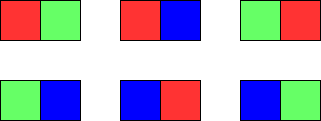
Input: m = 1, n = 2
Output: 6
Explanation: The six possible colorings are shown in the image above.
Example 3:
Input: m = 5, n = 5
Output: 580986
Constraints:
1 <= m <= 51 <= n <= 1000
Approaches
3 approaches with complexity analysis and trade-offs.
This approach attempts to solve the problem by exploring every possible way to color the grid, one cell at a time, using recursion. For each cell, it tries to place one of the three colors, ensuring it doesn't conflict with its already colored top and left neighbors. If a valid coloring for the entire grid is found, a counter is incremented. This is a brute-force method that systematically checks all combinations.
Algorithm
- Create a recursive function
backtrack(row, col). - If
row == m, a valid grid coloring is found. Increment the total count (modulo10^9 + 7) and return. - Determine the next cell
(next_row, next_col). Ifcol + 1 == n, the next cell is(row + 1, 0); otherwise, it's(row, col + 1). - Iterate through the 3 colors for the current cell
(row, col). - Check if the chosen color is valid by comparing it with the color of the cell above (
grid[row-1][col]) and to the left (grid[row][col-1]). - If the color is valid, assign it to
grid[row][col]and make a recursive call:backtrack(next_row, next_col). - After the recursive call returns, backtrack by resetting the cell's color to explore other possibilities (though this is implicitly handled by overwriting in the loop).
Walkthrough
We define a recursive function, say solve(row, col), that tries to color the cell at (row, col). The base case for the recursion is when we have successfully colored all cells (e.g., when row == m). At this point, we've found one valid way, so we increment our answer.
In the recursive step for solve(row, col), we iterate through the three colors (Red, Green, Blue). For each color, we check if placing it at (row, col) is valid. A color is valid if it's different from the color of the cell (row-1, col) (if row > 0) and the cell (row, col-1) (if col > 0).
If the color is valid, we place it in the grid and recursively call the function for the next cell. After the recursive call returns, we effectively "backtrack" by trying the next color for the current cell. This method explores the entire search space of colorings, pruning branches that violate the adjacency constraint as soon as they are detected.
class Solution { int m, n; long count = 0; int MOD = 1_000_000_007; int[][] grid; public int colorTheGrid(int m, int n) { this.m = m; this.n = n; // This approach will time out, but illustrates the concept. // A real solution would not use this for the given constraints. this.grid = new int[m][n]; // 1:Red, 2:Green, 3:Blue backtrack(0, 0); return (int) count; } private void backtrack(int row, int col) { if (row == m) { count = (count + 1) % MOD; return; } int nextRow = row; int nextCol = col + 1; if (nextCol == n) { nextRow = row + 1; nextCol = 0; } for (int color = 1; color <= 3; color++) { if (isSafe(row, col, color)) { grid[row][col] = color; backtrack(nextRow, nextCol); } } } private boolean isSafe(int row, int col, int color) { // Check top neighbor if (row > 0 && grid[row - 1][col] == color) { return false; } // Check left neighbor if (col > 0 && grid[row][col - 1] == color) { return false; } return true; }}Complexity
Time
O(3^(m*n)). At each of the `m*n` cells, we might try up to 3 colors, leading to an exponential number of paths in the recursion tree. This is too slow for the given constraints.
Space
O(m * n) to store the grid and for the recursion stack depth.
Trade-offs
Pros
Conceptually simple and a direct translation of the problem statement.
Easy to implement for a first attempt.
Cons
Extremely inefficient due to its exponential time complexity.
Will result in a 'Time Limit Exceeded' (TLE) error on any reasonably sized grid.
This approach leverages the small constraint on m (number of rows). Instead of coloring cell by cell, we color the grid column by column. The state of our dynamic programming is the coloring pattern of a single column. Since m is small, the number of valid column colorings is also small. We can then calculate the number of ways to color n columns based on the transitions between these valid column states.
Algorithm
- State Generation: Use a recursive helper function to generate all valid colorings for a single column of height
m. A column is valid if no two vertically adjacent cells have the same color. Represent each unique coloring (a "state") as an integer. - Compatibility Mapping: Create a data structure (e.g., an adjacency list or matrix) to store which pairs of states are compatible. Two states can be placed in adjacent columns if all corresponding cells have different colors.
- DP Initialization: Create a DP array,
dp, of size equal to the number of statesS. Initializedp[j] = 1for all statesj, representing the ways to color the first column. - DP Iteration: Loop from the second column to the
n-th column (ifrom 1 ton-1):- Create a new DP array
new_dpof sizeS, initialized to zeros. - For each state
s_currfrom 0 toS-1:- Iterate through all states
s_prevthat are compatible withs_curr. - Add
dp[s_prev]tonew_dp[s_curr], taking the result modulo10^9 + 7.
- Iterate through all states
- After iterating through all states, update
dp = new_dp.
- Create a new DP array
- Final Result: Sum all values in the final
dparray to get the total number of ways.
Walkthrough
State Definition: A "state" is a valid coloring of a single column of height m. A coloring is valid if no two vertically adjacent cells have the same color. We can represent each state as an integer using a base-3 encoding (e.g., color {1,2,3} -> digit {0,1,2}). For m=5, there are only 48 such states.
State Transition: We define a compatibility relationship between states. Two states stateA and stateB are compatible if stateB can be placed immediately to the right of stateA. This means for every row i, the color of cell i in stateA must be different from the color of cell i in stateB. We can pre-compute and store these compatibilities in a graph or an adjacency matrix.
DP Formulation: Let dp[i][state] be the number of ways to color the first i columns such that the i-th column has the coloring state. The recurrence is dp[i][state_curr] = sum(dp[i-1][state_prev]) for all state_prev compatible with state_curr. Since dp[i] only depends on dp[i-1], we can optimize space to O(S) by using only two arrays representing the previous and current columns' DP values.
import java.util.ArrayList;import java.util.HashMap;import java.util.List;import java.util.Map; class Solution { int MOD = 1_000_000_007; public int colorTheGrid(int m, int n) { List<Integer> states = new ArrayList<>(); generateStates(m, 0, 0, states); int numStates = states.size(); Map<Integer, List<Integer>> adj = new HashMap<>(); for (int i = 0; i < numStates; i++) { for (int j = 0; j < numStates; j++) { if (areCompatible(states.get(i), states.get(j), m)) { adj.computeIfAbsent(i, k -> new ArrayList<>()).add(j); } } } long[] dp = new long[numStates]; for (int i = 0; i < numStates; i++) { dp[i] = 1; } for (int col = 1; col < n; col++) { long[] newDp = new long[numStates]; for (int i = 0; i < numStates; i++) { if (adj.containsKey(i)) { for (int neighbor : adj.get(i)) { newDp[neighbor] = (newDp[neighbor] + dp[i]) % MOD; } } } dp = newDp; } long totalWays = 0; for (long count : dp) { totalWays = (totalWays + count) % MOD; } return (int) totalWays; } private void generateStates(int m, int row, int currentState, List<Integer> states) { if (row == m) { states.add(currentState); return; } for (int color = 1; color <= 3; color++) { if (row > 0) { int prevColor = 1 + (currentState / (int) Math.pow(3, row - 1)) % 3; if (color == prevColor) continue; } generateStates(m, row + 1, currentState + (color - 1) * (int) Math.pow(3, row), states); } } private boolean areCompatible(int state1, int state2, int m) { for (int i = 0; i < m; i++) { if ((state1 / (int) Math.pow(3, i)) % 3 == (state2 / (int) Math.pow(3, i)) % 3) { return false; } } return true; }}Complexity
Time
O(S^2 * n + 3^m * m), where `S` is the number of valid column states (`S <= 3 * 2^(m-1)`). The `3^m * m` part is for generating states, and `S^2 * n` is for the DP calculation. Since `m` is small, `S` is a small constant, making the complexity effectively O(n).
Space
O(S^2), where `S` is the number of states. We need `O(S^2)` to store the compatibility map/matrix and `O(S)` for the DP arrays. For `m=5`, `S=48`, so this is constant space.
Trade-offs
Pros
Highly efficient for the given constraints, reducing the complexity from being exponential in
m*nto linear inn.The number of states
Sis small and constant for a fixedm.
Cons
More complex to implement than backtracking.
The state generation and compatibility check logic requires careful implementation.
This is an optimization over the standard DP approach. The column-to-column transition in the DP can be viewed as a linear transformation represented by a transition matrix. Instead of iterating n-1 times to compute the result for the n-th column, we can use binary exponentiation (also known as exponentiation by squaring) to raise the transition matrix to the power of n-1. This reduces the time complexity's dependency on n from linear to logarithmic.
Algorithm
- State Generation: Generate all
Svalid column states, same as the previous DP approach. - Transition Matrix: Build an
S x Stransition matrixT. SetT[i][j] = 1if stateiis compatible with statej(meaning statejcan follow statei), and0otherwise. - Matrix Power: The number of ways to color
ncolumns is related to the(n-1)-th power of the transition matrix. ComputeT_final = T^(n-1)using binary exponentiation for matrices. This involves repeatedly squaring the matrix and multiplying, which takesO(log n)matrix multiplications. - Matrix Multiplication: Implement a function to multiply two
S x Smatrices, which takesO(S^3)time. - Final Result: The initial state vector (for the first column) is a vector of all 1s. The total number of ways is the sum of all elements in the resulting matrix
T_final. This is becausesum(dp_n) = sum(dp_1 * T^(n-1)) = sum( (1,1,...) * T^(n-1) ) = sum_{i,j} (T^(n-1))_{ij}.
Walkthrough
The core idea is that the DP state transition dp_k = dp_{k-1} * T is a linear recurrence, where dp_k is a vector of counts for each state at column k and T is the transition matrix. To get from the first column to the n-th, we apply this transformation n-1 times: dp_n = dp_1 * T^(n-1). The most computationally intensive part is calculating T^(n-1), which can be done efficiently.
Binary Exponentiation for Matrices: This algorithm computes matrix powers in logarithmic time. To compute T^k, if k is even, we compute T^(k/2) and square it. If k is odd, we compute T^(k-1) and multiply by T. This recursive structure leads to O(log k) matrix multiplications.
import java.util.ArrayList;import java.util.List; class Solution { long MOD = 1_000_000_007; public int colorTheGrid(int m, int n) { List<Integer> states = new ArrayList<>(); generateStates(m, 0, 0, states); int numStates = states.size(); long[][] transitionMatrix = new long[numStates][numStates]; for (int i = 0; i < numStates; i++) { for (int j = 0; j < numStates; j++) { if (areCompatible(states.get(i), states.get(j), m)) { transitionMatrix[i][j] = 1; } } } if (n == 1) return numStates; long[][] resultMatrix = matrixPower(transitionMatrix, n - 1); long totalWays = 0; // Initial vector is all 1s, so we sum all elements of the final matrix for (int i = 0; i < numStates; i++) { for (int j = 0; j < numStates; j++) { totalWays = (totalWays + resultMatrix[i][j]) % MOD; } } return (int) totalWays; } private long[][] matrixPower(long[][] base, int exp) { int size = base.length; long[][] result = new long[size][size]; for (int i = 0; i < size; i++) result[i][i] = 1; // Identity matrix while (exp > 0) { if (exp % 2 == 1) result = multiplyMatrices(result, base); base = multiplyMatrices(base, base); exp /= 2; } return result; } private long[][] multiplyMatrices(long[][] a, long[][] b) { int size = a.length; long[][] result = new long[size][size]; for (int i = 0; i < size; i++) { for (int j = 0; j < size; j++) { for (int k = 0; k < size; k++) { result[i][j] = (result[i][j] + a[i][k] * b[k][j]) % MOD; } } } return result; } // generateStates and areCompatible methods are the same as in the previous approach. private void generateStates(int m, int row, int currentState, List<Integer> states) { if (row == m) { states.add(currentState); return; } for (int color = 1; color <= 3; color++) { if (row > 0) { int prevColor = 1 + (currentState / (int) Math.pow(3, row - 1)) % 3; if (color == prevColor) continue; } generateStates(m, row + 1, currentState + (color - 1) * (int) Math.pow(3, row), states); } } private boolean areCompatible(int state1, int state2, int m) { for (int i = 0; i < m; i++) { if ((state1 / (int) Math.pow(3, i)) % 3 == (state2 / (int) Math.pow(3, i)) % 3) { return false; } } return true; }}Complexity
Time
O(S^3 * log n + S^2 * m). `S^2 * m` is for building the transition matrix and `S^3 * log n` is for the matrix exponentiation. Since `S` is a constant determined by `m`, this is effectively O(log n).
Space
O(S^2) to store the matrices required for the computation. Since `S` is a constant based on `m`, this is constant space.
Trade-offs
Pros
Asymptotically the fastest approach for large
n.Reduces the time complexity with respect to
nfrom linear to logarithmic.A powerful and general technique for solving problems with linear recurrences.
Cons
Implementation is more complex, requiring matrix multiplication and binary exponentiation logic.
The constant factor is larger due to the
S^3term in matrix multiplication. For smalln, the iterative DP might be faster in practice.
Solutions
Solution
class Solution {private int m;public int colorTheGrid(int m, int n) { this.m = m; final int mod = (int)1 e9 + 7; int mx = (int)Math.pow(3, m); Set<Integer> valid = new HashSet<>(); int[] f = new int[mx]; for (int i = 0; i < mx; ++i) { if (f1(i)) { valid.add(i); f[i] = 1; } } Map<Integer, List<Integer>> d = new HashMap<>(); for (int i : valid) { for (int j : valid) { if (f2(i, j)) { d.computeIfAbsent(i, k->new ArrayList<>()).add(j); } } } for (int k = 1; k < n; ++k) { int[] g = new int[mx]; for (int i : valid) { for (int j : d.getOrDefault(i, List.of())) { g[i] = (g[i] + f[j]) % mod; } } f = g; } int ans = 0; for (int x : f) { ans = (ans + x) % mod; } return ans; }private boolean f1(int x) { int last = -1; for (int i = 0; i < m; ++i) { if (x % 3 == last) { return false; } last = x % 3; x /= 3; } return true; }private boolean f2(int x, int y) { for (int i = 0; i < m; ++i) { if (x % 3 == y % 3) { return false; } x /= 3; y /= 3; } return true; }}class Solution {public: int colorTheGrid(int m, int n) { auto f1 = [&](int x) { int last = -1; for (int i = 0; i < m; ++i) { if (x % 3 == last) { return false; } last = x % 3; x /= 3; } return true; }; auto f2 = [&](int x, int y) { for (int i = 0; i < m; ++i) { if (x % 3 == y % 3) { return false; } x /= 3; y /= 3; } return true; }; const int mod = 1e9 + 7; int mx = pow(3, m); unordered_set<int> valid; vector<int> f(mx); for (int i = 0; i < mx; ++i) { if (f1(i)) { valid.insert(i); f[i] = 1; } } unordered_map<int, vector<int>> d; for (int i : valid) { for (int j : valid) { if (f2(i, j)) { d[i].push_back(j); } } } for (int k = 1; k < n; ++k) { vector<int> g(mx); for (int i : valid) { for (int j : d[i]) { g[i] = (g[i] + f[j]) % mod; } } f = move(g); } int ans = 0; for (int x : f) { ans = (ans + x) % mod; } return ans; }};class Solution: def colorTheGrid(self, m: int, n: int) -> int: def f1(x: int) -> bool: last = - 1 for _ in range(m): if x % 3 == last: return False last = x % 3 x //= 3 return True def f2(x: int, y: int) -> bool: for _ in range(m): if x % 3 == y % 3: return False x, y = x // 3, y // 3 return True mod = 10 ** 9 + 7 mx = 3 ** m valid = {i for i in range(mx) if f1(i)} d = defaultdict(list) for x in valid: for y in valid: if f2(x, y): d[x]. append(y) f = [int(i in valid) for i in range(mx)] for _ in range(n - 1): g = [0] * mx for i in valid: for j in d[i]: g[i] = (g[i] + f[j]) % mod f = g return sum(f) % modVideo walkthrough
Newsletter
One sharp idea, every week
System design and interview prep — short enough to finish.
No spam. Unsubscribe anytime.
Practice
Same difficulty — related problems to reinforce the pattern.