
Queries on Number of Points Inside a Circle
MedPrompt
You are given an array points where points[i] = [xi, yi] is the coordinates of the ith point on a 2D plane. Multiple points can have the same coordinates.
You are also given an array queries where queries[j] = [xj, yj, rj] describes a circle centered at (xj, yj) with a radius of rj.
For each query queries[j], compute the number of points inside the jth circle. Points on the border of the circle are considered inside.
Return an array answer, where answer[j] is the answer to the jth query.
Example 1:
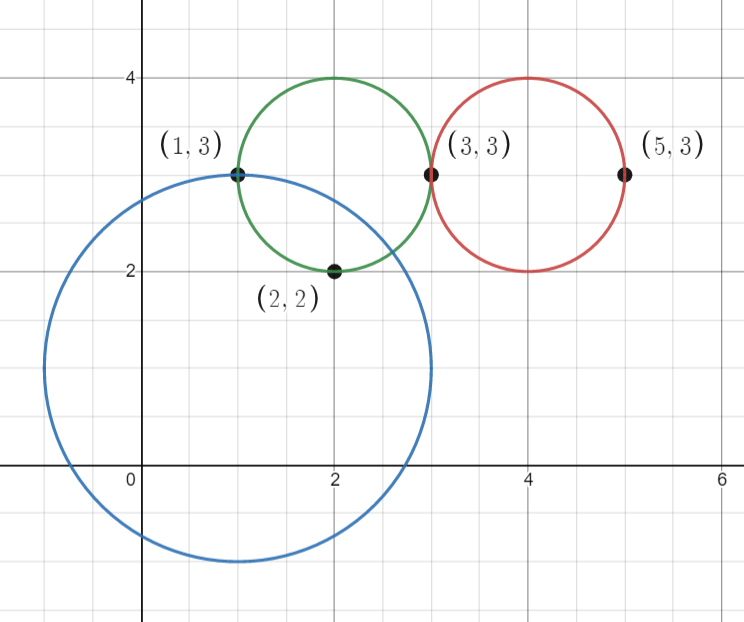
Input: points = [[1,3],[3,3],[5,3],[2,2]], queries = [[2,3,1],[4,3,1],[1,1,2]]
Output: [3,2,2]
Explanation: The points and circles are shown above.
queries[0] is the green circle, queries[1] is the red circle, and queries[2] is the blue circle.
Example 2:
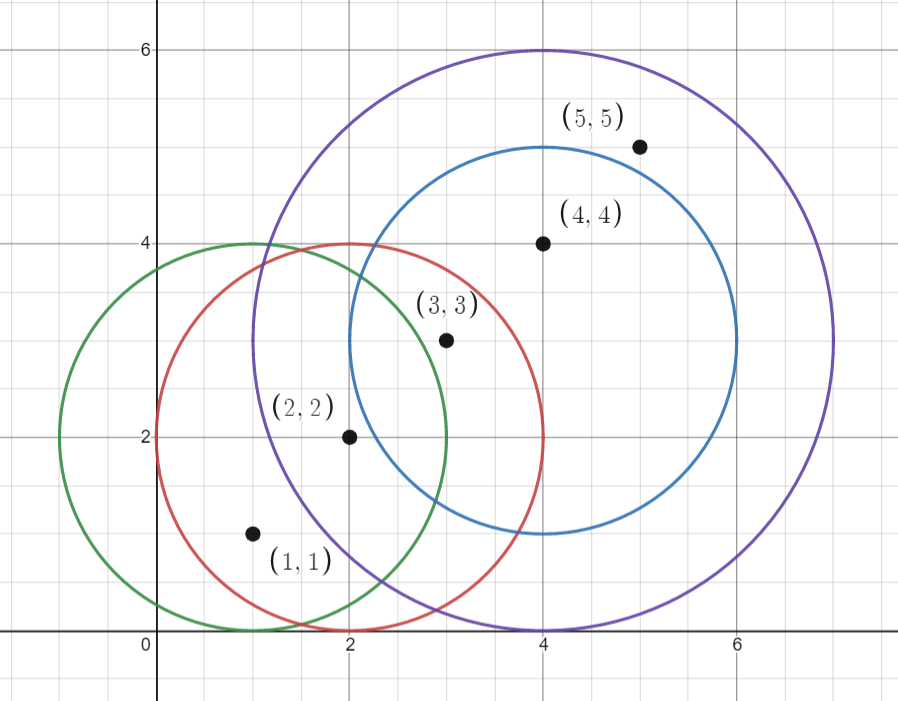
Input: points = [[1,1],[2,2],[3,3],[4,4],[5,5]], queries = [[1,2,2],[2,2,2],[4,3,2],[4,3,3]]
Output: [2,3,2,4]
Explanation: The points and circles are shown above.
queries[0] is green, queries[1] is red, queries[2] is blue, and queries[3] is purple.
Constraints:
1 <= points.length <= 500points[i].length == 20 <= xi, yi <= 5001 <= queries.length <= 500queries[j].length == 30 <= xj, yj <= 5001 <= rj <= 500- All coordinates are integers.
Follow up: Could you find the answer for each query in better complexity than O(n)?
Approaches
3 approaches with complexity analysis and trade-offs.
The most straightforward solution is to check every point for every query. For each circle defined in the queries array, we iterate through the entire points array. For each point, we calculate its distance from the circle's center and check if it's less than or equal to the radius.
Algorithm
- Initialize an integer array
answerwith the same size asqueries. - For each query
jinqueries:- Extract the circle's center
(cx, cy)and radiusr. - Initialize a counter
current_countto 0. - For each point
iinpoints:- Extract the point's coordinates
(px, py). - Calculate the squared distance:
dist_sq = (px - cx)² + (py - cy)². - If
dist_sqis less than or equal tor², incrementcurrent_count.
- Extract the point's coordinates
- Store
current_countinanswer[j].
- Extract the circle's center
- Return
answer.
Walkthrough
To implement this, we loop through each query. Inside this loop, we have another loop that goes through all the points. The core of the logic is the distance check. A point (px, py) is inside or on the border of a circle with center (cx, cy) and radius r if the Euclidean distance between them is at most r. This is expressed by the formula sqrt((px - cx)² + (py - cy)²) <= r. To avoid floating-point arithmetic and the computationally expensive square root operation, we can compare the squared distances instead: (px - cx)² + (py - cy)² <= r². This is more efficient and avoids potential precision issues. We maintain a count for each query and store the final counts in the result array.
class Solution { public int[] countPoints(int[][] points, int[][] queries) { int m = queries.length; int[] answer = new int[m]; for (int i = 0; i < m; i++) { int cx = queries[i][0]; int cy = queries[i][1]; int r = queries[i][2]; int rSquared = r * r; int count = 0; for (int[] point : points) { int px = point[0]; int py = point[1]; int dx = px - cx; int dy = py - cy; if (dx * dx + dy * dy <= rSquared) { count++; } } answer[i] = count; } return answer; }}Complexity
Time
`O(N * M)`, where `N` is the number of points and `M` is the number of queries. We have nested loops iterating through all queries and all points.
Space
`O(M)` to store the result array. If the output array is not considered part of the space complexity, it is `O(1)`.
Trade-offs
Pros
Simple to understand and implement.
Requires no complex data structures.
Sufficiently fast for the given problem constraints.
Cons
Inefficient for very large datasets.
Time complexity scales linearly with both the number of points and queries.
Solutions
Solution
class Solution { public int [] countPoints ( int [][] points , int [][] queries ) { int m = queries . length ; int [] ans = new int [ m ]; for ( int k = 0 ; k < m ; ++ k ) { int x = queries [ k ][ 0 ], y = queries [ k ][ 1 ], r = queries [ k ][ 2 ]; for ( var p : points ) { int i = p [ 0 ], j = p [ 1 ]; int dx = i - x , dy = j - y ; if ( dx * dx + dy * dy <= r * r ) { ++ ans [ k ]; } } } return ans ; } }Video walkthrough
Newsletter
One sharp idea, every week
System design and interview prep — short enough to finish.
No spam. Unsubscribe anytime.
Practice
Same difficulty — related problems to reinforce the pattern.