
Range Sum Query 2D - Immutable
MedPrompt
Given a 2D matrix matrix, handle multiple queries of the following type:
- Calculate the sum of the elements of
matrixinside the rectangle defined by its upper left corner(row1, col1)and lower right corner(row2, col2).
Implement the NumMatrix class:
NumMatrix(int[][] matrix)Initializes the object with the integer matrixmatrix.int sumRegion(int row1, int col1, int row2, int col2)Returns the sum of the elements ofmatrixinside the rectangle defined by its upper left corner(row1, col1)and lower right corner(row2, col2).
You must design an algorithm where sumRegion works on O(1) time complexity.
Example 1:
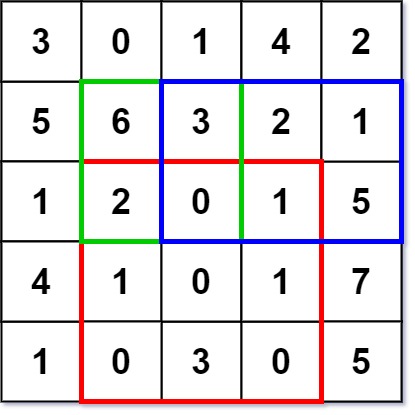
Input
["NumMatrix", "sumRegion", "sumRegion", "sumRegion"]
[[[[3, 0, 1, 4, 2], [5, 6, 3, 2, 1], [1, 2, 0, 1, 5], [4, 1, 0, 1, 7], [1, 0, 3, 0, 5]]], [2, 1, 4, 3], [1, 1, 2, 2], [1, 2, 2, 4]]
Output
[null, 8, 11, 12]

Explanation
NumMatrix numMatrix = new NumMatrix([[3, 0, 1, 4, 2], [5, 6, 3, 2, 1], [1, 2, 0, 1, 5], [4, 1, 0, 1, 7], [1, 0, 3, 0, 5]]);
numMatrix.sumRegion(2, 1, 4, 3); // return 8 (i.e sum of the red rectangle)
numMatrix.sumRegion(1, 1, 2, 2); // return 11 (i.e sum of the green rectangle)
numMatrix.sumRegion(1, 2, 2, 4); // return 12 (i.e sum of the blue rectangle)
Constraints:
m == matrix.lengthn == matrix[i].length1 <= m, n <= 200-104 <= matrix[i][j] <= 1040 <= row1 <= row2 < m0 <= col1 <= col2 < n- At most
104calls will be made tosumRegion.
Approaches
3 approaches with complexity analysis and trade-offs.
The most straightforward approach is to calculate the sum for each query by iterating through all elements in the specified rectangle. For each sumRegion call, we traverse the matrix from (row1, col1) to (row2, col2) and accumulate the sum.
Algorithm
- Store the original matrix in the constructor
- For each
sumRegionquery:- Initialize sum to 0
- Iterate through rows from row1 to row2
- For each row, iterate through columns from col1 to col2
- Add each element to the sum
- Return the accumulated sum
Walkthrough
This approach directly calculates the sum for each query without any preprocessing. When sumRegion(row1, col1, row2, col2) is called, we iterate through all rows from row1 to row2 and all columns from col1 to col2, adding each element to our running sum.
class NumMatrix { private int[][] matrix; public NumMatrix(int[][] matrix) { this.matrix = matrix; } public int sumRegion(int row1, int col1, int row2, int col2) { int sum = 0; for (int i = row1; i <= row2; i++) { for (int j = col1; j <= col2; j++) { sum += matrix[i][j]; } } return sum; }}This approach is simple to implement and understand, but it doesn't meet the O(1) requirement for sumRegion operations.
Complexity
Time
O(1) for constructor, O(m*n) for sumRegion in worst case where m and n are the dimensions of the query rectangle
Space
O(1) additional space (only storing reference to original matrix)
Trade-offs
Pros
Simple and straightforward implementation
No additional space required beyond storing the original matrix
Easy to understand and debug
Cons
Does not meet the O(1) requirement for sumRegion
Inefficient for multiple queries as it recalculates the same sums
Performance degrades significantly with larger query rectangles
Solutions
Solution
class NumMatrix { private int [][] s ; public NumMatrix ( int [][] matrix ) { int m = matrix . length , n = matrix [ 0 ]. length ; s = new int [ m + 1 ][ n + 1 ]; for ( int i = 0 ; i < m ; ++ i ) { for ( int j = 0 ; j < n ; ++ j ) { s [ i + 1 ][ j + 1 ] = s [ i + 1 ][ j ] + s [ i ][ j + 1 ] - s [ i ][ j ] + matrix [ i ][ j ]; } } } public int sumRegion ( int row1 , int col1 , int row2 , int col2 ) { return s [ row2 + 1 ][ col2 + 1 ] - s [ row2 + 1 ][ col1 ] - s [ row1 ][ col2 + 1 ] + s [ row1 ][ col1 ]; } } /** * Your NumMatrix object will be instantiated and called as such: * NumMatrix obj = new NumMatrix(matrix); * int param_1 = obj.sumRegion(row1,col1,row2,col2); */Video walkthrough
Newsletter
One sharp idea, every week
System design and interview prep — short enough to finish.
No spam. Unsubscribe anytime.
Practice
Same difficulty — related problems to reinforce the pattern.