
Recover Binary Search Tree
MedPrompt
You are given the root of a binary search tree (BST), where the values of exactly two nodes of the tree were swapped by mistake. Recover the tree without changing its structure.
Example 1:
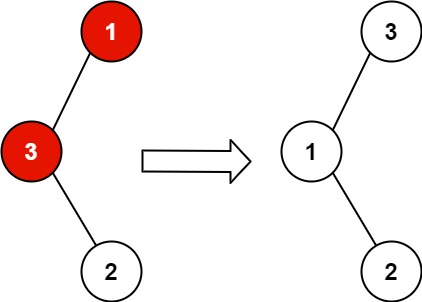
Input: root = [1,3,null,null,2]
Output: [3,1,null,null,2]
Explanation: 3 cannot be a left child of 1 because 3 > 1. Swapping 1 and 3 makes the BST valid.
Example 2:
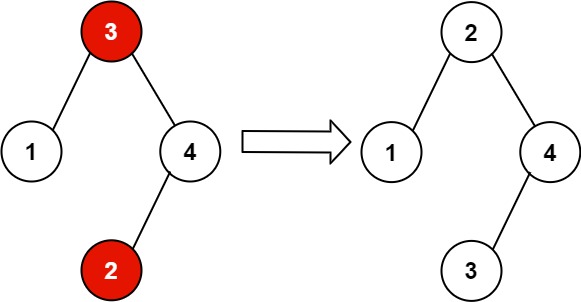
Input: root = [3,1,4,null,null,2]
Output: [2,1,4,null,null,3]
Explanation: 2 cannot be in the right subtree of 3 because 2 < 3. Swapping 2 and 3 makes the BST valid.
Constraints:
- The number of nodes in the tree is in the range
[2, 1000]. -231 <= Node.val <= 231 - 1
Follow up: A solution using
O(n) space is pretty straight-forward. Could you devise a constant O(1) space solution?Approaches
4 approaches with complexity analysis and trade-offs.
A straightforward but less efficient approach is to perform an in-order traversal of the tree, store all the node values in a list, sort the list to get the correct order, and then iterate through the tree again (or a list of nodes from the first traversal) to update the node values with the sorted ones.
Algorithm
- Create two lists: one to store
TreeNodeobjects (nodes) and another for their values (vals). - Perform an in-order traversal of the BST. In the traversal, add each visited node to the
nodeslist and its value to thevalslist. - After the traversal, the
nodeslist contains all nodes in in-order sequence, but thevalslist is out of order due to the swap. - Sort the
valslist. This gives the correct sequence of values for a valid BST. - Iterate from
i = 0ton-1, wherenis the number of nodes. For eachi, update the value of the node atnodes.get(i)with the value from the sorted listvals.get(i). This restores the BST property.
Walkthrough
This method relies on the fundamental property of a BST: an in-order traversal yields sorted values. By capturing the node references and their values, we can correct the tree by sorting the values and reassigning them to the nodes in their correct in-order positions.
public void recoverTree(TreeNode root) { List<TreeNode> nodes = new ArrayList<>(); List<Integer> vals = new ArrayList<>(); inorderTraversal(root, nodes, vals); Collections.sort(vals); for (int i = 0; i < nodes.size(); i++) { nodes.get(i).val = vals.get(i); }} private void inorderTraversal(TreeNode node, List<TreeNode> nodes, List<Integer> vals) { if (node == null) { return; } inorderTraversal(node.left, nodes, vals); nodes.add(node); vals.add(node.val); inorderTraversal(node.right, nodes, vals);}Complexity
Time
O(N log N)
Space
O(N)
Trade-offs
Pros
Conceptually simple and easy to understand.
Easy to implement correctly.
Cons
Has a suboptimal time complexity of O(N log N) due to sorting.
Uses O(N) extra space, which can be inefficient for very large trees.
It reassigns values to all nodes, which is unnecessary as only two nodes are incorrect.
Solutions
Solution
/** * Definition for a binary tree node. * public class TreeNode { * public int val; * public TreeNode left; * public TreeNode right; * public TreeNode(int val=0, TreeNode left=null, TreeNode right=null) { * this.val = val; * this.left = left; * this.right = right; * } * } */ public class Solution { private TreeNode prev , first , second ; public void RecoverTree ( TreeNode root ) { dfs ( root ); int t = first . val ; first . val = second . val ; second . val = t ; } private void dfs ( TreeNode root ) { if ( root == null ) { return ; } dfs ( root . left ); if ( prev != null && prev . val > root . val ) { if ( first == null ) { first = prev ; } second = root ; } prev = root ; dfs ( root . right ); } }Video walkthrough
Newsletter
One sharp idea, every week
System design and interview prep — short enough to finish.
No spam. Unsubscribe anytime.
Practice
Same difficulty — related problems to reinforce the pattern.