
Remove Duplicates from Sorted List II
MedPrompt
Given the head of a sorted linked list, delete all nodes that have duplicate numbers, leaving only distinct numbers from the original list. Return the linked list sorted as well.
Example 1:
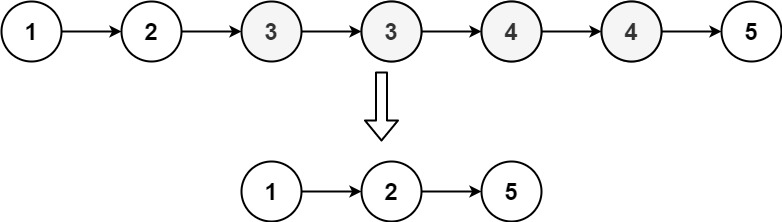
Input: head = [1,2,3,3,4,4,5]
Output: [1,2,5]
Example 2:
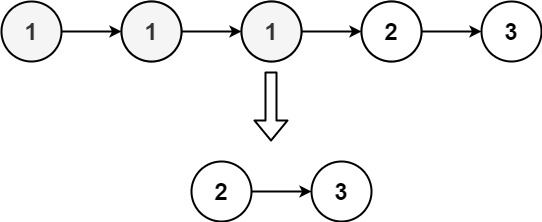
Input: head = [1,1,1,2,3]
Output: [2,3]
Constraints:
- The number of nodes in the list is in the range
[0, 300]. -100 <= Node.val <= 100- The list is guaranteed to be sorted in ascending order.
Approaches
3 approaches with complexity analysis and trade-offs.
This approach involves two traversals of the linked list. The first traversal counts the frequency of each number and stores it in a hash map. The second traversal builds a new linked list, including only the nodes whose values have a frequency of one.
Algorithm
- Create a
HashMapto store the frequency of each number. - Traverse the linked list from
headtotail, and for each node, update its value's count in the hash map. - Initialize a
sentinelnode and atailpointer pointing to it. This will be the start of our new list. - Traverse the original linked list again.
- For each node, look up its value in the hash map.
- If the count is 1, create a new node with this value and append it to the list pointed to by
tail. Movetailto this new node. - Return
sentinel.next.
Walkthrough
We first iterate through the entire linked list to populate a hash map (or a frequency array since the value range is small) with the counts of each node value.
After counting, we create a new sentinel (dummy) node to simplify the construction of the result list. A tail pointer will track the end of this new list.
We then iterate through the original list again. For each node, we check its value's frequency in our hash map.
If the frequency is exactly 1, it means the node is unique. We create a new node with this value and append it to our result list, advancing the tail pointer.
Finally, we return the next of our sentinel node, which is the head of the new, filtered list.
/** * Definition for singly-linked list. * public class ListNode { * int val; * ListNode next; * ListNode() {} * ListNode(int val) { this.val = val; } * ListNode(int val, ListNode next) { this.val = val; this.next = next; } * } */class Solution { public ListNode deleteDuplicates(ListNode head) { if (head == null) { return null; } Map<Integer, Integer> counts = new HashMap<>(); ListNode current = head; while (current != null) { counts.put(current.val, counts.getOrDefault(current.val, 0) + 1); current = current.next; } ListNode sentinel = new ListNode(0); ListNode tail = sentinel; current = head; while (current != null) { if (counts.get(current.val) == 1) { tail.next = new ListNode(current.val); tail = tail.next; } current = current.next; } return sentinel.next; }}Complexity
Time
O(N)
Space
O(K), where K is the number of distinct elements
Trade-offs
Pros
Simple to understand and implement.
Separates the logic of counting and building, which can be easier to reason about.
Cons
Requires two passes over the list.
Uses O(K) extra space for the hash map, where K is the number of distinct elements.
It's not an in-place solution as it builds a completely new list.
This approach solves the problem recursively. The function processes the list starting from the head. It decides whether to keep the head node based on whether it's a duplicate. If it is, it skips the entire sequence of duplicates and recursively calls itself on the rest of the list. If not, it keeps the head and recursively processes the remainder of the list.
Algorithm
- Define a recursive function
deleteDuplicates(node). - Base Case: If
nodeisnull, returnnull. - Check if
node.nextexists andnode.val == node.next.val. - If true (duplicate found):
- Create a temporary pointer
tempand move it forward as long as the nodes have the same value asnode. - Return the result of
deleteDuplicates(temp).
- Create a temporary pointer
- If false (node is unique):
- The
nodeis part of the result. Recursively process the rest of the list by callingdeleteDuplicates(node.next). - Set
node.nextto the result of the recursive call. - Return
node.
- The
Walkthrough
The base case for the recursion is an empty list (head == null), in which case we return null.
We check if the current head node is part of a duplicate sequence by comparing its value with the next node's value (head.next != null && head.val == head.next.val).
If it is a duplicate, we must discard all nodes with this value. We use a loop to advance a pointer past all nodes with the same value. Then, we make a recursive call with the first node that has a different value. The result of this recursive call is the result for the current level.
If the head is not a duplicate, we know it must be included in the final list. So, we keep it and recursively call the function on head.next. The result of this sub-problem becomes the new head.next. We then return the head.
/** * Definition for singly-linked list. * public class ListNode { * int val; * ListNode next; * ListNode() {} * ListNode(int val) { this.val = val; } * ListNode(int val, ListNode next) { this.val = val; this.next = next; } * } */class Solution { public ListNode deleteDuplicates(ListNode head) { // Base case: empty list or a single node list if (head == null || head.next == null) { return head; } // Check if the head is part of a duplicate sequence if (head.val == head.next.val) { // Skip all nodes with the same value as head ListNode current = head; while (current != null && current.val == head.val) { current = current.next; } // Recursively call on the rest of the list return deleteDuplicates(current); } else { // Head is not a duplicate, keep it. // Recursively call on the rest of the list and connect it head.next = deleteDuplicates(head.next); return head; } }}Complexity
Time
O(N)
Space
O(N)
Trade-offs
Pros
Code can be very concise and elegant.
Follows a natural divide-and-conquer pattern.
Cons
Can lead to a stack overflow for very long lists due to deep recursion.
Space complexity is O(N) in the worst case because of the recursion call stack.
This is the most optimal approach, using a single pass and constant extra space. It uses a sentinel node and a predecessor pointer to rebuild the list in-place. The predecessor points to the last node in the result list that is guaranteed to be unique.
Algorithm
- Create a
sentinelnode and set itsnextto the originalhead. - Initialize a
pred(predecessor) pointer to thesentinel. - Initialize a
currentpointer tohead. - Loop while
currentis notnull:- Check if
currentis the start of a duplicate sequence (current.next != null && current.val == current.next.val). - If true (duplicate found):
- Move
currentforward until it's the last node in the duplicate sequence. - Update
pred.nextto point tocurrent.next, effectively skipping the entire duplicate sequence.
- Move
- If false (node is unique):
- Move
predto the next node (pred = pred.next).
- Move
- Move
currentto the next node (current = current.next).
- Check if
- Return
sentinel.next.
Walkthrough
We introduce a sentinel (or dummy) node, which points to the original head. This helps manage edge cases, such as when the head of the list is a duplicate and needs to be removed.
We use a pred (predecessor) pointer, initialized to the sentinel. This pointer will always point to the node just before a potential sequence of duplicates.
We iterate through the list using a head pointer.
In each step, we check if head is the beginning of a duplicate sequence (i.e., head.next != null && head.val == head.next.val).
If it is, we enter an inner loop to skip all nodes that are part of this duplicate sequence. We keep moving head forward until it points to a node with a different value. After the inner loop, head is the last node of the duplicate sequence. We then link pred.next to head.next, effectively removing the entire duplicate sequence.
If head is not the start of a duplicate sequence, it means this node is unique and should be kept. We simply move our pred pointer forward to pred.next.
In both cases, we advance head to the next node to continue the process.
Finally, we return sentinel.next.
/** * Definition for singly-linked list. * public class ListNode { * int val; * ListNode next; * ListNode() {} * ListNode(int val) { this.val = val; } * ListNode(int val, ListNode next) { this.val = val; this.next = next; } * } */class Solution { public ListNode deleteDuplicates(ListNode head) { // Use a sentinel node to handle deletion of the head node ListNode sentinel = new ListNode(0, head); // Predecessor is the last node before the sublist of duplicates ListNode pred = sentinel; while (head != null) { // If it's a beginning of duplicates sublist // i.e. head.next is not null and its value is the same as head if (head.next != null && head.val == head.next.val) { // Move till the end of duplicates sublist while (head.next != null && head.val == head.next.val) { head = head.next; } // Skip all duplicates pred.next = head.next; // Otherwise, move predecessor } else { pred = pred.next; } // Move forward head = head.next; } return sentinel.next; }}Complexity
Time
O(N)
Space
O(1)
Trade-offs
Pros
Most efficient solution with O(1) space complexity.
Modifies the list in-place.
Handles all edge cases gracefully, especially with the use of a sentinel node.
Cons
The pointer manipulation can be slightly more complex to reason about compared to other approaches.
Solutions
Solution
/** * Definition for singly-linked list. * public class ListNode { * public int val; * public ListNode next; * public ListNode(int val=0, ListNode next=null) { * this.val = val; * this.next = next; * } * } */ public class Solution { public ListNode DeleteDuplicates ( ListNode head ) { ListNode dummy = new ListNode ( 0 , head ); ListNode pre = dummy ; ListNode cur = head ; while ( cur != null ) { while ( cur . next != null && cur . next . val == cur . val ) { cur = cur . next ; } if ( pre . next == cur ) { pre = cur ; } else { pre . next = cur . next ; } cur = cur . next ; } return dummy . next ; } }/** * Definition for singly-linked list. * public class ListNode { * int val; * ListNode next; * ListNode() {} * ListNode(int val) { this.val = val; } * ListNode(int val, ListNode next) { this.val = val; this.next = next; } * } */ class Solution { public ListNode deleteDuplicates ( ListNode head ) { ListNode dummy = new ListNode ( 0 , head ); ListNode pre = dummy ; ListNode cur = head ; while ( cur != null ) { while ( cur . next != null && cur . next . val == cur . val ) { cur = cur . next ; } if ( pre . next == cur ) { pre = cur ; } else { pre . next = cur . next ; } cur = cur . next ; } return dummy . next ; } }/** * Definition for singly-linked list. * function ListNode(val, next) { * this.val = (val===undefined ? 0 : val) * this.next = (next===undefined ? null : next) * } */ /** * @param {ListNode} head * @return {ListNode} */ var deleteDuplicates = function ( head ) { const dummy = new ListNode ( 0 , head ); let pre = dummy ; let cur = head ; while ( cur ) { while ( cur . next && cur . val === cur . next . val ) { cur = cur . next ; } if ( pre . next === cur ) { pre = cur ; } else { pre . next = cur . next ; } cur = cur . next ; } return dummy . next ; };/** * Definition for singly-linked list. * struct ListNode { * int val; * ListNode *next; * ListNode() : val(0), next(nullptr) {} * ListNode(int x) : val(x), next(nullptr) {} * ListNode(int x, ListNode *next) : val(x), next(next) {} * }; */ class Solution { public: ListNode * deleteDuplicates ( ListNode * head ) { ListNode * dummy = new ListNode ( 0 , head ); ListNode * pre = dummy ; ListNode * cur = head ; while ( cur ) { while ( cur -> next && cur -> next -> val == cur -> val ) { cur = cur -> next ; } if ( pre -> next == cur ) { pre = cur ; } else { pre -> next = cur -> next ; } cur = cur -> next ; } return dummy -> next ; } };# Definition for singly-linked list. # class ListNode: # def __init__(self, val=0, next=None): # self.val = val # self.next = next class Solution : def deleteDuplicates ( self , head : Optional [ ListNode ]) -> Optional [ ListNode ]: dummy = pre = ListNode ( next = head ) cur = head while cur : while cur . next and cur . next . val == cur . val : cur = cur . next if pre . next == cur : pre = cur else : pre . next = cur . next cur = cur . next return dummy . nextVideo walkthrough
Newsletter
One sharp idea, every week
System design and interview prep — short enough to finish.
No spam. Unsubscribe anytime.
Practice
Same difficulty — related problems to reinforce the pattern.