
Rotate List
MedPrompt
Given the head of a linked list, rotate the list to the right by k places.
Example 1:
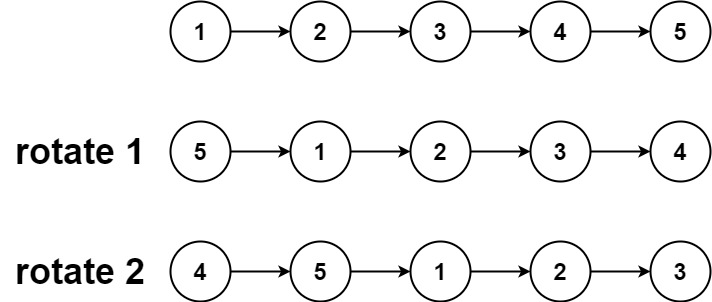
Input: head = [1,2,3,4,5], k = 2
Output: [4,5,1,2,3]
Example 2:
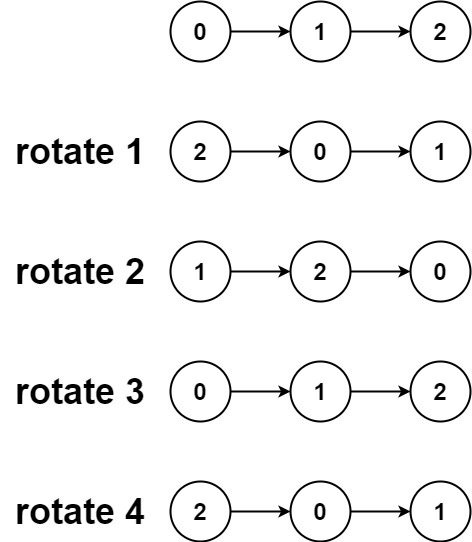
Input: head = [0,1,2], k = 4
Output: [2,0,1]
Constraints:
- The number of nodes in the list is in the range
[0, 500]. -100 <= Node.val <= 1000 <= k <= 2 * 109
Approaches
2 approaches with complexity analysis and trade-offs.
This approach simulates the rotation process directly. We rotate the list to the right by one position and repeat this operation k times. A key optimization is to first calculate the effective number of rotations, k % n, where n is the length of the list, to handle large values of k.
Algorithm
- If
headis null,head.nextis null, orkis 0, returnhead. - Calculate the length of the list,
n. - Calculate
k = k % n. Ifk == 0, returnhead. - Repeat
ktimes:- Traverse to the end of the list to find the last node (
last) and the second-to-last node (secondLast). - Set
secondLast.next = null. - Set
last.next = head. - Update
head = last.
- Traverse to the end of the list to find the last node (
- Return
head.
Walkthrough
The core idea is to perform the rotation one step at a time. To rotate the list to the right by one, we need to move the last element to the front. This involves finding the last and second-to-last nodes, making the last node the new head, and adjusting the pointers accordingly. This entire process is repeated k times.
To avoid unnecessary rotations when k is larger than the list length n, we first compute the effective number of rotations as k' = k % n. If k' is 0, the list remains unchanged. Otherwise, we perform the single-step rotation k' times.
Here is the algorithm:
- Handle edge cases: an empty list, a single-node list, or
k=0. - Calculate the list's length,
n. - Compute
k = k % n. Ifkis 0, return the original list. - Loop
ktimes: a. Find the last node and its predecessor (the second-to-last node). b. Set thenextof the second-to-last node tonull. c. Set thenextof the last node to the current head. d. Update the head to be the last node. - Return the modified head.
/** * Definition for singly-linked list. * public class ListNode { * int val; * ListNode next; * ListNode() {} * ListNode(int val) { this.val = val; } * ListNode(int val, ListNode next) { this.val = val; this.next = next; } * } */class Solution { public ListNode rotateRight(ListNode head, int k) { if (head == null || head.next == null || k == 0) { return head; } // Find the length of the list int n = 1; ListNode current = head; while (current.next != null) { current = current.next; n++; } // Calculate effective rotations k = k % n; if (k == 0) { return head; } // Rotate k times for (int i = 0; i < k; i++) { ListNode last = head; ListNode secondLast = null; while (last.next != null) { secondLast = last; last = last.next; } if (secondLast != null) { secondLast.next = null; last.next = head; head = last; } } return head; }}Complexity
Time
O(n * (k % n))
Space
O(1)
Trade-offs
Pros
Conceptually simple and easy to understand.
Cons
Very inefficient, as it requires traversing the list
ktimes.Leads to Time Limit Exceeded on most platforms for large
korn.
Solutions
Solution
/** * Definition for singly-linked list. * public class ListNode { * public int val; * public ListNode next; * public ListNode(int val=0, ListNode next=null) { * this.val = val; * this.next = next; * } * } */ public class Solution { public ListNode RotateRight ( ListNode head , int k ) { if ( head == null || head . next == null ) { return head ; } var cur = head ; int n = 0 ; while ( cur != null ) { cur = cur . next ; ++ n ; } k %= n ; if ( k == 0 ) { return head ; } var fast = head ; var slow = head ; while ( k -- > 0 ) { fast = fast . next ; } while ( fast . next != null ) { fast = fast . next ; slow = slow . next ; } var ans = slow . next ; slow . next = null ; fast . next = head ; return ans ; } }Video walkthrough
Newsletter
One sharp idea, every week
System design and interview prep — short enough to finish.
No spam. Unsubscribe anytime.
Practice
Same difficulty — related problems to reinforce the pattern.