
Self Crossing
HardPrompt
You are given an array of integers distance.
You start at the point (0, 0) on an X-Y plane, and you move distance[0] meters to the north, then distance[1] meters to the west, distance[2] meters to the south, distance[3] meters to the east, and so on. In other words, after each move, your direction changes counter-clockwise.
Return true if your path crosses itself or false if it does not.
Example 1:
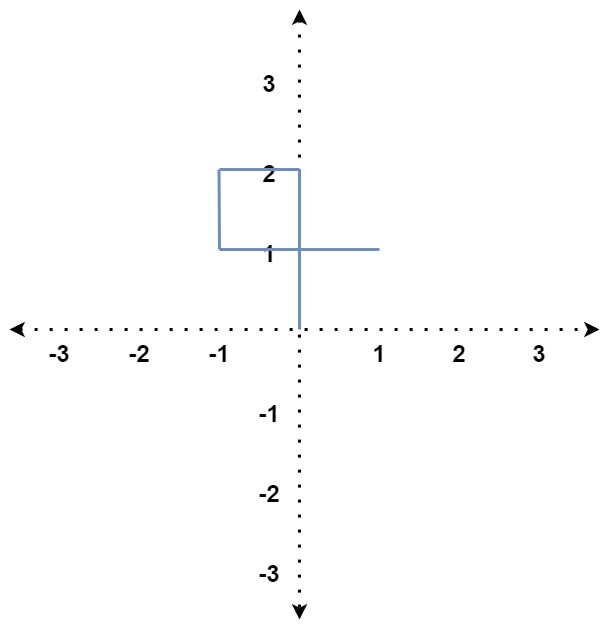
Input: distance = [2,1,1,2]
Output: true
Explanation: The path crosses itself at the point (0, 1).
Example 2:
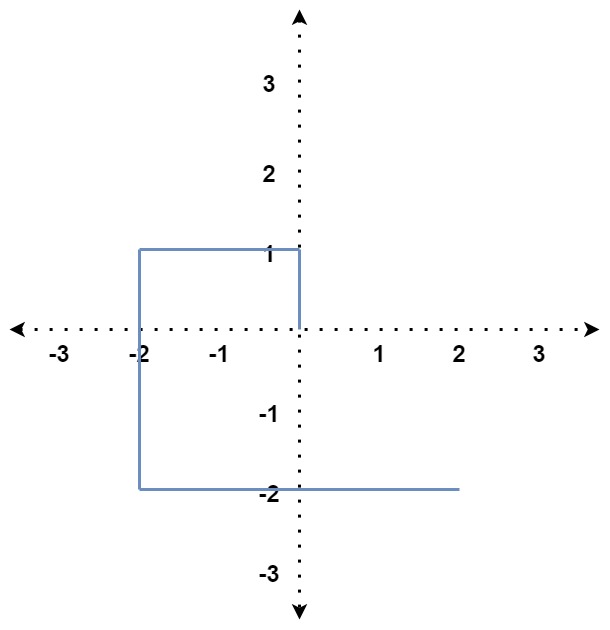
Input: distance = [1,2,3,4]
Output: false
Explanation: The path does not cross itself at any point.
Example 3:
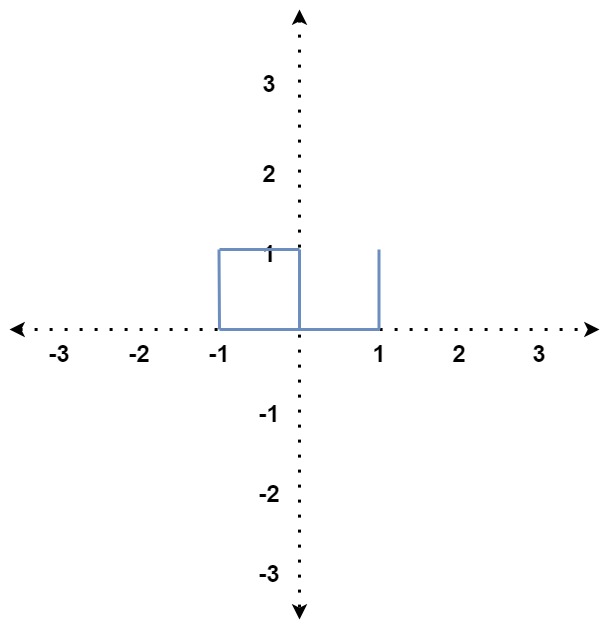
Input: distance = [1,1,1,2,1]
Output: true
Explanation: The path crosses itself at the point (0, 0).
Constraints:
1 <= distance.length <= 1051 <= distance[i] <= 105
Approaches
2 approaches with complexity analysis and trade-offs.
This approach simulates the path-drawing process step by step. For each new line segment being drawn, we check if it intersects with any of the previous non-adjacent segments. If an intersection is found at any point, we can immediately conclude that the path crosses itself.
Algorithm
- Initialize a list of line segments,
lines, to store the path. - Start at
(x, y) = (0, 0). - Define the direction vectors: North
(0, 1), West(-1, 0), South(0, -1), East(1, 0). - Iterate through the
distancearray fromi = 0ton-1: a. Determine the current direction based oni % 4. b. Calculate the end point(nextX, nextY)of the new segment. c. The new segment is from(x, y)to(nextX, nextY). d. Iterate through all previously generated segments inlinesfrom indexj = 0toi-2(to avoid checking adjacent segments). e. For each previous segment, check if it intersects with the new segment. f. Since all segments are either horizontal or vertical, the intersection check is straightforward:- A horizontal segment
(x1, y)-(x2, y)intersects a vertical segment(x, y1)-(x, y2)ifmin(x1, x2) <= x <= max(x1, x2)andmin(y1, y2) <= y <= max(y1, y2). g. If an intersection is found, returntrue. h. Add the new segment to thelineslist. i. Update the current position:x = nextX,y = nextY.
- A horizontal segment
- If the loop completes without finding any intersections, return
false.
Walkthrough
The core idea is to maintain a list of all line segments that constitute the path. As we generate each new segment based on the distance array, we perform an intersection test against all segments already in our list, except for the one immediately preceding it (as adjacent segments naturally touch at a vertex, which isn't considered a crossing unless they overlap).
Since the path consists only of North, West, South, and East movements, all segments are either perfectly horizontal or vertical. This simplifies the intersection check between two segments. A horizontal segment and a vertical segment cross if the x-coordinate of the vertical line is within the x-range of the horizontal line, and the y-coordinate of the horizontal line is within the y-range of the vertical line.
import java.util.ArrayList;import java.util.List; class Solution { public boolean isSelfCrossing(int[] distance) { int n = distance.length; if (n <= 3) { return false; } List<long[]> lines = new ArrayList<>(); long x = 0, y = 0; int[][] dirs = {{0, 1}, {-1, 0}, {0, -1}, {1, 0}}; // N, W, S, E for (int i = 0; i < n; i++) { long prevX = x; long prevY = y; x += dirs[i % 4][0] * (long)distance[i]; y += dirs[i % 4][1] * (long)distance[i]; long[] newLine = {prevX, prevY, x, y}; // Check for intersection with non-adjacent previous lines for (int j = 0; j < lines.size() - 1; j++) { if (intersects(lines.get(j), newLine)) { return true; } } lines.add(newLine); } return false; } private boolean intersects(long[] l1, long[] l2) { // l1 is horizontal, l2 is vertical if (l1[1] == l1[3] && l2[0] == l2[2]) { return check(l1[0], l1[2], l2[0]) && check(l2[1], l2[3], l1[1]); } // l1 is vertical, l2 is horizontal if (l1[0] == l1[2] && l2[1] == l2[3]) { return check(l2[0], l2[2], l1[0]) && check(l1[1], l1[3], l2[1]); } return false; } private boolean check(long a, long b, long c) { return Math.min(a, b) <= c && c <= Math.max(a, b); }}Complexity
Time
O(N^2), where N is the length of the `distance` array. For each of the N segments, we iterate through up to O(N) previous segments to check for intersections. The intersection check itself is O(1).
Space
O(N), where N is the length of the `distance` array. We need to store the coordinates of all N line segments.
Trade-offs
Pros
Conceptually simple and easy to follow.
Directly models the problem statement.
Cons
Highly inefficient due to the nested loop structure.
The space requirement grows linearly with the input size.
Will likely result in a 'Time Limit Exceeded' error on platforms like LeetCode for large inputs.
A much more efficient approach is to recognize that a self-crossing is a local event. The path has a spiral-like structure, either expanding or contracting. A crossing can only occur when this structure is violated in specific ways. By analyzing the relative lengths of the last six segments, we can determine if the current move will cause a crossing. This allows us to solve the problem in a single pass with constant memory.
Algorithm
- The path can only cross itself in a limited number of ways due to its spiral nature.
- Any crossing must involve the current line segment and one of the few most recent segments. A crossing with a much older segment would imply a crossing with a more recent one first.
- We can iterate through the
distancearray once, and at each stepi, check for three specific geometric crossing patterns involving the last 6 segments (itoi-5). - Let
dbe thedistancearray. Iterate fromi = 3ton-1:- Case 1: Fourth segment crosses first. The
i-th segment crosses the(i-3)-th. This happens when the spiral shrinks. Condition:d[i] >= d[i-2]andd[i-1] <= d[i-3]. - Case 2: Fifth segment crosses first. The
i-th segment becomes collinear with the(i-4)-th segment and crosses the path. This requiresi >= 4. Condition:d[i-1] == d[i-3]andd[i] + d[i-4] >= d[i-2]. - Case 3: Sixth segment crosses first. The path gets trapped in a rectangle formed by previous segments, forcing a cross. This requires
i >= 5. Condition:d[i-2] >= d[i-4],d[i-3] >= d[i-1],d[i] + d[i-4] >= d[i-2], andd[i-1] + d[i-5] >= d[i-3].
- Case 1: Fourth segment crosses first. The
- If any of these conditions are met during the iteration, return
true. - If the loop finishes without any condition being met, it means no crossing occurred, so return
false.
Walkthrough
Instead of a full simulation, we can use geometric insights. The path won't cross itself if it's always spiraling outwards (e.g., distance[i] > distance[i-2] for all i >= 2) or always spiraling inwards. A crossing happens when the spiral changes its behavior, for example, by starting to shrink after expanding, or vice-versa.
We only need to check for three scenarios that cover all possible ways a crossing can occur. We iterate through the path from the fourth segment (i=3) onwards, as a crossing requires at least four segments.
- Case 1: The current segment
icrosses segmenti-3. This typically happens when an expanding spiral begins to contract. For example, the 4th segment (going East) crosses the 1st segment (going North). - Case 2: The current segment
ibecomes collinear with segmenti-4and is long enough to cross the line of segmenti-2. This happens when, for example,distance[i-1] == distance[i-3], which aligns the start of segmentiwith segmenti-4. - Case 3: The path spirals in such a way that segment
igets trapped within a box formed by segmentsi-1throughi-5, forcing it to cross segmenti-5.
By checking these three conditions at each step, we can detect any crossing in constant time per step.
class Solution { public boolean isSelfCrossing(int[] distance) { int n = distance.length; if (n <= 3) { return false; } for (int i = 3; i < n; i++) { // Case 1: 4th line crosses 1st line if (distance[i] >= distance[i - 2] && distance[i - 1] <= distance[i - 3]) { return true; } // Case 2: 5th line meets 1st line if (i >= 4 && distance[i - 1] == distance[i - 3] && distance[i] + distance[i - 4] >= distance[i - 2]) { return true; } // Case 3: 6th line meets 1st line if (i >= 5 && distance[i - 2] >= distance[i - 4] && distance[i - 3] >= distance[i - 1] && distance[i - 1] + distance[i - 5] >= distance[i - 3] && distance[i] + distance[i - 4] >= distance[i - 2]) { return true; } } return false; }}Complexity
Time
O(N), where N is the length of the `distance` array. We perform a single pass through the array, and each step involves a constant number of comparisons.
Space
O(1). We only need to access a fixed number of previous elements from the input array at any given time.
Trade-offs
Pros
Extremely efficient with linear time complexity.
Requires only constant extra space, making it suitable for very large inputs.
Cons
The logic is complex and the derivation of the geometric conditions is not trivial.
It's easy to make mistakes with the indices and inequalities in the conditions.
Solutions
Solution
public class Solution { public bool IsSelfCrossing(int[] x) { for (var i = 3; i < x.Length; ++i) { if (x[i] >= x[i - 2] && x[i - 1] <= x[i - 3]) return true; if (i > 3 && x[i] + x[i - 4] >= x[i - 2]) { if (x[i - 1] == x[i - 3]) return true; if (i > 4 && x[i - 2] >= x[i - 4] && x[i - 1] <= x[i - 3] && x[i - 1] + x[i - 5] >= x[i - 3]) return true; } } return false; }}class Solution {public boolean isSelfCrossing(int[] distance) { int[] d = distance; for (int i = 3; i < d.length; ++i) { if (d[i] >= d[i - 2] && d[i - 1] <= d[i - 3]) { return true; } if (i >= 4 && d[i - 1] == d[i - 3] && d[i] + d[i - 4] >= d[i - 2]) { return true; } if (i >= 5 && d[i - 2] >= d[i - 4] && d[i - 1] <= d[i - 3] && d[i] >= d[i - 2] - d[i - 4] && d[i - 1] + d[i - 5] >= d[i - 3]) { return true; } } return false; }}class Solution {public: bool isSelfCrossing(vector<int> &distance) { vector<int> d = distance; for (int i = 3; i < d.size(); ++i) { if (d[i] >= d[i - 2] && d[i - 1] <= d[i - 3]) return true; if (i >= 4 && d[i - 1] == d[i - 3] && d[i] + d[i - 4] >= d[i - 2]) return true; if (i >= 5 && d[i - 2] >= d[i - 4] && d[i - 1] <= d[i - 3] && d[i] >= d[i - 2] - d[i - 4] && d[i - 1] + d[i - 5] >= d[i - 3]) return true; } return false; }};class Solution: def isSelfCrossing(self, distance: List[int]) -> bool: d = distance for i in range(3, len(d)): if d[i] >= d[i - 2] and d[i - 1] <= d[i - 3]: return True if i >= 4 and d[i - 1] == d[i - 3] and d[i] + d[i - 4] >= d[i - 2]: return True if (i >= 5 and d[i - 2] >= d[i - 4] and d[i - 1] <= d[i - 3] and d[i] >= d[i - 2] - d[i - 4] and d[i - 1] + d[i - 5] >= d[i - 3]): return True return FalseVideo walkthrough
Newsletter
One sharp idea, every week
System design and interview prep — short enough to finish.
No spam. Unsubscribe anytime.
Practice
Same difficulty — related problems to reinforce the pattern.