
Shortest Path in a Weighted Tree
HardPrompt
You are given an integer n and an undirected, weighted tree rooted at node 1 with n nodes numbered from 1 to n. This is represented by a 2D array edges of length n - 1, where edges[i] = [ui, vi, wi] indicates an undirected edge from node ui to vi with weight wi.
You are also given a 2D integer array queries of length q, where each queries[i] is either:
[1, u, v, w']– Update the weight of the edge between nodesuandvtow', where(u, v)is guaranteed to be an edge present inedges.[2, x]– Compute the shortest path distance from the root node 1 to nodex.
Return an integer array answer, where answer[i] is the shortest path distance from node 1 to x for the ith query of [2, x].
Example 1:
Input: n = 2, edges = [[1,2,7]], queries = [[2,2],[1,1,2,4],[2,2]]
Output: [7,4]
Explanation:
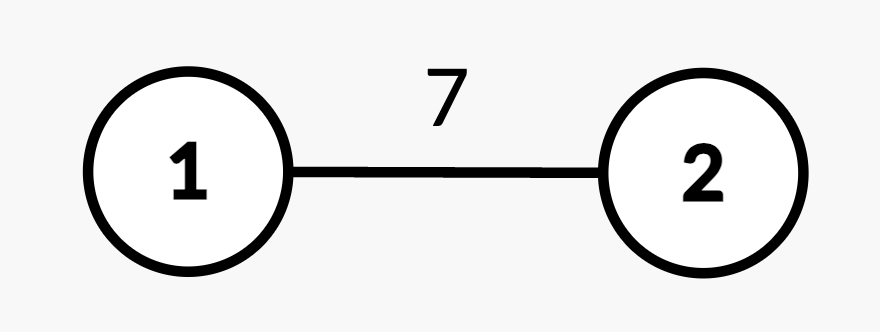
- Query
[2,2]: The shortest path from root node 1 to node 2 is 7. - Query
[1,1,2,4]: The weight of edge(1,2)changes from 7 to 4. - Query
[2,2]: The shortest path from root node 1 to node 2 is 4.
Example 2:
Input: n = 3, edges = [[1,2,2],[1,3,4]], queries = [[2,1],[2,3],[1,1,3,7],[2,2],[2,3]]
Output: [0,4,2,7]
Explanation:
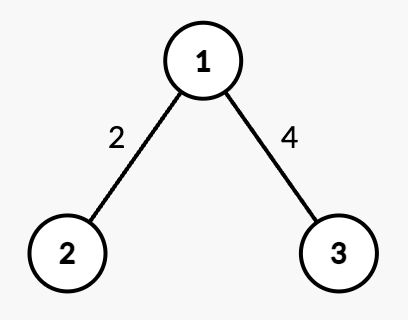
- Query
[2,1]: The shortest path from root node 1 to node 1 is 0. - Query
[2,3]: The shortest path from root node 1 to node 3 is 4. - Query
[1,1,3,7]: The weight of edge(1,3)changes from 4 to 7. - Query
[2,2]: The shortest path from root node 1 to node 2 is 2. - Query
[2,3]: The shortest path from root node 1 to node 3 is 7.
Example 3:
Input: n = 4, edges = [[1,2,2],[2,3,1],[3,4,5]], queries = [[2,4],[2,3],[1,2,3,3],[2,2],[2,3]]
Output: [8,3,2,5]
Explanation:
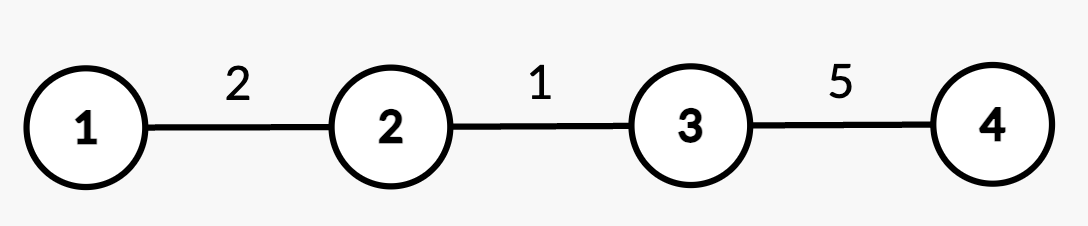
- Query
[2,4]: The shortest path from root node 1 to node 4 consists of edges(1,2),(2,3), and(3,4)with weights2 + 1 + 5 = 8. - Query
[2,3]: The shortest path from root node 1 to node 3 consists of edges(1,2)and(2,3)with weights2 + 1 = 3. - Query
[1,2,3,3]: The weight of edge(2,3)changes from 1 to 3. - Query
[2,2]: The shortest path from root node 1 to node 2 is 2. - Query
[2,3]: The shortest path from root node 1 to node 3 consists of edges(1,2)and(2,3)with updated weights2 + 3 = 5.
Constraints:
1 <= n <= 105edges.length == n - 1edges[i] == [ui, vi, wi]1 <= ui, vi <= n1 <= wi <= 104- The input is generated such that
edgesrepresents a valid tree. 1 <= queries.length == q <= 105queries[i].length == 2or4queries[i] == [1, u, v, w']or,queries[i] == [2, x]1 <= u, v, x <= n(u, v)is always an edge fromedges.1 <= w' <= 104
Approaches
3 approaches with complexity analysis and trade-offs.
The key observation for an efficient solution is that an edge weight update affects all nodes in a specific subtree uniformly. This pattern of "range updates" (on a subtree) and "point queries" (for a node's distance) suggests using a specialized data structure. By linearizing the tree using DFS start and end times, we can map the subtree updates to range updates on an array. A Fenwick Tree (or a Segment Tree) is an excellent tool for handling these operations efficiently.
Algorithm
- Preprocessing:
- Build an adjacency list.
- Perform a DFS from the root (node 1) to compute:
initial_dist[i]: The initial distance from the root to nodei.parent[i]: The parent of nodei.startTime[i]andendTime[i]: The entry and exit times for each node in the DFS traversal. This linearizes the tree such that all nodes in a subtree ofvhave start times in the range[startTime[v], endTime[v]].
- Data Structure:
- Initialize a Fenwick Tree (BIT) of size
Nwith all zeros. This BIT will store the accumulated delta changes.
- Initialize a Fenwick Tree (BIT) of size
- Query Processing:
- For an update query
[1, u, v, w']:- Determine the child node (e.g.,
v). - Calculate
delta = w' - w_old. - This
deltaapplies to all nodes in the subtree ofv. In our linearized representation, this corresponds to the range of start times[startTime[v], endTime[v]]. - Perform a range update on the BIT:
bit.add(startTime[v], delta)andbit.add(endTime[v] + 1, -delta).
- Determine the child node (e.g.,
- For a distance query
[2, x]:- The total change in distance for node
xis the sum of all deltas for ranges that includestartTime[x]. This can be found with a point query on our BIT structure, which isbit.query(startTime[x]). - The final distance is
initial_dist[x] + bit.query(startTime[x]).
- The total change in distance for node
- For an update query
Walkthrough
This approach combines tree algorithms with a data structure to handle the queries efficiently.
1. Preprocessing:
We start with a DFS from the root (node 1). During this traversal, we compute several properties for each node: its parent, its initial distance from the root, and its DFS start and end times. The start time is recorded when a node is first visited, and the end time is recorded after all its descendants have been visited. This mapping ensures that for any node v, all nodes u in its subtree satisfy startTime[v] <= startTime[u] <= endTime[v].
2. Fenwick Tree for Updates and Queries:
We use a Fenwick Tree (BIT) to manage the distance modifications. A standard BIT supports point updates and prefix sum queries. To handle range updates and point queries, we can use a clever trick: to add a value delta to a range [l, r], we perform two point updates on the BIT: add(l, delta) and add(r + 1, -delta). The effect of this is that when we query the prefix sum up to an index i (query(i)), we get the sum of all deltas for ranges that start at or before i. This is exactly the total change affecting the node corresponding to time i.
3. Handling Queries:
- Update
[1, u, v, w']: We find the child node (sayv), calculatedelta, and update the BIT atstartTime[v]andendTime[v] + 1. This takesO(log N)time. - Query
[2, x]: The current distance is the initial distance plus all accumulated changes. We retrieve this by querying the BIT atstartTime[x]. The result isinitial_dist[x] + bit.query(startTime[x]). This also takesO(log N)time.
import java.util.*; class Solution { private int timer; private int[] parent, startTime, endTime; private long[] initialDist; private List<Map<Integer, Integer>> adj; public long[] shortestPath(int n, int[][] edges, int[][] queries) { adj = new ArrayList<>(); for (int i = 0; i <= n; i++) adj.add(new HashMap<>()); for (int[] edge : edges) { adj.get(edge[0]).put(edge[1], edge[2]); adj.get(edge[1]).put(edge[0], edge[2]); } parent = new int[n + 1]; startTime = new int[n + 1]; endTime = new int[n + 1]; initialDist = new long[n + 1]; timer = 0; dfs(1, 0, 0); FenwickTree bit = new FenwickTree(n); List<Long> answers = new ArrayList<>(); for (int[] query : queries) { if (query[0] == 1) { int u = query[1], v = query[2], w = query[3]; if (parent[u] == v) { // Ensure u is parent of v int temp = u; u = v; v = temp; } long oldWeight = adj.get(u).get(v); long delta = w - oldWeight; adj.get(u).put(v, w); adj.get(v).put(u, w); bit.add(startTime[v], delta); bit.add(endTime[v] + 1, -delta); } else { int x = query[1]; long currentChange = bit.query(startTime[x]); answers.add(initialDist[x] + currentChange); } } long[] result = new long[answers.size()]; for (int i = 0; i < answers.size(); i++) result[i] = answers.get(i); return result; } private void dfs(int u, int p, long currentDist) { parent[u] = p; initialDist[u] = currentDist; startTime[u] = ++timer; for (Map.Entry<Integer, Integer> entry : adj.get(u).entrySet()) { int v = entry.getKey(); if (v != p) { dfs(v, u, currentDist + entry.getValue()); } } endTime[u] = timer; }} class FenwickTree { private long[] bit; private int size; public FenwickTree(int n) { this.size = n; this.bit = new long[n + 2]; } public void add(int index, long delta) { for (; index <= size; index += index & -index) { bit[index] += delta; } } public long query(int index) { long sum = 0; for (; index > 0; index -= index & -index) { sum += bit[index]; } return sum; }}Complexity
Time
O(N + Q * log N). Preprocessing (DFS) takes O(N). Each of the Q queries takes O(log N) for BIT operations.
Space
O(N) for the adjacency list, parent/distance/time arrays, and the Fenwick Tree.
Trade-offs
Pros
Highly efficient, with logarithmic time complexity for both updates and queries.
Scales well for large inputs, passing the given constraints.
It's a standard and powerful technique for a class of problems involving queries on trees.
Cons
More complex to implement due to the need for DFS traversal times and a Fenwick Tree.
The constant factors might be higher than simpler approaches for very small N.
Video walkthrough
Newsletter
One sharp idea, every week
System design and interview prep — short enough to finish.
No spam. Unsubscribe anytime.
Practice
Same difficulty — related problems to reinforce the pattern.