
Split the Array to Make Coprime Products
HardPrompt
You are given a 0-indexed integer array nums of length n.
A split at an index i where 0 <= i <= n - 2 is called valid if the product of the first i + 1 elements and the product of the remaining elements are coprime.
- For example, if
nums = [2, 3, 3], then a split at the indexi = 0is valid because2and9are coprime, while a split at the indexi = 1is not valid because6and3are not coprime. A split at the indexi = 2is not valid becausei == n - 1.
Return the smallest index i at which the array can be split validly or -1 if there is no such split.
Two values val1 and val2 are coprime if gcd(val1, val2) == 1 where gcd(val1, val2) is the greatest common divisor of val1 and val2.
Example 1:
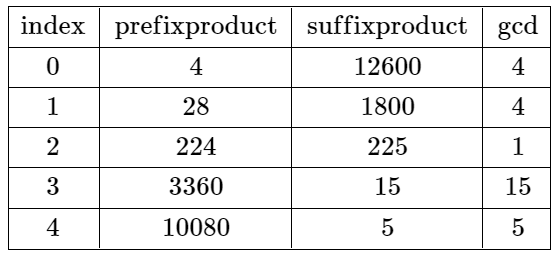
Input: nums = [4,7,8,15,3,5]
Output: 2
Explanation: The table above shows the values of the product of the first i + 1 elements, the remaining elements, and their gcd at each index i.
The only valid split is at index 2.
Example 2:
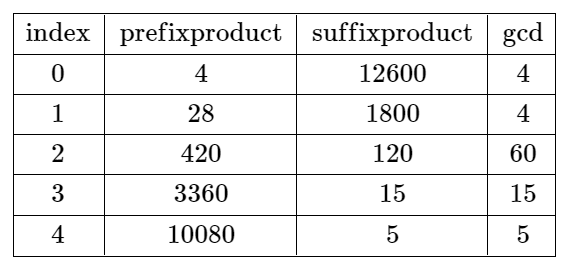
Input: nums = [4,7,15,8,3,5]
Output: -1
Explanation: The table above shows the values of the product of the first i + 1 elements, the remaining elements, and their gcd at each index i.
There is no valid split.
Constraints:
n == nums.length1 <= n <= 1041 <= nums[i] <= 106
Approaches
2 approaches with complexity analysis and trade-offs.
This approach directly translates the problem statement into code. For every possible split point, it calculates the set of unique prime factors for the left and right sub-arrays and then checks if these two sets are disjoint. A split is valid if the sets have no common prime factors.
Algorithm
- Create a helper function
getPrimeFactors(int n)that finds all unique prime factors of a numbernusing trial division. It iterates from 2 up tosqrt(n). - Iterate through each possible split index
ifrom0ton - 2. - For each
i, initialize two empty sets,leftFactorsandrightFactors. - Populate
leftFactorsby iterating fromj = 0toi, getting the prime factors ofnums[j], and adding them to the set. - Populate
rightFactorsby iterating fromk = i + 1ton - 1, getting the prime factors ofnums[k], and adding them to the set. - Check for any common elements between
leftFactorsandrightFactors. A simple way is to iterate through one set and check for existence in the other. - If no common factors are found, the split at
iis valid. Since we are iterating from the smallesti, this is the first valid split, so we returni. - If the loop completes without finding any valid split, it means no such split exists. Return
-1.
Walkthrough
The core of this method is to test each potential split index i from 0 to n-2. For each i, we need to determine if the product of elements nums[0...i] is coprime with the product of elements nums[i+1...n-1]. Instead of calculating the products, which could be enormous, we work with their prime factors. Two numbers are coprime if and only if they share no common prime factors.
We implement a helper function, getPrimeFactors, to find the unique prime factors of any given number. Then, for each split i, we build two sets: one for all prime factors of the left part and one for all prime factors of the right part. We then check for an intersection between these two sets. If the intersection is empty, we've found our answer. Since the problem asks for the smallest index, the first one we find will be the solution.
import java.util.HashSet;import java.util.Set; class Solution { // Helper to get prime factors by trial division private Set<Integer> getPrimeFactors(int n) { Set<Integer> factors = new HashSet<>(); for (int i = 2; i * i <= n; i++) { if (n % i == 0) { factors.add(i); while (n % i == 0) { n /= i; } } } if (n > 1) { factors.add(n); } return factors; } public int findValidSplit(int[] nums) { int n = nums.length; if (n <= 1) { return -1; } for (int i = 0; i < n - 1; i++) { Set<Integer> leftFactors = new HashSet<>(); for (int j = 0; j <= i; j++) { leftFactors.addAll(getPrimeFactors(nums[j])); } Set<Integer> rightFactors = new HashSet<>(); for (int k = i + 1; k < n; k++) { rightFactors.addAll(getPrimeFactors(nums[k])); } boolean commonFactorFound = false; for (int factor : leftFactors) { if (rightFactors.contains(factor)) { commonFactorFound = true; break; } } if (!commonFactorFound) { return i; } } return -1; }}Complexity
Time
O(n^2 * sqrt(M))
Space
O(P)
Trade-offs
Pros
Simple to understand and implement.
It is a direct application of the problem's definition.
Cons
Extremely inefficient and will lead to a 'Time Limit Exceeded' error on larger test cases.
Repeatedly calculates prime factors for the same numbers in different iterations.
A much more efficient approach involves pre-computation and a single pass over the array. The key insight is that a split at index i is invalid if and only if there is some prime p that divides a number in nums[0...i] and also divides a number in nums[i+1...n-1]. We can track these 'common' primes as we iterate through the possible split points.
Algorithm
- Pre-computation:
- Use a Sieve of Eratosthenes to pre-compute the Smallest Prime Factor (SPF) for all numbers up to the maximum possible value in
nums(10^6). This allows for fast factorization. - Create a helper function
getPrimeFactors(n)that uses the SPF array to find the unique prime factors ofninO(log n)time.
- Use a Sieve of Eratosthenes to pre-compute the Smallest Prime Factor (SPF) for all numbers up to the maximum possible value in
- Count Total Factor Occurrences:
- Create a frequency map,
totalFreq, to store how many numbers in thenumsarray are divisible by each prime factor. Iterate throughnums, get the factors for each number, and populate this map.
- Create a frequency map,
- Single Pass Simulation:
- Initialize an empty frequency map
leftFreq(to count factors on the left side of the split) and an empty setcommonFactors(to track primes that exist on both sides). - Iterate with index
ifrom0ton-2:- For the current number
nums[i], get its prime factors. - For each factor
pofnums[i]:- Increment its count in
leftFreq. - If this is the first time
pappears on the left side and it also exists on the right (i.e.,totalFreq[p] > leftFreq[p]), addptocommonFactors. - If all occurrences of
pare now on the left side (i.e.,totalFreq[p] == leftFreq[p]), removepfromcommonFactors.
- Increment its count in
- After processing
nums[i], if thecommonFactorsset is empty, it means the split atiis valid. Returni.
- For the current number
- Initialize an empty frequency map
- If the loop finishes, no valid split was found, so return
-1.
Walkthrough
This optimized method avoids redundant calculations by first pre-computing necessary information. We use a Sieve to find the smallest prime factor (SPF) for all numbers up to 10^6. This allows us to find the prime factors of any number k efficiently in O(log k) time.
First, we iterate through the entire array once to build a frequency map, totalFreq, which counts how many numbers in the array are divisible by each prime. For example, if nums = [6, 10], the prime 2 appears in both numbers, so totalFreq[2] would be 2.
Next, we iterate from i = 0 to n-2, simulating the split. We maintain a leftFreq map for the left side of the split and a commonFactors set. As we process nums[i], we move its prime factors from the conceptual 'right' side to the 'left' side by updating leftFreq. We use totalFreq and leftFreq to determine if a prime factor currently exists on both sides. If 0 < leftFreq[p] < totalFreq[p], then prime p is a common factor. We update the commonFactors set accordingly. If at any point this set becomes empty, we have found the smallest valid split.
import java.util.HashMap;import java.util.HashSet;import java.util.Map;import java.util.Set; class Solution { private static final int MAX_VAL = 1000001; private int[] spf = new int[MAX_VAL]; private void sieve() { if (spf[1] == 1) return; // Sieve already computed in a previous test case spf[1] = 1; for (int i = 2; i < MAX_VAL; i++) { spf[i] = i; } for (int i = 2; i * i < MAX_VAL; i++) { if (spf[i] == i) { // i is prime for (int j = i * i; j < MAX_VAL; j += i) { if (spf[j] == j) { // If spf[j] is not set yet spf[j] = i; } } } } } private Set<Integer> getPrimeFactors(int n) { Set<Integer> factors = new HashSet<>(); while (n != 1) { factors.add(spf[n]); n = n / spf[n]; } return factors; } public int findValidSplit(int[] nums) { sieve(); int n = nums.length; Map<Integer, Integer> totalFreq = new HashMap<>(); for (int num : nums) { for (int factor : getPrimeFactors(num)) { totalFreq.put(factor, totalFreq.getOrDefault(factor, 0) + 1); } } Map<Integer, Integer> leftFreq = new HashMap<>(); Set<Integer> commonFactors = new HashSet<>(); for (int i = 0; i < n - 1; i++) { for (int factor : getPrimeFactors(nums[i])) { int currentLeftCount = leftFreq.getOrDefault(factor, 0); // If factor is appearing on the left for the first time if (currentLeftCount == 0) { // And it exists on the right, it becomes a common factor if (totalFreq.get(factor) > 1) { commonFactors.add(factor); } } leftFreq.put(factor, currentLeftCount + 1); // If all occurrences of the factor are now on the left, it's no longer common if (leftFreq.get(factor).equals(totalFreq.get(factor))) { commonFactors.remove(factor); } } if (commonFactors.isEmpty()) { return i; } } return -1; }}Complexity
Time
O(M log(log(M)) + n * log(M))
Space
O(M + P)
Trade-offs
Pros
Highly efficient and passes the given constraints.
Processes the array in a single pass after an initial setup, avoiding redundant work.
Cons
Requires significant auxiliary space
O(M)for the sieve array.Implementation is more complex due to the sieve and frequency map management.
Solutions
Solution
class Solution { public int findValidSplit ( int [] nums ) { Map < Integer , Integer > first = new HashMap <>(); int n = nums . length ; int [] last = new int [ n ]; for ( int i = 0 ; i < n ; ++ i ) { last [ i ] = i ; } for ( int i = 0 ; i < n ; ++ i ) { int x = nums [ i ]; for ( int j = 2 ; j <= x / j ; ++ j ) { if ( x % j == 0 ) { if ( first . containsKey ( j )) { last [ first . get ( j )] = i ; } else { first . put ( j , i ); } while ( x % j == 0 ) { x /= j ; } } } if ( x > 1 ) { if ( first . containsKey ( x )) { last [ first . get ( x )] = i ; } else { first . put ( x , i ); } } } int mx = last [ 0 ]; for ( int i = 0 ; i < n ; ++ i ) { if ( mx < i ) { return mx ; } mx = Math . max ( mx , last [ i ]); } return - 1 ; } }class Solution {public: int findValidSplit(vector<int> &nums) { unordered_map<int, int> first; int n = nums.size(); vector<int> last(n); iota(last.begin(), last.end(), 0); for (int i = 0; i < n; ++i) { int x = nums[i]; for (int j = 2; j <= x / j; ++j) { if (x % j == 0) { if (first.count(j)) { last[first[j]] = i; } else { first[j] = i; } while (x % j == 0) { x /= j; } } } if (x > 1) { if (first.count(x)) { last[first[x]] = i; } else { first[x] = i; } } } int mx = last[0]; for (int i = 0; i < n; ++i) { if (mx < i) { return mx; } mx = max(mx, last[i]); } return -1; }};class Solution : def findValidSplit ( self , nums : List [ int ]) -> int : first = {} n = len ( nums ) last = list ( range ( n )) for i , x in enumerate ( nums ): j = 2 while j <= x // j : if x % j == 0 : if j in first : last [ first [ j ]] = i else : first [ j ] = i while x % j == 0 : x //= j j += 1 if x > 1 : if x in first : last [ first [ x ]] = i else : first [ x ] = i mx = last [ 0 ] for i , x in enumerate ( last ): if mx < i : return mx mx = max ( mx , x ) return - 1Video walkthrough
Newsletter
One sharp idea, every week
System design and interview prep — short enough to finish.
No spam. Unsubscribe anytime.
Practice
Same difficulty — related problems to reinforce the pattern.