
Stamping the Grid
HardPrompt
You are given an m x n binary matrix grid where each cell is either 0 (empty) or 1 (occupied).
You are then given stamps of size stampHeight x stampWidth. We want to fit the stamps such that they follow the given restrictions and requirements:
- Cover all the empty cells.
- Do not cover any of the occupied cells.
- We can put as many stamps as we want.
- Stamps can overlap with each other.
- Stamps are not allowed to be rotated.
- Stamps must stay completely inside the grid.
Return true if it is possible to fit the stamps while following the given restrictions and requirements. Otherwise, return false.
Example 1:
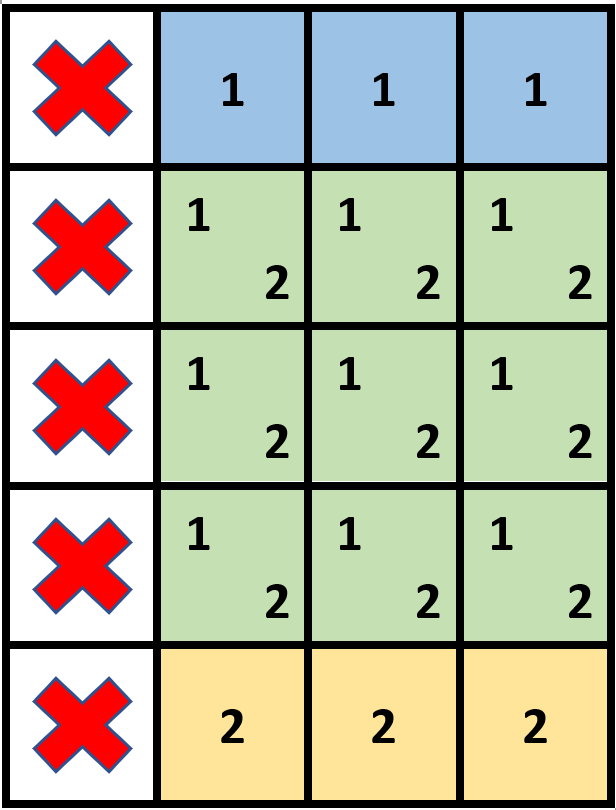
Input: grid = [[1,0,0,0],[1,0,0,0],[1,0,0,0],[1,0,0,0],[1,0,0,0]], stampHeight = 4, stampWidth = 3
Output: true
Explanation: We have two overlapping stamps (labeled 1 and 2 in the image) that are able to cover all the empty cells.
Example 2:
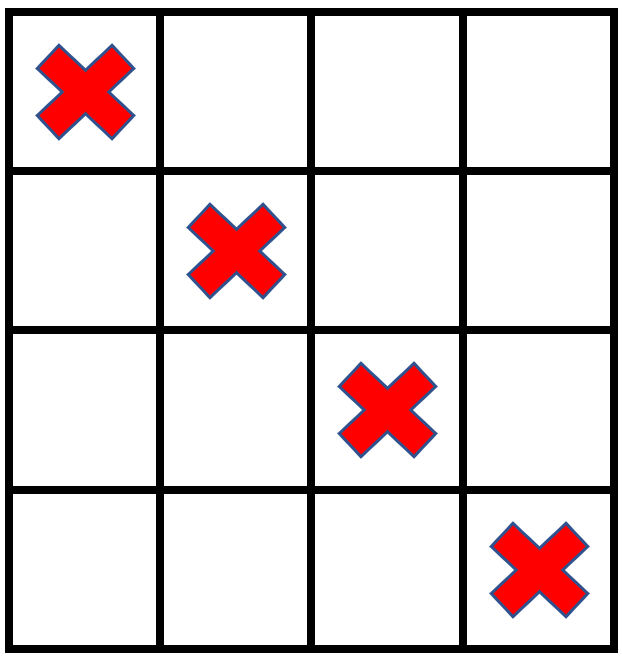
Input: grid = [[1,0,0,0],[0,1,0,0],[0,0,1,0],[0,0,0,1]], stampHeight = 2, stampWidth = 2
Output: false
Explanation: There is no way to fit the stamps onto all the empty cells without the stamps going outside the grid.
Constraints:
m == grid.lengthn == grid[r].length1 <= m, n <= 1051 <= m * n <= 2 * 105grid[r][c]is either0or1.1 <= stampHeight, stampWidth <= 105
Approaches
2 approaches with complexity analysis and trade-offs.
A straightforward but inefficient approach that directly simulates the process. It first identifies all valid stamp locations by exhaustively checking each potential stampHeight x stampWidth rectangle for occupied cells. Then, for each empty cell in the grid, it exhaustively checks if any of the valid stamp placements cover it. This method relies on nested loops and avoids complex data structures.
Algorithm
- Create a boolean grid,
canStamp, of sizem x n. - Iterate through all possible top-left corners
(r, c)for a stamp. - For each
(r, c), scan thestampHeight x stampWidtharea. If it contains no1s, setcanStamp[r][c] = true. - Iterate through every cell
(i, j)of the originalgrid. - If
grid[i][j]is0, check if there exists a valid stamp placement(r', c')(wherecanStamp[r'][c']is true) that covers(i, j). - If any empty cell
(i, j)cannot be covered, returnfalse. - If all empty cells are coverable, return
true.
Walkthrough
This approach tackles the problem with nested loops, making it easy to understand but computationally expensive.
Algorithm
- Identify All Possible Stamp Placements (Slow Method):
- Create a boolean grid,
canStamp, of sizem x n, to store whether a stamp's top-left corner can be placed at(r, c). - Iterate through every possible top-left corner
(r, c)from(0, 0)to(m - stampHeight, n - stampWidth). - For each
(r, c), perform a nested loop to scan the entirestampHeight x stampWidtharea starting from(r, c). - If any cell
(i, j)within this area hasgrid[i][j] == 1, then this placement is invalid. - If the scan completes without finding any
1s, markcanStamp[r][c] = true.
- Create a boolean grid,
- Verify Coverage for Each Empty Cell (Slow Method):
- Iterate through every cell
(i, j)of the originalgrid. - If
grid[i][j] == 0, we must check if it can be covered. - Initialize a boolean flag
isCovered = false. - Iterate through all possible top-left corners
(r', c')that could cover(i, j). - For each such
(r', c'), check ifcanStamp[r'][c']istrue. If so, setisCovered = trueand break. - If after checking all possibilities,
isCoveredis stillfalse, returnfalse.
- Iterate through every cell
- Final Result:
- If the main loop completes, return
true.
- If the main loop completes, return
Code Snippet
class Solution { public boolean possibleToStamp(int[][] grid, int stampHeight, int stampWidth) { int m = grid.length; int n = grid[0].length; // Step 1: Identify all possible stamp placements (slowly) boolean[][] canStamp = new boolean[m][n]; for (int r = 0; r <= m - stampHeight; r++) { for (int c = 0; c <= n - stampWidth; c++) { boolean possible = true; for (int i = 0; i < stampHeight; i++) { for (int j = 0; j < stampWidth; j++) { if (grid[r + i][c + j] == 1) { possible = false; break; } } if (!possible) break; } if (possible) { canStamp[r][c] = true; } } } // Step 2: Verify coverage for each empty cell (slowly) for (int i = 0; i < m; i++) { for (int j = 0; j < n; j++) { if (grid[i][j] == 0) { boolean isCovered = false; // Check all stamps that could potentially cover (i, j) for (int r = Math.max(0, i - stampHeight + 1); r <= i; r++) { for (int c = Math.max(0, j - stampWidth + 1); c <= j; c++) { // Check if this potential stamp is within bounds and is valid if (r <= m - stampHeight && c <= n - stampWidth && canStamp[r][c]) { isCovered = true; break; } } if (isCovered) break; } if (!isCovered) { return false; } } } } return true; }}Complexity
Time
`O(m * n * stampHeight * stampWidth)`. Both finding valid placements and checking coverage involve nested loops that depend on the stamp size, leading to this high complexity.
Space
`O(m * n)` to store the `canStamp` grid which indicates possible stamp locations.
Trade-offs
Pros
The logic is direct and easy to follow, closely mirroring the problem's definition.
Requires minimal complex data structures, mainly just a boolean grid.
Cons
The time complexity is very high, making it impractical for the given constraints.
Will likely result in a 'Time Limit Exceeded' (TLE) error on competitive programming platforms.
Solutions
Solution
class Solution {public boolean possibleToStamp(int[][] grid, int stampHeight, int stampWidth) { int m = grid.length, n = grid[0].length; int[][] s = new int[m + 1][n + 1]; for (int i = 1; i <= m; ++i) { for (int j = 1; j <= n; ++j) { s[i][j] = s[i - 1][j] + s[i][j - 1] - s[i - 1][j - 1] + grid[i - 1][j - 1]; } } int[][] d = new int[m + 2][n + 2]; for (int i = 1; i + stampHeight - 1 <= m; ++i) { for (int j = 1; j + stampWidth - 1 <= n; ++j) { int x = i + stampHeight - 1, y = j + stampWidth - 1; if (s[x][y] - s[x][j - 1] - s[i - 1][y] + s[i - 1][j - 1] == 0) { d[i][j]++; d[i][y + 1]--; d[x + 1][j]--; d[x + 1][y + 1]++; } } } for (int i = 1; i <= m; ++i) { for (int j = 1; j <= n; ++j) { d[i][j] += d[i - 1][j] + d[i][j - 1] - d[i - 1][j - 1]; if (grid[i - 1][j - 1] == 0 && d[i][j] == 0) { return false; } } } return true; }}Video walkthrough
Newsletter
One sharp idea, every week
System design and interview prep — short enough to finish.
No spam. Unsubscribe anytime.
Practice
Same difficulty — related problems to reinforce the pattern.