
Sum of Nodes with Even-Valued Grandparent
MedPrompt
Given the root of a binary tree, return the sum of values of nodes with an even-valued grandparent. If there are no nodes with an even-valued grandparent, return 0.
A grandparent of a node is the parent of its parent if it exists.
Example 1:
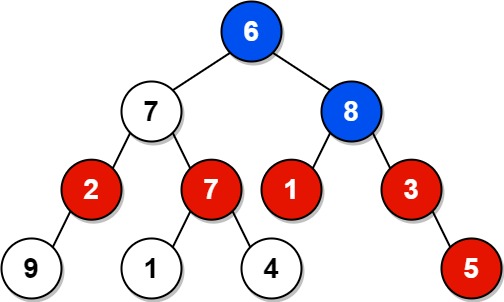
Input: root = [6,7,8,2,7,1,3,9,null,1,4,null,null,null,5]
Output: 18
Explanation: The red nodes are the nodes with even-value grandparent while the blue nodes are the even-value grandparents.
Example 2:

Input: root = [1]
Output: 0
Constraints:
- The number of nodes in the tree is in the range
[1, 104]. 1 <= Node.val <= 100
Approaches
3 approaches with complexity analysis and trade-offs.
This method uses two passes over the tree. The first pass builds a map to link each node to its parent. The second pass then uses this map to find the grandparent for each node and sums up the values of nodes with an even-valued grandparent.
Algorithm
- If the
rootisnull, return 0. - Create a
Map<TreeNode, TreeNode>to store parent pointers. - Use a queue for BFS to traverse the tree, starting with the
root. - In the BFS loop, for each
node, populate the parent map for its children. - Initialize
sum = 0. - Iterate through each
nodein the map's key set (which represents all nodes except the root). - Get its
parentfrom the map. - Get the
grandparent(parent of the parent) from the map. - If a
grandparentexists and its value is even, add the currentnode.valtosum. - Return
sum.
Walkthrough
This approach first builds a complete map of parent pointers for every node in the tree. This is done by traversing the tree once, for instance, using Breadth-First Search (BFS), and storing (child, parent) pairs in a HashMap.
After the map is built, we iterate through all nodes that have a parent. For each node, we look up its parent in the map. If a parent exists, we look up the parent's parent (the grandparent). If the grandparent also exists and its value is even, we add the current node's value to our total sum.
While this approach correctly solves the problem, it is suboptimal due to its space and time overhead. It requires O(N) extra space for the map and it traverses all nodes twice.
/** * Definition for a binary tree node. * public class TreeNode { * int val; * TreeNode left; * TreeNode right; * TreeNode() {} * TreeNode(int val) { this.val = val; } * TreeNode(int val, TreeNode left, TreeNode right) { * this.val = val; * this.left = left; * this.right = right; * } * } */class Solution { public int sumEvenGrandparent(TreeNode root) { if (root == null) { return 0; } Map<TreeNode, TreeNode> parentMap = new HashMap<>(); Queue<TreeNode> queue = new LinkedList<>(); queue.offer(root); parentMap.put(root, null); // Root has no parent while (!queue.isEmpty()) { TreeNode node = queue.poll(); if (node.left != null) { parentMap.put(node.left, node); queue.offer(node.left); } if (node.right != null) { parentMap.put(node.right, node); queue.offer(node.right); } } int sum = 0; for (TreeNode node : parentMap.keySet()) { TreeNode parent = parentMap.get(node); if (parent != null) { TreeNode grandparent = parentMap.get(parent); if (grandparent != null && grandparent.val % 2 == 0) { sum += node.val; } } } return sum; }}Complexity
Time
O(N), where N is the number of nodes. The first pass to build the map takes O(N), and the second pass to iterate and sum takes O(N).
Space
O(N). The `parentMap` stores N-1 entries. The queue for BFS can also hold up to O(N) nodes in the worst case (for a complete binary tree).
Trade-offs
Pros
The logic is separated into two distinct and easy-to-understand steps: building parent relationships and then calculating the sum.
Cons
Inefficient due to requiring two full passes over the tree's nodes.
Requires O(N) extra space for the parent map, which is generally worse than single-pass solutions that use O(H) space.
Solutions
Solution
/** * Definition for a binary tree node. * public class TreeNode { * int val; * TreeNode left; * TreeNode right; * TreeNode() {} * TreeNode(int val) { this.val = val; } * TreeNode(int val, TreeNode left, TreeNode right) { * this.val = val; * this.left = left; * this.right = right; * } * } */ class Solution { private int res ; public int sumEvenGrandparent ( TreeNode root ) { res = 0 ; dfs ( root , root . left ); dfs ( root , root . right ); return res ; } private void dfs ( TreeNode g , TreeNode p ) { if ( p == null ) { return ; } if ( g . val % 2 == 0 ) { if ( p . left != null ) { res += p . left . val ; } if ( p . right != null ) { res += p . right . val ; } } dfs ( p , p . left ); dfs ( p , p . right ); } }Video walkthrough
Newsletter
One sharp idea, every week
System design and interview prep — short enough to finish.
No spam. Unsubscribe anytime.
Practice
Same difficulty — related problems to reinforce the pattern.